http://www.waynemadsenreport.com/intelwhispers/intel.htm 08/25/2005
Mysterious Geneva money mover: tied to Enron, Saudis, Osama Bin Laden, and Iran-contra principals. NGIC Charlottesville HQ. Cooked intelligence on Iraq and cozy with MZM, the contractor that is under Federal Grand Jury and FBI investigations.
WASHINGTON, DC -- August 25, 2005 -- WMR has obtained further paper trails linking George H. W. Bush's longtime mysterious Swiss German money mover (see July 24-25 article below) to a now defunct bank operated on behalf of Osama Bin Laden, his family, and some of his closest business associates. The network of Swiss-based terrorist financiers are also linked to the Muslim Brotherhood and prominent European fascist leaders. The bank, Al Taqwa ("Fear of God"), was headquartered in the Italian Swiss enclave Campione d'Italia and had offices in the Bahamas. It ceased operations after its assets were blocked by a US Treasury Department order, its assets were frozen by the Swiss government, and its banking license was revoked by the Bahamas. Al Taqwa subsequently changed its name to Nada Management Organization. Al Taqwa and a complex web of affiliate front companies and brass plates in Switzerland, the Bahamas, Italy, Saudi Arabia, Jersey, Isle of Man, Turkey, Kuwait, Afghanistan, Bosnia, Croatia, Slovenia, the United States (Delaware and Texas), Germany, Belgium, Albania, Ethiopia, Eritrea, Somalia, Sudan, Uganda, Kenya, Tanzania, Austria, Bahrain, Singapore, Thailand, Bangladesh, Pakistan, and Liechtenstein were reportedly involved in funding terrorist operations around the world, including the procurement of nuclear material from the former Soviet Union through Baltic intermediaries. According to a EUROPOL diagram obtained by WMR, these companies included Iksir Holding, SA (Italy), Asat Trust (Liechtenstein), Iksir Ltd. (Bahamas), Gulf Center (Italy), NASCO (Turkey), Nasreddin International Group (Liechtenstein), Akida Bank (Bahamas), MIGA (Switzerland), and Nasreddin Foundation (Liechtenstein). According to intelligence sources in the United States and Europe, the Al Taqwa network intersected with tranches in Geneva and the Isle of Man that involve front companies associated with George H. W. Bush and Enron: Topaz Liberty, Bluelake World, and Potomac Capital. The Iranian con man and Pentagon neocon contact Manucher Ghorbanifar, Saudi billionaire Adnan Khashoggi, and members of the Bin Laden family are reportedly linked to Geneva-based Potomac Capital, a front company created by George H. W. Bush when he was CIA Director in 1976. Interestingly, it was George W. Bush, who, in November 2001, cited Al Taqwa as part of "Al Qaeda's" money laundering activities. However, Bush's neocon allies at The Washington Times and World Net Daily quickly altered course and drew attention away from Al Taqwa's Saudi and Kuwaiti investors and began to erroneously link Al Taqwa to Saddam Hussein's Iraq. Further criminal investigations of Al Taqwa's principals were also quickly dropped. Potomac Capital appeared on the radar screen of Federal investigators during the Iran-Contra investigation conducted in the late 1980s and early 1990s. The Al Taqwa connection to weapons of mass destruction proliferation, Bin Laden, and George H. W. Bush and his business associates stands as another reason the George W. Bush administration leaked the CIA's Brewster Jennings & Associates counter-WMD network. The CIA counter-proliferation team was getting uncomfortably close to tying members of the Bush family and their business associates to the same financial networks that fund Osama Bin Laden and his "Al Qaeda" network. WMR has also obtained a possible second connection between the Swiss network connected to George H. W. Bush and other 911 hijackers. The first connection concerned hijacker Fayyaz Ahmed and a $50,000 check he received from a tranche connected to the Swiss network. The second is the listing of Ahmed Mesfer Ahmed Alghamdi as a shareholder of Al Taqwa on a Central Bank of the Bahamas document dated April 15, 2000. Ahmed Alghamdi and Hamza Alghamdi were two of the Saudi hijackers on board United Flight 175, which struck the South Tower of the World Trade Center. Saeed Alghamdi was one of the hijackers on board United Flight 93, which crashed in Pennsylania after being shot down by U.S. military fighter planes (according to an NSA employee who was on duty in the National Security Operations Center on the morning of 911). According to the FBI, the Alghamdi hijackers used a number of aliases. Ahmed Alghamdi used the names Ahmed Saeed Saleh Alghamdi, Ahmed Mohammed Alghamdi, Saeed Alghamdi, Ahmed Saleh, and Juan Poncho Bennett. Hamza Alghamdi used Saleh Alghamdi Hamzah. Saeed Alghamdi used Mohsalih Alghamdi, Mokhlidmazid Almotairi, Saeedayed Alghamdi, and Saeed H. Alghamdi. Other Alghamdis wanted by the FBI for involvement with "Al Qaeda" include Nora Alghamdi, Ali A. Alghamdi, Abdulrahman Alghamdi, Othman Alghamdi, Sadda Alghamdi, and Tareqsaeed Alghamdi.
UPDATE -- WASHINGTON, DC -- July 31, 2005 -- On June 20, Intelligence Whispers reported on New York Attorney General Eliot Spitzer's investigation of American Insurance Group and shady deals involving Citigroup, Enron, and UBS. This weekend brought two strange deaths involving recently retired top banking officials -- one in New York and the other in Europe. On July 30, it was reported that former Citigroup board member Arthur Zankel fell from the window of his 9th floor Manhattan apartment. Zankel retired from Citigroup's board in 2004 and was said by his longtime friend and colleague, Citigroup Chairman Sanford Weill to have been suffering from depression. Hours later, Wim Duisenberg, the retired head of the European Central Bank, was found dead in his swimming pool at his villa in Faucon, in southeastern France. Duisenberg retired in 2003. On July 29, Milan prosecutors announced indictments against subsidiaries of UBS, Deutsche Bank, Citigroup, and Morgan Stanley as part of the investigation of the financial collapse of the Italian dairy mega-corporation Parmalat. Duisenberg was backed for the head of the European Central Bank by the German banking establishment, including Deutsche Bank. "Follow the Money ... The Truth is Out There."
UPDATED -- WASHINGTON, DC, HOUSTON, AND ZURICH -- July 24-25, 2005 -- On July 15, Intelligence Whispers reported on a July 31, 1995, $10 million transfer of funds (US Treasury Bills) from Banca Svizzera Italiana (BSI) in Zurich, via Swiss Bank Corp., New York, to Nations Bank in Texas that originated from Saudi Arabia. On Sept. 28, 1995, a $50,000 check drawn on those funds was cashed by Fayyaz Ahmed, identified as one of the 911 hijackers aboard United Flight 175 that crashed into the South Tower of the World Trade Center. WMR has now obtained the SWIFT documents from that funds transfer, which identifies Treatment Services of the Southwest Corporation of Houston, the account name for the account (account number 2664055561) on which the $50,000 check to Ahmed was drawn. Topaz Liberty, Inc. of Zurich and a firm called Andromeda International Ltd. of Edmonton, Alberta are mentioned in the SWIFT cashback wire transfer notice. Topaz Liberty maintained a brass plate front at MSL Office Services, Todistrasse, Zurich. Topaz Liberty also had a business relationship with Stephens Securities of Little Rock, Arkansas and businessmen in Oklahoma. The payee of the $10 million was Bluelake World, SA, a Swiss-registered firm. The wire transfer, itself, was a violation of SWIFT rules, which specified that a company had to be in existence for at least 6 months prior to a wire transfer via SWIFT. Bluelake World, which had working capital of $40 million, had only been in existence for 5 months when the $10 million SWIFT transfer to Texas was made. The FBI in Phoenix was investigating the transfer of some of the $10 million to Egyptian nationals it had under surveillance in Arizona and Dallas, some of whom were involved in flight training. The Dallas-based Egyptians were concentrating on training on Boeing 727s. The FBI investigated a Dallas-based distribution channel for the money called RDC Holdings, Inc., according to a well-placed source. RDC used a Merrill Lynch account (Account No. 41C-07021) to receive $7,499,985 from Bluelake on December 15, 1995. On March 29, 1996, $7.5 million from RDC's Merrill Lynch account was seized by the Arizona Attorney General. Some of the funds were returned to Bluelake but some of the money is still in Arizona accounts. It has also been revealed that the Russian Foreign Intelligence agency, the SVR, had a well-placed mole inside Barclay's Bank who was monitoring the transfer of Saudi money to Texas, including 1996 $10 billion Saudi transfer to the Enron account. It was the financial intelligence about large scale Saudi money movements to the United States that contributed to Russian intelligence warnings to the CIA prior to the 911 attacks. The mysterious Geneva-based money mover described in the article below is also reported to be a longtime supporter of both Islamist radical movements and neo-Nazi organizations. He is linked to providing financial support for Osama bin Laden, the late President of Azerbaijan Gaidar Aliev, Manuel Noriega (who he later testified against at the Panamanian dictator's Miami trial), the Muslim Brotherhood, and neo-Nazi and other right-wing groups in Europe and America. The SWIFT documents: WASHINGTON, DC AND HOUSTON
-- UPDATED -- July 15, 2005 -- On June 20, Intelligence Whispers reported on a secret meeting between UNOCAL, Enron, and Taliban officials in Tashkent, Uzbekistan in 1996. The report stated: "Prior to the Tashkent oil summit, on June 23, 1996, a $10 billion wire transfer was made from Cyprus, via Barclays Bank in London, to Enron in Houston. Cyprus is a major banking center for illicit activity. The Tashkent meeting was followed by a spring 1997 meeting between Enron, UNOCAL, and Taliban representatives at the posh Houstonian Hotel in Houston." Now, more information has been gleaned from knowledgeable intelligence sources about the secret UNOCAL, Enron, and Taliban negotiations over the Central Asian Gas pipeline (CentGas). The source of the $10 billion was the Saudi Royal family and the recipient was Enron's LJM1 off-the-books partnership, also known as LJM Cayman, LP. LJM1 was primarily set up to finance the CentGas pipeline deal. Convicted Enron Executive Vice President and Chief Financial Officer Andrew J. Fastow was the managing member of the LJM1 partners. In addition to Barclays, the Canadian Imperial Bank of Commerce was also allegedly used to transfer the $10 billion to the Enron account. The Russian Finance Ministry, which became interested in the deals hammered out at the Tashkent meeting between UNOCAL, Enron, and the Taliban, was aware of where the $10 billion came from and where it ultimately went. Russia backed the anti-Taliban Northern Alliance when the CentGas pipeline deal was being negotiated with the Taliban in Tashkent on September 7, 1996. The Cyprus financial middleman, an on-and-off resident of Vienna, Austria, and a specialist in international financial transfers, made a smaller transfer a year before he moved the $10 billion. In 1995, a $10 million transfer was made to Houston and the source was, again, the Saudi Royal family. The funds were transferred to Nations Bank via Banca Svizzera Italiana via SWIFT. On September 28, 1995, a $50,000 check was cashed at Nation's Bank of Pasadena, Texas. It allegedly originated from the $10 million of transferred funds from Saudi Arabia and the payee was "Fayyaz Ahmed." Fayyaz Ahmed, aka Fayez Ahmad, was also named as one of the hijackers aboard United 175 that crashed into the South Tower of the World Trade Center. The $50,000 check was signed by a Texas businessman who was later jailed by Federal authorities for three years for money laundering and wire fraud. The Dallas criminal case is as follows:
Office: Dallas Filed: 04/08/1998
County: Dallas Terminated: 05/17/1999 Reopened:
Other Court Case: None
Count: 1 Citation: 15:77Q.F Offense Level: 4
15:77Q(a) and 77(x) FRAUDULENT INTERSTATE TRANSACTIONS
Count: 11s Citation: 18:1956-3300.F Offense Level: 4
18:1956(a)(1)(A)(i), 1956(a)(1)(B)(i) and 2 MONEY LAUNDERING - INTERSTATE COMMERCE and Aiding and Abetting
Count: 12s Citation: 18:1956-3300.F Offense Level: 4
18:1956(a)(1)(A)(i) and 2 MONEY LAUNDERING - INTERSTATE COMMERCE and Aiding and Abetting
Count: 1s Citation: 15:77Q.F Offense Level: 4
15:77Q(a) and 77x FRAUDULENT INTERSTATE TRANSACTIONS
Count: 2s Citation: 18:1343.F Offense Level: 4
18:1343 and 2 FRAUD BY WIRE, RADIO, OR TELEVISION and Aiding and Abetting
Count: 3s-10s Citation: 18:1956-3300.F Offense Level: 4
18:1956(a)(1)(A)(i) and 2 MONEY LAUNDERING - INTERSTATE COMMERCE and Aiding and Abetting
Count: 1ss Citation: 15:77Q.F Offense Level: 4
15:77Q.F FRAUDULENT INTERSTATE TRANSACTIONS
Count: 2ss Citation: 18:1343.F Offense Level: 4
18:1343.F and 2 FRAUD BY WIRE, RADIO, OR TELEVISION aiding and abetting
Count: 3ss-13ss Citation: 18:1956-4700.F Offense Level: 4
18:1956-4700.F and 2 MONEY LAUNDERING - POSTAL, INTERSTATE WIRE, RADIO, ETC. aiding and abetting
The account from which the $50,000 was paid was in the name of Treatment Services of the Southwest Corporation, 14359 Torrey Chase Blvd., Suite D Houston TX 77014-1635, in North Harris County --check number 266-406556-1; Tax ID # 76-0455993. Much of the funds evetually ended up in Phoenix, later the location of some of the 911 hijacker trainees. Ahmad also used the aliases Banihammad Fayez Abu Dhabi Banihammad, Fayez Rashid Ahmed, Banihammad Fayez, Rasid Ahmed Hassen Alqadi, Abu Dhabi Banihammad Ahmed Fayez, with the FBI officially tagging him as one Fayez Rashid Ahmed Hassan al Qadi Banihammad. Fayyaz Ahmed had been a resident of Delray Beach, Florida. The FBI later said that the "Fayyaz Ahmed" who cashed the check in Pasadena was merely a student paying for college tuition but the note on the check states "contingent for travel expenses." Dallas, Texas was also one of the locations used by the hijackers for flight simulator training. One of the flight training "tasks," the hijackers trained to do was to maneuver planes between World Trade Center 1 and 2. The international financial transfer specialist, a German national, is now reportedly living in Geneva after spending time in Glasgow (12 Claremount Avenue, Giffnock, Glasgow G46 5UT Scotland) and reportedly had past connections to the Iranian Iran-contra figure Manucher Ghorbanifar, the late Azerbaijani President Gaidar Aliev, jailed Panamanian dictator Manuel Noriega, current Director of National Intelligence John Negroponte, and a secretive investment firm called Potomac Capital, set up as a CIA proprietary in 1976 by then-CIA Director George H. W. Bush as a means to launder large amounts of cash for classified operations. In 1996, Interpol and the Swiss police raided the money mover's Zurich office, a brass plate which represented his Panamanian registered corporation, Topaz Liberty, Inc. The firm is reported to have had close links to Negroponte's covert Central American operations and was linked to the failed Bank of Credit and Commerce International (BCCI). The FBI desperately tried to interview the money mover in May 1996 but were unsuccessful. Potomac Capital, which reportedly had its CIA links severed during the Clinton administration, was the template for BCCI. Potomac Capital reportedly now maintains a brass plate office in the same office building in Geneva that houses Ghorbanifar's company. The mysterious money mover is also suspected of currently providing funds to Osama bin Laden. A well-placed intelligence source criticized the George W. Bush administration for using former CIA proprietaries for political purposes having nothing to do with national security. Potomac Capital was used to finance an airline called ULTRAIR, which allegedly bought weapons and shipped them to the Afghan mujaheddin in the 1980s. ULTRAIR bought a couple of former Eastern Airlines Boeing 727s from Texas Air Corporation after Texas Air chairman Frank Lorenzo conducted a corporate raid on the faltering airline using junk bonds. After ULTRAIR fell into financial difficulties, President George H. W. Bush leased the planes for White House use in a highly questionable deal. After Bush left office, the new White House Deputy Counsel Vince Foster began looking into White House travel records in an investigation of the prior administration's leasing deals with ULTRAIR. Foster's investigation was complemented by a similar Justice Department probe ordered by Attorney General Janet Reno. Financial ties between Al Qaeda, Saudi Arabia, and American banks do not end with the Texas payments. A former chief of Mossad confided that Israeli intelligence was well aware that Al Qaeda funded its activities through the top six U.S. banks, including Nation's Bank (now Bank of America). After Israeli troops swarmed into the West Bank and Gaza in Operation Protective Shield in 2002, seizure of records from banks showed that a number of terrorist groups received funding through U.S. bank accounts. Two checks below show the involvement of Chase Manhattan Bank in the financing activities. The copies were provided by Israeli military intelligence. The source of the funds were Saudi. Furthermore, a U.S. intelligence source recently confided that Florida Governor Jeb Bush was heavily involved in the spiriting of members of the Saudi Royal family out of Florida on a U.S. government plane after the attacks of September 11, 2001. A third check provided by Israeli military intelligence is drawn on the Saudi American Bank, which has an office just across the street from the Saudi Embassy in Washington, DC in the Watergate complex. The former head of Saudi intelligence, Prince Turki bin Faisal, who acted as the Saudi govenrment's main interlocutor with Osama bin Laden, is due to take up the post as Saudi ambassador to the United States.
Sunday, 28 August 2005
Saturday, 27 August 2005
middle east: the bernard lewis map
Labels:
afghanistan,
central asia,
egypt,
geopolitics,
iran,
iraq,
israel,
jordan,
kuwait,
lebanon,
map,
middle east,
nuke,
saudi arabia,
syria,
turkey,
us
.
http://www.rense.com/general67/heading.htm
Bush-Cheney Heading For Nuclear Rendevous At Desert One
Webster Griffin Tarpley
Author - 9/11 Synthetic Terrorism: Made in USA
8-27-5

related map and post: us academy colonel redraws middle east map
http://www.rense.com/general67/heading.htm
Bush-Cheney Heading For Nuclear Rendevous At Desert One
Webster Griffin Tarpley
Author - 9/11 Synthetic Terrorism: Made in USA
8-27-5

related map and post: us academy colonel redraws middle east map
- WASHINGTON DC/LOS ANGELES --
With the direct threat of military attack against Iran issued Aug. 13 by Bush, the world has entered a phase of new and acute danger of general war. Bush made the threat in an interview with Israeli television. "All options are on the table," said Bush, speaking from his estate in Crawford, Texas. Asked if that included the use of force, Bush replied: "As I say, all options are on the table. The use of force is the last option for any president and you know, we've used force in the recent past to secure our country." (Reuters, dateline Jerusalem, August 13, 2005)
Bush's comments were ostensibly made in the context of the US campaign to shut down the Iranian nuclear program, but in reality came in the midst of feverish US-UK preparations for a new 9/11 of state-sponsored, false flag synthetic terrorism which is intended in the intentions of the terrorist controllers in London and Washington to set the stage for the attack on Iran, as well as for martial law austerity dictatorships throughout the English-speaking world, and beyond.
...
Bush and Cheney, and their masters in the US secret government, appeared determined to repeat, on a grand scale, the fiasco of the April 1980 Operation Eagle Claw the attempt to extract the US hostages from Iran which left 8 US dead among a field of burning aircraft at the Iranian site labeled Desert One. This time, the toll would be many orders of magnitude greater.
GERMANY: "EXTREMELY DANGEROUS" "UNCONTROLLED ESCALATION"
That Bush's threats were no mere throw-away lines was shown by the blunt response just a few hours later by German Chancellor Gerhard Schroeder, who in August 2002 had been the first NATO head of government to repudiate the then-imminent Iraq war. "Take the military options off the table, since we,ve seen that they are worthless," said Schroeder in a campaign speech in Hanover. He told the newspaper Bild am Sonntag: "I consider the military option extremely dangerousI can definitely exclude that under my leadership this government would be a part of it." Instead, Schroeder spoke in favor of "patient diplomacy," and also of German-Russian reconciliation. Schroeder pointed to the evident limits of the much-touted US "superpower," noting that "in the United States, one should realize that the US might, unilaterally, win wars, but cannot win peace, as we have seen in Afghanistan, and even more so in Iraq." (BamS, August 14, 2005)
German Foreign Minister Fischer warned that military operations against Iran would always bring the risk of uncontrollable escalation. (DPA, August 13) In an irony of history, Schroeder's prompt stand against a wider war has increased the penalty for the aggression now being planned by the Bush-Cheney regime and its backers. If the US attacks Iran before the September 18 German elections, Schroeder might be swept back into office, given the clear inability of his feckless opposition to resist US dictation. When Wolfgang Schaeubele, one of Schroeder's key opponents, visited Bush, Bush told him that "his greatest concern is Iran." However, Bush reassured his guest that there would be no US attack on Iran before the German vote on September 18. (Frankfurter Rundschau, August 18)
The British Foreign Office was compelled to align itself with Schroeder's critique. The Foreign Office spokesman stated: "Our position is clear and has been made very, very clear by the Foreign Secretary. We do not think there are any circumstances where military action would be justified against Iran. It does not form part of British foreign policy." (Sunday Times, August 14, 2005) Thus, according to all present indications, the US would go into Iran utterly alone, without even the window dressing of a sham coalition of the bribed and the blackmailed.
PUTIN: DON'T LOWER THE NUCLEAR THRESHOLD
Russian President Vladimir Putin offered his own response to Bush from the deck of the Russian battle cruiser Peter the Great in the Barents Sea. Putin's warning addressed the Cheney-Rumsfeld reliance on low-yield nuclear weapons as a key component of US strategy.
"I think that lowering the threshold for the use of nuclear arms is a dangerous trend, because somebody may feel tempted to use nuclear weapons," Putin told journalists. "If that happens, the next step can be taken -- more powerful nuclear arms can be used, which may lead to a nuclear conflict. This extremely dangerous trend is in the back of the mind of some politicians and military officials," the president said. (Interfax, August 17)
This can be read as a nuclear counterthreat in response to Bush's "all options are on the table." The threatening overtone took on consistency over the following hours. Putin flew in a Tupolev-160 strategic bomber with Major General Anatoly Zhikharev, deputy commander of the Russian strategic air force. With Putin on board, this plane was one of two which successfully flight-tested what Russia described as "a new, high-precision, long-range cruise missile." Putin had his picture taken in a flight helmet and, in contrast to Bush's ludicrous "Mission Accomplished" bluster, announced that the cruise missiles had hit their target. A new Russian RSM-54 ICBM, called SS-N-23 Skiff by NATO, was fired from the submerged nuclear sub Yekaterinburg in the Barents Sea and also hit its target on the Kura testing range on the Kamchatka peninsula. All this was in the context of maneuvers by the surface warships and subs of the Russian Northern Fleet.
Russia was also joining with China in Peace Mission 05, an unprecedented joint exercise in the Far East between August 18 and August 26, evidently directed against US-UK meddling in the region. The political basis of this cooperation against hegemonism had been outlined in the July 15 Russo-Chinese joint statement on the world strategic situation. At the same time, intelligence agencies of Russia, Kazakhstan, Ukraine, and Belarus held a drill involving the prevention of terror attacks on energy assets. Between August 22 and August 30 the combined air defense forces of the Commonwealth of Independent States will drill warding off air attacks around Astrakhan at the northern end of the Caspian Sea. The hypothetical aggressor was, once again, clearly the United States. Russian military sources indicated that the US and NATO had so far not mounted military exercises on this scale in multiple regions. The message of all this is that Russia's military comeback has succeeded to a remarkable degree, with more to come: Putin also announced a 22% increase in the Russian military budget, which is still dwarfed overall by the US. Russia, however, has been able to maintain substantial superiority in a limited number of strategically decisive categories.
As the US has grown weaker under catastrophic neocon misleadership, Putin has grown more assertive: On August 17, Putin met with King Abdullah of Jordan in Sochi and called for a fixed timetable for the gradual departure of foreign forces from Iraq the theme Bush sees as taboo. Putin also called for the convocation before the end of the year of an international conference to stabilize Iraq another Bush bugaboo.
US intentions in the Far East had been made clear by attack dog Zbigniew Brzezinski in a July 29 article in the Moscow Nezavisimaya Gazeta, which boasted that the Russian presence in that region was about to collapse. During August, Pakistan was holding Tri-Service maneuvers along its border with Iran, thus possibly creating a diversion to complicate Iran's situation.
WAR PSYCHOSIS IN WASHINGTON
For weeks, top US officials foolishly ignoring rumblings from many quarters around the world -- have given free rein to their obsession with Iran. When a few days after the London 7/7 attacks, a bomb in Israel claimed the lives of two victims, Rumsfeld placed the blame on Hezbollah and Iran. On August 9, Rumsfeld and outgoing Chairman of the Joint Chiefs of Staff Richard Meyers complained that Iran was responsible for the availability in Iraq of new types of shaped charge explosive devices, which had played a key roll in the heavy US losses of early August. Press accounts alleged that the Iranian Revolutionary Guards had created a special terror unit for anti-US operations inside Iraq, featuring the use of sophisticated and deadly shaped charges which were capable of easily knocking out the US Abrams tanks. According to one version, the Iranian commander of this irregular warfare group is a certain Abu Mustafa al Sheibani, who leads a score of teams of Iraqi Shiites and Hezbollah fighters who are expert in using the shaped charges. The overall commander of the effort is identified as Brigadier General Qassim Sullaimani. (Michael Wane, "Inside Iran's Secret War for Iraq," Time, August 21, 2005) The propaganda value of such stories for whipping up an anti-Iran war psychosis is obvious.
In an article appearing August 1, Rumsfeld went far towards declaring Moslems in general as inferior beings against which crusades could and should be waged. According to Rumsfeld, the terrorists "seek to destroy things they could never build in 1,000 years and kill people they could never persuade." (London Financial Times, August 1, 2005)
These statements were accompanied by a campaign of warmongering hysteria in the reactionary and neofascist media. Arnaud de Borchgrave, the Belgian count who runs United Press International, wrote on August 16 that Iran is responsible for having made Iraq "hell for the US," and that the current Jaafari regime represents a step towards a "greater Iranian Shiite empire." In de Borchgrave's view, the "military option for air strikes is on the table." (UPI, August 16, 2005)
THE GIRALDI SIGNAL PIECE
The acute danger of a US nuclear sneak attack on Iran had been indicated by a signal piece contributed by CIA veteran Philip Giraldi to the magazine The American Conservative. Giraldi is the partner of retired CIA operations man Vince Cannistraro, and can be presumed to be drawing on high-level leaks by those opposed to the Bush-Cheney war scenario. Giraldi wrote: "The Pentagon, acting under instructions from Vice President Dick Cheney's office, has tasked the United States Strategic Command (STRATCOM) with drawing up a contingency plan to be employed in response to another 9/11-type terrorist attack on the United States. The plan includes a large-scale air assault on Iran employing both conventional and tactical nuclear weapons. Within Iran there are more than 450 major strategic targets, including numerous suspected nuclear-weapons-program development sites. Many of the targets are hardened or are deep underground and could not be taken out by conventional weapons, hence the nuclear option. As in the case of Iraq, the response is not conditional on Iran actually being involved in the act of terrorism directed against the United States. Several senior Air Force officers involved in the planning are reportedly appalled at the implications of what they are doing that Iran is being set up for an unprovoked nuclear attack but no one is prepared to damage his career by posing any objections." (The American Conservative, August 1, 2005; reprinted by Justin Raimondo, Antiwar.com, July 25, 2005)
The notion of a massive nuclear and conventional attack on Iran which is so graphically evoked here should not obscure the other, more immediately important, element of this warning: Cheney is counting on "another 9/11-type terrorist attack on the United States." It is evident that such a determined warmonger as Cheney is hardly likely to leave the coming of that indispensable terrorist provocation to chance: the terror event that provides the pretext for war must be an integral part of the plan being pushed through the US bureaucracy by the secret government, their spokesmen Bush and Cheney, and the neocon faction in general. We are dealing in short with state sponsored terrorism.
As for the military side, US nuclear sneak attack plans have been in the works for some years under the supervision of the utopian Secretary of Defense, Donald Rumsfeld. In the summer of 2004, Rumsfeld promulgated an "Interim Global Strike Alert Order." "Global strike" is Pentagon jargon for pre-emptive attack or, in plain English, a sneak attack. Under this order, the US STRATCOM (Strategic Command, corresponding to the Cold War Strategic Air Command) in Nebraska revamped its posture to be ready to deliver nuclear and conventional attacks on states alleged to be developing weapons of mass destruction (WMD).
The plans to deal with an alleged threat from North Korea and/or Iran go under the designation CONPLAN (or contingency plan) 8022-22. This planning was ordered by Bush in a January 2003 secret directive in order to provide a "full-spectrum" global strike, including notably "a capability to deliver rapid, extended range, precision kinetic (nuclear and conventional) and non-kinetic (elements of space and information operations) effects in support of theater and national objectives." A centerpiece of CONPLAN 8022-22 is the so-called bunker-busting nuclear projectile, a specially configured earth-penetrating bomb designed to destroy deeply buried facilities, command bunkers, and the like. The entire package was foreshadowed in the pre-emptive war clauses of Bush's National Security Strategy published in September 2002, supposedly in response to the 9/11 events. In December 2002, the Pentagon's quadrennial Nuclear Posture Review ordered STRATCOM to prepare for greater flexibility in nuclear attack options against Iraq, Iran, North Korea, Libya, Syria and China quite an enemies, list. According to Lt. Gen. Bruce Carlson, commander of the 8th Air Force, his fleet of B-2 and B-52 bombers had been reorganized to be able to carry out such short-notice pre-emptive attacks. "We're now at the point where we are essentially on alert," Carlson said in an interview. "We have the capacity to plan and execute global strikes." Carlson boasted that his headquarters was the U.S. Strategic Command's "focal point for global strike" and were ready to execute an attack "in half a day or less."
In July 2004, Gen. Richard B. Myers, chairman of the Joint Chiefs of Staff, praised the progress made on CONPLAN 8022-22, gloating that "the president charged you to 'be ready to strike at any moment's notice in any dark corner of the world' [and] that's exactly what you've done."
The May 15, 2005 Washington Post article by William Arkin detailing CONPLAN 8022-22 was an important signal piece and would take an important place in a chronology of the current escalation. CONPLAN 8022-22 appears to ignore the messy experience of defeat in Iraq and rather chooses to harken back to a mythologized version of the Afghan campaign of 2001-2002. It calls for nuclear and conventional air strikes, with limited use of Special Forces teams: the result is practically no "boots on the ground" or "follow-on ground operations," according to published reports. Afghanistan was subdued in 2001-2002 by means of air power to enforce deals made on the ground by CIA negotiators with local warlords and druglords. Something similar involving bribery of Iraqi generals was tried on the way to the bloody morass of present-day Iraq. The CONPLAN 8022-22 strategy is utopian enough to enrage any military traditionalist concerned about logistics, depth, and political factors. It is Blitzkrieg, with the utopian elements accentuated. Wayne Madsen reports information he describes as coming from the Bundesnachrichtendienst (BND), the German foreign intelligence service, according to which the nuclear and conventional bombing campaigns already detailed will be supplemented by infrastructure sabotage and other acts of terrorism by the People's Mujaheddin (Mujaheddin e Khalq, MEK), US Special Operations units, and other marauders. (Despite recent talk of a US "war on terror," the Pentagon is not reticent about using the MEK, who are still on the State Department list of terrorist organizations, as auxiliaries. In fact, some of the MEK personnel have been personally rehabilitated by none other than General Geoffrey Miller, one of the principal felons of Guantanamo and Abu Ghraib.)
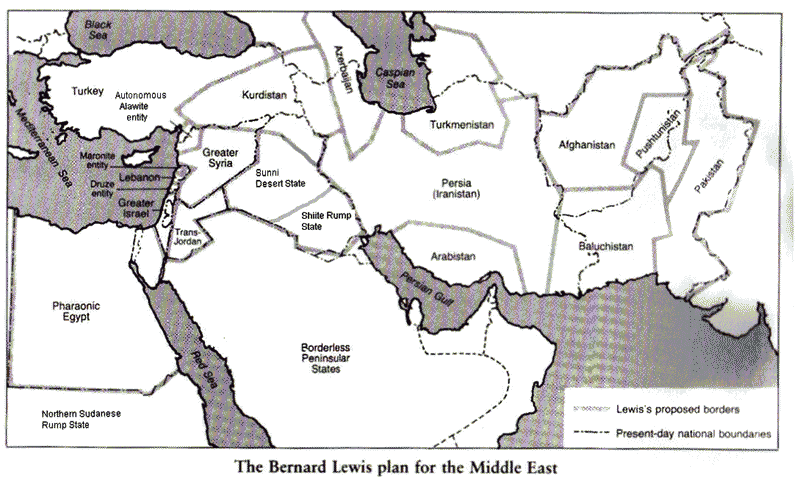
The goals of the US operations include inciting a rebellion in the Khuzestan province of southwestern Iran, the site of many of Iran's oil fields and refineries, most probably including the critical Kharg Island tanker terminal. The majority of this area's population are Shiite Arabs. According to one scenario, the US would intervene in response to an appeal from the phantomatic Al Ahwaz Popular Democratic Front, whose program would include secession from Iran and the declaration of an independent Arab state calling itself Ahwaz. This simulacrum of Ahwaz corresponds to the new state called simply "Arabistan" in the standard Bernard Lewis Plan for the Balkanization of the Middle East. (see map).
Also in correspondence with the Bernard Lewis Plan, the CIA is agitating among Kurds and Turkmen along the border with Iraq and Turkey and among Baluchis along the border with Pakistan by promising them their own balkanized homelands. The Persians, according to this report, would be relegated to an oil-poor "Irani triangle" (or "Iranistan," in classic Bernard Lewis Plan terminology) around Teheran, Isfahan, and Qom. According to the BND, the US Navy is tapping Iranian undersea cables, while US Task Force 121 covert action teams are swarming over sensitive points inside Iran. The presence of US special forces teams on Iranian territory has been an open secret since the beginning of 2005, along with numerous violations of US airspace by US military aircraft. (See
US WAR AIMS: THE BERNARD LEWIS PLAN
To clarify these points, a map reflecting the Bernard Lewis Plan for the Balkanization of the Middle East is included with this article. This map is based on one published in Linda de Hoyos, Derivative Assassination: Who Killed Indira Ghandi? (New York: New Benjamin Franklin House, 1985), with some changes.
Bernard Lewis served during World War II as an agent of the British Arab Bureau, the imperialist agency charged with keeping the Arab world weak so as to preserve London's domination. Bernard Lewis is associated with two principal ideas about the Moslem and Arab world. The first is that the real basis of Islam is not at all to be found in the luminous Baghdad Renaissance of the Caliph Haroun al Rashid around 800 AD, in its time the most advanced civilization in the world, but is to be sought rather in the benighted irrationalism of al Ghazali and his Destruction of Philosophy the world of dervishes, sheikhs, and necromancers.
Over more than a century, the British have sought to control the Arab and Islamic sense of identity by finding, publicizing, and glorifying the most backward and self-destructive tendencies in one and a half millennia of Moslem history, attempting to accredit these as the true essence of Islam. Bernard Lewis, glorification of Moslem irrationalism thus prepares the way for the ideology attributed to al Qaeda.
Lewis, second idea is that the existing Arab countries are illegitimate, and need to be carved up into a crazy quilt of ridiculous petty states who will be unable to threaten any important interest of Anglo-American imperialism.
In a 1992 Foreign Affairs article in which he surveyed the region in the aftermath of the 1991 Operation Desert Storm, Lewis offered the following prophecy of the coming Lebanization of the entire Middle East on the lines of the post-1975 Lebanese civil war:
"The eclipse of pan-Arabism has left Islamic fundamentalism as the most attractive alternative to all those who feel that there has to be something better, truer and more hopeful than the inept tyrannies of their rulers and the bankrupt ideologies foisted on them from outside... The more oppressive the regime, the greater the help it gives to fundamentalists by eliminating competing oppositionists. If the central power is sufficiently weakened, there is no real civil society to hold the polity together, no real sense of common national identity or overriding allegiance to the nation-state. The state then disintegrates"as happened in Lebanon"into a chaos of squabbling, feuding, fighting sects, tribes, regions and parties." Of course, Bernard Lewis only repeats with his usual arid banality the geopolitical nostrums which his British imperialist predecessors had expressed with far greater panache. T.E. Lawrence ("of Arabia"), for example, who was a far more colorful operative than Lewis, developed similar ideas in an October 29, 1918 meeting with Lord Cecil, Lord Curzon, Lord Balfour, General Smuts, and Mark Sykes of the Foreign Office, who helped draw up the map of the modern Middle East in the infamous Sykes-Picot deal. At that time the British effort was to break up and balkanize a Caliphate that actually existed, with its center in Constantinople. Lawrence stated: "If the Sultan of Turkey were to disappear, then the Caliphate by the common consent of Islam would fall to the family of the prophet, the present representative of which is Hussein, the Sharif of Mecca. Hussein's activities seem beneficial to us, because it marches with our immediate aims, the breakup of the Islamic bloc and the disruption of the Ottoman Empire, and because the states he would set up to succeed the Turks would be as harmless to ourselves as Turkey was. If properly handled the Arab states would remain in a state of political mosaic, a tissue of jealous principalities incapable of cohesion, and yet always ready to combine against an outside force." In other words, the eternal British mantra of divide and conquer, now embraced with giddy enthusiasm by fanatical parvenu neocons, greedy barbarian Bushmen, and cost-plus arrivistes along the Potomac.
The Bernard Lewis Plan represents the real US-UK war aims in the Middle East. This map is what Appalachian poor whites, no-future rural youth, and black and Hispanic ghetto victims are dying for in Iraq. The hogwash spouted by neocons about democracy, or Bush's pledge to bring reform and modernization to Arab societies, are cynical subterfuges to achieve this goal. In the light of this analysis, the basic purpose of Bush's Iraq invasion was quite simply the destruction of that society, and the deliberate provoking of a three-way civil war. This is, after all, what we are observing empirically. Maybe it is now clear why, despite an alleged $20 billion in reconstruction funds available, there is so little electricity in Baghdad.


Friday, 26 August 2005
assassination team after wayne madsen
Labels:
cia,
espionage,
secret services,
us
http://www.insider-magazine.com/madsen_under_threat.htm
MADSEN UNDER THREAT OF ASSASSINATION
FLEES WASHINGTON, D.C.
By John Caylor
Following months of harassment by the Bush administration, that includes getting him fired from his job at a think tank and attempting to strip him of his membership in the Washington Press Club, the Bush administration has stooped to new lows in trying to make former National Security Agency employee Wayne Madsen disappear. America has entered a dangerous new age of the Neo-Con and new Nazi movement that thrives on lies and propaganda from Fox News and right wing talk show hosts. With Pat Robinson pushing for assassination of foreign leaders are domestic internet journalists next?
Insider Editor's Notes:
"Dear Readers: At Wayne Madsen's request we are putting this message to him from a source high in a United States Intelligence agency. Wayne is now in hiding and on the run after his source revealed that a private contractor assassination team had been hired to take him out due to his articles and exposures in Insider-Magazine.com and WayneMadsenreport.com. We will keep you informed and If the assassination teams kill him then all the world will know where the orders came from..."

Wayne Madsen
Dear John:
You now have what was sent to me by someone who has excellent bona fides. If anything happens to me -- send this far and wide. I am leaving Washington for a few days.
wm
Intelligence Source:
We have reason to think that a "project" will be undertaken against "someone" considered problematic now...not next week but NOW. That person is not specified but is in the US, in an apartment setting and lives alone. It is a "he" and he works via www. This information is specific to an intent but not specific to a person. The source is impeccable and you know my track record which have parallel sourcing. The "project" will be assigned to "parallel contractors" who will make any action appear random and witnesses would suggest Middle Eastern in source. Actions would be carried out in or near the home. We do not hear things like this often (almost never) and so far every warning of this type has been within 24 hours of action and these warnings have proven 100% accurate in the past. We do not know of any direct reason for someone to use this source to provide wrong or misleading information or for use by those who are "contracting" this action. Your recent work and profile make us tell you this directly.
Please respond with a note that all is normal there. Please consider the warning we received as it can be applied to many including yourself. It is possible that someone considers "us" linked in some way and that this warning may be a "deterrent" to work that some may not want completed. We have no reason to think this but I want to consider every possible angle and application to this warning. Please consider what can be done while taking any measures you think necessary to avoid this "project". We consider this warning as coming with the highest level "authenticity" and purity of motive, but the subject and message subject and it's specifications were too unusual to be sure of intent.
Wednesday, 3 August 2005
mossad killed maxwell
Labels:
espionage,
europe,
israel,
middle east,
mossad,
russia,
secret services,
uk
http://www.the7thfire.com/new_world_order/zionism/mossad/mossad_murder_of_robert_maxwell.htm The Mossad Murder of Robert Maxwell, Agent
|
Special Report: The Contrasting Media Treatment of Israeli and Islamic Death Threats by Victor Ostrovsky
Ludvig Hoch was born the same year as Henry Kissinger (Heinz Kissingen) in Czechoslovakia. The son of Hasidic Jews, he ran away from home in 1938 to join the resistance. Later he changed his name to Robert Maxwell. --Colonel Donn de Grand Pre' in The Viper's Venom
 Robert Maxwell's contact was not in the best of moods when he received a call on a special secure line at the Israeli embassy in Madrid. Maxwell was phoning from London, saying it was imperative that a meeting be set up. He was willing to come to Madrid. {p. 284} OCTOBER 30 1991
The ties between Maxwell and the Mossad went back a long way. Elements within the Mossad had offered to finance Maxwell's first big business ventures, and in later years Maxwell received inside information on global matters from the Office. Maxwell was originally codenamed "the Little Czech," and the sobriquet stuck. Only a handful of people in the Israeli intelligence community knew who the Little Czech was, yet he provided an unending supply of slush money for the organization whenever it ran low.
For years, Maxwell would hit financial lows whenever the Mossad was in the midst of expensive operations that could not be funded legitimately and when other less legitimate sources were unavailable, as was the case after the American invasion of Panama in 1990, which dried up the Mossad's income from drug trafficking and forced Maxwell to dig deep into his corporate pockets.
But the Mossad had used its ace in the hole one time too many. Asking Maxwell to get involved in a matter of secondary importance (namely, the Vanunu affair) had been a big mistake, for which the media mogul would be made to pay the price.
That involvement caused suspicion in the British Parliament that there was no smoke without fire, particularly after the publication of a book by an American reporter claiming Maxwell was a Mossad agent. Maxwell retaliated in a lawsuit, but the ground was starting to burn under his feet. The Mossad was late in giving him back his money, and the usual {p. 285} last-minute rescue of his financial empire was looking less and less feasible.
For Maxwell, what was already bad was about to get worse. His call couldn't have been more poorly timed. Israel was participating in a peace negotiation process that the Mossad top clique believed would be detrimental to the country's security. At the same time, news was reaching the Office of a growing scandal caused by Mossad involvement in Germany. This scandal was a result of Uri's having made a call to the Hamburg River Police informing them that a shipment of arms was about to be loaded onto an Israeli ship.
The arms consisted of Soviet tanks and antiaircraft equipment, concealed in large crates marked agricultural equipment. The shipment had been arranged with the help of the BND, without the knowledge of the German government or the Ministry of Defense. It was exactly the same equipment that the Ministry of Defense had refused to send to Israel in March of the same year, because they believed the shipment would defy the German law forbidding the shipment of war materiel to a conflict zone.
The Mossad's right-wing element wasn't sure to what extent this scandal would grow. They remembered very well the scandal that had occurred in 1978 when the German police had allowed Mossad officers posing as German intelligence officers to interrogate Palestinians in German prisons. If the German government could contain the situation, things would be fine. But once the story was in the hands of the media, there was no telling where it would go.
And then came this call from Maxwell, insisting he must meet his contact on a matter of great urgency. The mogul was rebuffed at first, but then he issued a veiled threat: Now that he was being investigated by Parliament and the British media, if he wasn't able to straighten out his financial affairs, he wasn't sure he could keep the Kryuchkov meeting a secret.
What he was referring to (and in doing so, he sealed his fate) was a meeting that he'd helped arrange between the Mossad liaison and the former head of the KGB, Vladimir Kryuchkov, who was now jailed in Number Four Remand Center in Moscow for his role in the Soviet Union's August coup to oust Mikhail Gorbachev.
At that meeting, which took place on Maxwell's yacht at anchor in Yugoslav waters, Mossad support for the plot to oust Gorbachev was discussed. The Mossad promised to bring about, through its political connections, an early recognition of the new regime, as well as other logistical assistance for the coup. In exchange, it requested that {p. 286} all Soviet Jews be released, or rather expelled, which would create a massive exodus of people that would be too large to be absorbed by other countries and would therefore go to Israel.
Certain right-wingers within the government had believed this meeting with the coup plotters was a necessity. They knew that if the Soviet Union were to stop being the enemy, there'd no longer be a threat from the East, and the strategic value of Israel to its greatest ally, the United States, would diminish. Alliances between the United States and the Arab nations in the region would then be a realistic prospect.
It was Maxwell who'd helped create the ties with the now-defunct KGB. The right-wingers realized it would be a devastating blow to Israel's standing in the West if the world were to learn that the Mossad had participated in any way, as minute as that participation might be, in the attempted coup to stop the democratization of the Soviet Union. It would be perceived as treason against the West. Maxwell was now using the Mossad's participation as a threat, however veiled, to force an immediate burst of aid to his ailing empire. His contact asked him to call back in a few hours.
A small meeting of right-wingers at Mossad headquarters resulted in a consensus to terminate Maxwell. At first, the participants thought it would take several weeks to put together a plan, but then someone pointed out that the process could be accelerated if the Little Czech could be made to travel to a rendezvous where the Mossad would be waiting to strike.
Maxwell was asked to come to Spain the following day. His contact promised that things would be worked out and that there was no need to panic. The mogul was asked to sail on his yacht to Madeira and wait there for a message.
Maxwell arrived in Gibraltar on October 31, 1991, boarded his yacht, the Lady Ghislaine, and set sail for Madeira, as instructed. There he waited for directions. Meanwhile, the Mossad was getting read to strike. On Friday, November 1, a special Mossad troubleshooting team that was in Spain to cover the peace talks was dispatched. The team flew to Morocco, where they were met by a confederate who'd already taken care of all the necessary equipment and other arrangements.
At first, Maxwell was told that the meeting would take place in Madeira and that he'd receive as much money as he needed to calm the situation. Additional moneys would be advanced to him later. All this was to be kept completely quiet, since there was no point in pro- {p. 287} viding more fodder for his enemies, who would have liked nothing better than to show his direct connection to the Mossad.
On November 2, the Mossad learned that Maxwell had called his son in England and scheduled a meeting with him on the island. Maxwell was told to cancel the meeting. He was also told that the meeting with the money people would now take place on the island of Tenerife.
When he reached Santa Cruz on the island of Tenerife, he headed for a meeting in the Hotel Mency. As he dined alone in the hotel restaurant, someone walked over to him and gave him a message indicating that he should be in Los Cristos on the other side of the island the next morning. He was to make his way there in his yacht, sailing around the island of Grand Canary.
I learned all this in a phone conversation with Ephraim. He had no idea how the Kidon team had managed to get to Maxwell at sea while the yacht was cruising at fifteen knots, but making it look impossible was part of the Kidon magic. Some time during the night of November 4-5, the Mossad's problem was laid to rest in the salty waters of the Atlantic.
After an autopsy that raised more questions than it answered, a second autopsy was held in Israel under the watchful eye of the security apparatus. Whatever was not detected then was buried forever on Mount of Olives in Jerusalem, the resting place for the nation's most revered heroes.
"He had done more for Israel than can today be said," Prime Minister Shamir eulogized at Maxwell's burial.
{end of selections}
Victor Ostrovsky, now living in Canada, hosts a weekly radio show called Spytalk.
Thursday, 21 July 2005
Friday, 15 July 2005
us army has secret spaceships
http://www.rense.com/general67/hackerfeelsUSnavyhas.htm
Hacker Feels US Navy Has Spaceships, Crews In Space
7-15-5
He did a few trial runs, hacking into Oxford University’s network, for example, and he found the whole business « incredibly exciting. And then it got more exciting when I started going to places where I really shouldn’t be. »
« Like where? » I ask.
« The US Space Command, » he says.
« What was the most exciting thing you saw? »
« I found a list of officers’ names, » he says, « under the heading ‘Non-Terrestrial Officers’. It doesn’t mean little green men. What I think it means is not Earth-based. I found a list of ‘fleet-to-fleet transfers’, and a list of ship names. I looked them up. They weren’t US Navy ships. What I saw made me believe they have some kind of spaceship, off-planet. »
« The Americans have a secret spaceship? » I ask.
« That’s what this trickle of evidence has led me to believe. »
The Nerd Who Saw Too Much
The Guardian - UK
7-15-5
Terrified Gary McKinnon says his forays into secret Pentagon networks were never politically motivated.
A computer geek faces 70 years in jail for hacking into the top levels of US defence. He tells Jon Ronson how, hooked and stoned, he landed himself in such hot water.
In 1983, when Gary McKinnon was 17, he went to see the movie WarGames. In the film, a geeky computer whiz-kid hacks into a secret Pentagon network and, inadvertently, almost instigates World War III. Sitting in the cinema, the teenage McKinnon wondered if he, too, could be a hacker. « Really, » I say to him now, « WarGames should have put you off hacking for life. »
« Well, » he replies, « I didn’t mean it to actually come true. »
WarGames ends with the Pentagon officials telling the young nerd how impressed they are with his technical acumen. He’s probably going to grow up to have a brilliant career at NASA or the Department of Defence. This is an unlikely scenario for McKinnon. He faces 20 charges in the US, including stealing computer files, obtaining secrets that might have been « useful to an enemy », intentionally causing damage to a protected computer, and interfering with maritime navigation equipment in New Jersey.
Last month he attended extradition proceedings at Bow Street Magistrates Court in London. He had, the US prosecutors said, perpetrated the « biggest military computer hack of all time ». He « caused damage and impaired the integrity of information. The US military district of Washington became inoperable and the cost of repairing the shutdown was $700,000 US. » These hacking attacks occurred immediately after September 11, 2001, they said.
This is McKinnon’s first interview. He called me out of the blue last week, just as I was screaming at my child to stop knocking on people’s doors and running away. « Your son sounds like a hacker, » he said. Then he invited me to his home in Bounds Green, north London.
He is good-looking, funny, slightly camp, nerdy, a chain-smoker - and terrified. « I’m walking down the road and I find I can’t control my own legs, » he says. « And I’m sitting up all night thinking about jail and about being arse-f---ed. And, remember, according to them I was making Washington inoperable ‘immediately after September 11’.
« I’m having all these visions of « McKinnon puts on a redneck prisoner voice, « ’What you doing attacking our country, boy? Pick up that soap.’ Yeah, it is absolutely f---ing terrifying. »
The sentence the US Justice Department is seeking - should McKinnon be extradited - is up to 70 years. What McKinnon was hunting for, as he snooped around NASA, and the Pentagon’s network, was evidence of a UFO cover-up.
McKINNON was born in Glasgow in 1966. His parents separated when he was six and he moved to London with his mother and stepfather, a bit of a UFO buff. « He comes from Falkirk, » McKinnon says, « and just outside Falkirk there’s a place called Bonnybridge, which is the UFO capital of the world. When he lived there, he had a dream that he was walking around Bonnybridge seeing huge ships. He told me this and it inflamed my curiosity. He was a great science-fiction reader. So, him being my second father, I started reading science-fiction, too, and doing everything he did. »
McKinnon read Isaac Asimov and Robert Heinlein - « the golden age of science-fiction ». When he was 15 he joined Bufora, the British UFO Research Association, which describes itself as « a nationwide network of [about] 300 people who have a dedicated, non-cultist interest in understanding the wide-ranging extent of the UFO enigma ».
Then he saw WarGames, and he thought: « Can you really do it? Can you really gain unauthorised access to incredibly interesting places? Surely it can’t be that easy. » And so, in 1995, he gave it a try.
He sat in his girlfriend, Tamsin’s, aunt’s house in Crouch End, and he began to hack. McKinnon was looking for - and found time and again - network administrators in high levels of the US government and military establishments who hadn’t bothered to give themselves passwords. That’s how he got in.
He did a few trial runs, hacking into Oxford University’s network, for example, and he found the whole business « incredibly exciting. And then it got more exciting when I started going to places where I really shouldn’t be. »
« Like where? » I ask.
« The US Space Command, » he says.
And so, for the next seven years, on and off, McKinnon sat in that aunt’s house, a joint in the ashtray and a can of Foster’s next to the mouse pad, and he snooped. From time to time, some NASA scientist sitting at his desk somewhere would see his cursor move for no apparent reason. On those occasions, McKinnon’s connection would be cut. This would never fail to freak out the then-stoned McKinnon.
When I ask if he is brilliant, he says no. He’s just an ordinary, self-taught techie. And, he says, he was never alone. « Once you’re on the network, you can do a command called NetStat - Network Status - and it lists all the connections to that machine. There were hackers from Denmark, Italy, Germany, Turkey, Thailand. »
« All on at once? » I ask. « You could see hackers from all over the world, snooping around, without the spaceniks or the military realising? »
« Every night, » he says.
« What was the most exciting thing you saw? »
« I found a list of officers’ names, » he says, « under the heading ‘Non-Terrestrial Officers’. It doesn’t mean little green men. What I think it means is not Earth-based. I found a list of ‘fleet-to-fleet transfers’, and a list of ship names. I looked them up. They weren’t US Navy ships. What I saw made me believe they have some kind of spaceship, off-planet. »
« The Americans have a secret spaceship? » I ask.
« That’s what this trickle of evidence has led me to believe. »
« What were the ship names? »
« I can’t remember, » he says. « I was smoking a lot of dope at the time. Not good for the intellect. »
This was November 2000. By now, McKinnon was hooked. He quit his job as a systems administrator for a small business, « which hugely pissed off my girlfriend, Tamsin ».
« It was the last straw, » he says. « She dumped me and started seeing this other bloke because I was such a selfish waste of space. Poor Tamsin. And she was the one paying the phone bill because I didn’t have a job. We were still living together. God, have you ever tried living with someone after you’ve split up? It’s bad. »
So, while Tamsin was trying to get on with her new relationship, McKinnon was in the living room of her aunt’s house, hacking. He snooped around all the forts - Fort Meade, Fort Benning, and others - reading internal court-martial reports of soldiers getting imprisoned for rape and murder and drug abuse.
« You end up lusting after more and more complex security measures, » he says. « It was like a game. I loved computer games. I still do. It was like a real game. It was addictive. Hugely addictive. » It was never really politically motivated.
Yes, he was hacking immediately after September 11, 2001, but only because he wanted to see if there was a conspiracy. « Why did the building fall like a controlled series of explosions? » he asks. « I hate conspiracy theories, so I thought I’d find out for myself. »
He strenuously denies the Justice Department’s charge that he caused the « US military district of Washington » to become « inoperable ». Well, once, he admits - but only once - he inadvertently pressed the wrong button and may have deleted some government files.
« I thought, ‘Ooh, bloody hell.’ And that’s when I stopped for a while. And then my friend told me about DARPA. And so I started again. »
DARPA is the Defence Advanced Research Projects Agency, an intriguing collection of brilliant military scientists, funded by the Pentagon. DARPA has been widely credited with inventing, among other things, the internet, the global positioning system, the computer mouse, and - somewhat more boneheadedly - FutureMAP, an online futures market designed to predict assassinations and bombings by encouraging investor speculation in such crimes. The US Senate once described FutureMAP as « an unbelievably stupid idea ». DARPA has long been of interest to conspiracy theorists because it is semi-secretive, bizarre and occupies that murky world that lies between science and war.
McKinnon was caught in November 2002. He says it was inevitable because he was « getting a bit sloppy ». He pauses. « I’d never have envisaged this happening to myself, but I did get a bit megalomaniacal, as well. It got a bit silly. I ended up talking to people I hacked into - I’d instant-message them, using WordPad, with a bit of a political diatribe. You know, I’d leave a message on their desktop that read, ‘Secret government is blah blah blah. »’
McKinnon was tracked down because he’d used his email address to download a hacking program called Remotely Anywhere. « God knows why I used my real email address, » he says. « I suppose it means I’m not a secretive, sophisticated checking myself every-step-of-the-way type of hacker. »
On the night before his arrest, McKinnon had been up playing games. « Maybe I’d been doing a bit of weak, fun hacking, too, » he says. « I’d had one hour’s sleep, and I woke up completely muddled, and suddenly at the bottom of my bed there was this voice: ‘Hello, my name’s Jeff Donson from the National High Tech Crime Unit. Gary McKinnon, you’re under arrest.’
« They put Tamsin and me in the meat wagon. They took my PC, Tamsin’s PC, three other computers I was fixing for friends. They went upstairs and took my girlfriend’s aunty’s daughter’s computer. »
McKinnon was kept in a police station overnight. Then the Americans offered him a deal, via his British solicitor. « They said, ‘If you incur the cost of the whole extradition process, be a good boy, come over here, we’ll give you three or four years, rather than the whole sentence.’
« I said, ‘OK, give me that in writing.’ They said, ‘Oh, no, we can’t do that.’ So they were offering a secret trial, no right of appeal on the outcome, no comment to the newspapers, and nothing in writing. My solicitor, doing her job, advised me to take it, and when I said no, she was very ‘Ooh, they’re going to come down heavy’. »
In return, McKinnon offered a somewhat harebrained counter deal, via a Virginia public defender. « I made a sort of veiled threat to them. I said, ‘You know the places I’ve been, so you know the stuff I’ve seen,’ kind of thing. » He pauses and blushes slightly.
« You know, the, uh, Non-Terrestrial Officers. The spaceships. ‘The whole world thinks it’s co-operating in building the International Space Station, but you’ve already got a space-based army that you refer to as Non-Terrestrial Officers. »’ There is a silence. « I had very little evidence. It’s not a very good bargaining chip at all, really, is it? »
Given the Justice Department has announced the information McKinnon downloaded was not « classified », and he was stoned much of the time, perhaps we can assume NASA is not too worried about his « discoveries ».
McKinnon hasn’t spoken publicly before, but now, with the extradition proceedings, nothing is left open to him. For a while, he thought he might end up like the computer nerd from WarGames, having a brilliant career working for the Americans. « They need people like me, » he says. « But that’s not going to happen. »
He and Tamsin have split. He no longer lives in Crouch End, but in the nearby, slightly more down-at-heel Bounds Green, and has given up smoking dope. He is not allowed near the internet, is not allowed a passport, and spends a lot of time reading and sitting in the pub, awaiting his fate.
Nothing much happened in the years since his arrest in 2002 under the Computer Misuse Act - no charges were brought against him in Britain. Then, on June 8, he found himself in front of Bow Street magistrates, the target of extradition proceedings. That’s when the panic attacks kicked in again, the horror visions of life in a US jail. He had poked around, he says, but he hadn’t broken anything, besides that one mistake. He thought he was going to get a year, max. Now they’re talking about 70 years. « You know, » he says. « everyone thinks this is fun or exciting. But it isn’t exciting to me. It is terrifying. »
The extradition hearing will resume on July 27.
http://www.smh.com.au/news/technology/the-nerd-who-saw-too-much/2005/07/12/
1120934245512.html?oneclick=true
Hacker Feels US Navy Has Spaceships, Crews In Space
7-15-5
He did a few trial runs, hacking into Oxford University’s network, for example, and he found the whole business « incredibly exciting. And then it got more exciting when I started going to places where I really shouldn’t be. »
« Like where? » I ask.
« The US Space Command, » he says.
« What was the most exciting thing you saw? »
« I found a list of officers’ names, » he says, « under the heading ‘Non-Terrestrial Officers’. It doesn’t mean little green men. What I think it means is not Earth-based. I found a list of ‘fleet-to-fleet transfers’, and a list of ship names. I looked them up. They weren’t US Navy ships. What I saw made me believe they have some kind of spaceship, off-planet. »
« The Americans have a secret spaceship? » I ask.
« That’s what this trickle of evidence has led me to believe. »
The Nerd Who Saw Too Much
The Guardian - UK
7-15-5
Terrified Gary McKinnon says his forays into secret Pentagon networks were never politically motivated.
A computer geek faces 70 years in jail for hacking into the top levels of US defence. He tells Jon Ronson how, hooked and stoned, he landed himself in such hot water.
In 1983, when Gary McKinnon was 17, he went to see the movie WarGames. In the film, a geeky computer whiz-kid hacks into a secret Pentagon network and, inadvertently, almost instigates World War III. Sitting in the cinema, the teenage McKinnon wondered if he, too, could be a hacker. « Really, » I say to him now, « WarGames should have put you off hacking for life. »
« Well, » he replies, « I didn’t mean it to actually come true. »
WarGames ends with the Pentagon officials telling the young nerd how impressed they are with his technical acumen. He’s probably going to grow up to have a brilliant career at NASA or the Department of Defence. This is an unlikely scenario for McKinnon. He faces 20 charges in the US, including stealing computer files, obtaining secrets that might have been « useful to an enemy », intentionally causing damage to a protected computer, and interfering with maritime navigation equipment in New Jersey.
Last month he attended extradition proceedings at Bow Street Magistrates Court in London. He had, the US prosecutors said, perpetrated the « biggest military computer hack of all time ». He « caused damage and impaired the integrity of information. The US military district of Washington became inoperable and the cost of repairing the shutdown was $700,000 US. » These hacking attacks occurred immediately after September 11, 2001, they said.
This is McKinnon’s first interview. He called me out of the blue last week, just as I was screaming at my child to stop knocking on people’s doors and running away. « Your son sounds like a hacker, » he said. Then he invited me to his home in Bounds Green, north London.
He is good-looking, funny, slightly camp, nerdy, a chain-smoker - and terrified. « I’m walking down the road and I find I can’t control my own legs, » he says. « And I’m sitting up all night thinking about jail and about being arse-f---ed. And, remember, according to them I was making Washington inoperable ‘immediately after September 11’.
« I’m having all these visions of « McKinnon puts on a redneck prisoner voice, « ’What you doing attacking our country, boy? Pick up that soap.’ Yeah, it is absolutely f---ing terrifying. »
The sentence the US Justice Department is seeking - should McKinnon be extradited - is up to 70 years. What McKinnon was hunting for, as he snooped around NASA, and the Pentagon’s network, was evidence of a UFO cover-up.
McKINNON was born in Glasgow in 1966. His parents separated when he was six and he moved to London with his mother and stepfather, a bit of a UFO buff. « He comes from Falkirk, » McKinnon says, « and just outside Falkirk there’s a place called Bonnybridge, which is the UFO capital of the world. When he lived there, he had a dream that he was walking around Bonnybridge seeing huge ships. He told me this and it inflamed my curiosity. He was a great science-fiction reader. So, him being my second father, I started reading science-fiction, too, and doing everything he did. »
McKinnon read Isaac Asimov and Robert Heinlein - « the golden age of science-fiction ». When he was 15 he joined Bufora, the British UFO Research Association, which describes itself as « a nationwide network of [about] 300 people who have a dedicated, non-cultist interest in understanding the wide-ranging extent of the UFO enigma ».
Then he saw WarGames, and he thought: « Can you really do it? Can you really gain unauthorised access to incredibly interesting places? Surely it can’t be that easy. » And so, in 1995, he gave it a try.
He sat in his girlfriend, Tamsin’s, aunt’s house in Crouch End, and he began to hack. McKinnon was looking for - and found time and again - network administrators in high levels of the US government and military establishments who hadn’t bothered to give themselves passwords. That’s how he got in.
He did a few trial runs, hacking into Oxford University’s network, for example, and he found the whole business « incredibly exciting. And then it got more exciting when I started going to places where I really shouldn’t be. »
« Like where? » I ask.
« The US Space Command, » he says.
And so, for the next seven years, on and off, McKinnon sat in that aunt’s house, a joint in the ashtray and a can of Foster’s next to the mouse pad, and he snooped. From time to time, some NASA scientist sitting at his desk somewhere would see his cursor move for no apparent reason. On those occasions, McKinnon’s connection would be cut. This would never fail to freak out the then-stoned McKinnon.
When I ask if he is brilliant, he says no. He’s just an ordinary, self-taught techie. And, he says, he was never alone. « Once you’re on the network, you can do a command called NetStat - Network Status - and it lists all the connections to that machine. There were hackers from Denmark, Italy, Germany, Turkey, Thailand. »
« All on at once? » I ask. « You could see hackers from all over the world, snooping around, without the spaceniks or the military realising? »
« Every night, » he says.
« What was the most exciting thing you saw? »
« I found a list of officers’ names, » he says, « under the heading ‘Non-Terrestrial Officers’. It doesn’t mean little green men. What I think it means is not Earth-based. I found a list of ‘fleet-to-fleet transfers’, and a list of ship names. I looked them up. They weren’t US Navy ships. What I saw made me believe they have some kind of spaceship, off-planet. »
« The Americans have a secret spaceship? » I ask.
« That’s what this trickle of evidence has led me to believe. »
« What were the ship names? »
« I can’t remember, » he says. « I was smoking a lot of dope at the time. Not good for the intellect. »
This was November 2000. By now, McKinnon was hooked. He quit his job as a systems administrator for a small business, « which hugely pissed off my girlfriend, Tamsin ».
« It was the last straw, » he says. « She dumped me and started seeing this other bloke because I was such a selfish waste of space. Poor Tamsin. And she was the one paying the phone bill because I didn’t have a job. We were still living together. God, have you ever tried living with someone after you’ve split up? It’s bad. »
So, while Tamsin was trying to get on with her new relationship, McKinnon was in the living room of her aunt’s house, hacking. He snooped around all the forts - Fort Meade, Fort Benning, and others - reading internal court-martial reports of soldiers getting imprisoned for rape and murder and drug abuse.
« You end up lusting after more and more complex security measures, » he says. « It was like a game. I loved computer games. I still do. It was like a real game. It was addictive. Hugely addictive. » It was never really politically motivated.
Yes, he was hacking immediately after September 11, 2001, but only because he wanted to see if there was a conspiracy. « Why did the building fall like a controlled series of explosions? » he asks. « I hate conspiracy theories, so I thought I’d find out for myself. »
He strenuously denies the Justice Department’s charge that he caused the « US military district of Washington » to become « inoperable ». Well, once, he admits - but only once - he inadvertently pressed the wrong button and may have deleted some government files.
« I thought, ‘Ooh, bloody hell.’ And that’s when I stopped for a while. And then my friend told me about DARPA. And so I started again. »
DARPA is the Defence Advanced Research Projects Agency, an intriguing collection of brilliant military scientists, funded by the Pentagon. DARPA has been widely credited with inventing, among other things, the internet, the global positioning system, the computer mouse, and - somewhat more boneheadedly - FutureMAP, an online futures market designed to predict assassinations and bombings by encouraging investor speculation in such crimes. The US Senate once described FutureMAP as « an unbelievably stupid idea ». DARPA has long been of interest to conspiracy theorists because it is semi-secretive, bizarre and occupies that murky world that lies between science and war.
McKinnon was caught in November 2002. He says it was inevitable because he was « getting a bit sloppy ». He pauses. « I’d never have envisaged this happening to myself, but I did get a bit megalomaniacal, as well. It got a bit silly. I ended up talking to people I hacked into - I’d instant-message them, using WordPad, with a bit of a political diatribe. You know, I’d leave a message on their desktop that read, ‘Secret government is blah blah blah. »’
McKinnon was tracked down because he’d used his email address to download a hacking program called Remotely Anywhere. « God knows why I used my real email address, » he says. « I suppose it means I’m not a secretive, sophisticated checking myself every-step-of-the-way type of hacker. »
On the night before his arrest, McKinnon had been up playing games. « Maybe I’d been doing a bit of weak, fun hacking, too, » he says. « I’d had one hour’s sleep, and I woke up completely muddled, and suddenly at the bottom of my bed there was this voice: ‘Hello, my name’s Jeff Donson from the National High Tech Crime Unit. Gary McKinnon, you’re under arrest.’
« They put Tamsin and me in the meat wagon. They took my PC, Tamsin’s PC, three other computers I was fixing for friends. They went upstairs and took my girlfriend’s aunty’s daughter’s computer. »
McKinnon was kept in a police station overnight. Then the Americans offered him a deal, via his British solicitor. « They said, ‘If you incur the cost of the whole extradition process, be a good boy, come over here, we’ll give you three or four years, rather than the whole sentence.’
« I said, ‘OK, give me that in writing.’ They said, ‘Oh, no, we can’t do that.’ So they were offering a secret trial, no right of appeal on the outcome, no comment to the newspapers, and nothing in writing. My solicitor, doing her job, advised me to take it, and when I said no, she was very ‘Ooh, they’re going to come down heavy’. »
In return, McKinnon offered a somewhat harebrained counter deal, via a Virginia public defender. « I made a sort of veiled threat to them. I said, ‘You know the places I’ve been, so you know the stuff I’ve seen,’ kind of thing. » He pauses and blushes slightly.
« You know, the, uh, Non-Terrestrial Officers. The spaceships. ‘The whole world thinks it’s co-operating in building the International Space Station, but you’ve already got a space-based army that you refer to as Non-Terrestrial Officers. »’ There is a silence. « I had very little evidence. It’s not a very good bargaining chip at all, really, is it? »
Given the Justice Department has announced the information McKinnon downloaded was not « classified », and he was stoned much of the time, perhaps we can assume NASA is not too worried about his « discoveries ».
McKinnon hasn’t spoken publicly before, but now, with the extradition proceedings, nothing is left open to him. For a while, he thought he might end up like the computer nerd from WarGames, having a brilliant career working for the Americans. « They need people like me, » he says. « But that’s not going to happen. »
He and Tamsin have split. He no longer lives in Crouch End, but in the nearby, slightly more down-at-heel Bounds Green, and has given up smoking dope. He is not allowed near the internet, is not allowed a passport, and spends a lot of time reading and sitting in the pub, awaiting his fate.
Nothing much happened in the years since his arrest in 2002 under the Computer Misuse Act - no charges were brought against him in Britain. Then, on June 8, he found himself in front of Bow Street magistrates, the target of extradition proceedings. That’s when the panic attacks kicked in again, the horror visions of life in a US jail. He had poked around, he says, but he hadn’t broken anything, besides that one mistake. He thought he was going to get a year, max. Now they’re talking about 70 years. « You know, » he says. « everyone thinks this is fun or exciting. But it isn’t exciting to me. It is terrifying. »
The extradition hearing will resume on July 27.
http://www.smh.com.au/news/technology/the-nerd-who-saw-too-much/2005/07/12/
1120934245512.html?oneclick=true
Wednesday, 13 July 2005
london bombing exercise
London Underground Bombing 'Exercises' Took Place at Same Time as Real Attack
Culpability cover scenario echoes 9/11 wargames
Paul Joseph Watson & Alex Jones/
Prison Planet
july 13 2005
UPDATE: London Underground Exercises and the Magically Exploding Terrorists: Important Questions
A consultancy agency with government and police connections was running an exercise for an unnamed company that revolved around the London Underground being bombed at the exact same times and locations as happened in real life on the morning of July 7th.
On a BBC Radio 5 interview that aired on the evening of the 7th, the host interviewed Peter Power, Managing Director of Visor Consultants, which bills itself as a 'crisis management' advice company, better known to you and I as a PR firm.
Peter Power was a former Scotland Yard official, working at one time with the Anti Terrorist Branch.
Power told the host that at the exact same time that the London bombings were taking place, his company was running a 1,000 person strong exercise which drilled the London Underground being bombed at the exact same locations, at the exact same times, as happened in real life.
The transcript is as follows.
POWER: At half past nine this morning we were actually running an exercise for a company of over a thousand people in London based on simultaneous bombs going off precisely at the railway stations where it happened this morning, so I still have the hairs on the back of my neck standing up right now.
HOST: To get this quite straight, you were running an exercise to see how you would cope with this and it happened while you were running the exercise?
POWER: Precisely, and it was about half past nine this morning, we planned this for a company and for obvious reasons I don't want to reveal their name but they're listening and they'll know it. And we had a room full of crisis managers for the first time they'd met and so within five minutes we made a pretty rapid decision that this is the real one and so we went through the correct drills of activating crisis management procedures to jump from slow time to quick time thinking and so on.
Click here for a clip of this dialogue. Click here for a longer clip where the comments can be heard in their full context.
The fact that the exercise mirrored the exact locations and times of the bombings is light years beyond a coincidence. Power said the drill focused around 'simultaneous bombings'. At first the bombings were thought to have been spread over an hour, but the BBC reports just today that the bombings were in fact simultaneous.
Mr. Power (pictured above) and Visor Consultants need not have been 'in on the bombing' or anything of that nature for this to be of importance. The British government or one of their private company offshoots could have hired Visor to run the exercise for a number of purposes.
We are not suggesting that Mr. Power had any knowledge of the real purpose of the exercise, and the open shock he exclaims in relating the story underlines this.
The exercise fulfils several different goals. It acts as a cover for the small compartamentalized government terrorists to carry out their operation without the larger security services becoming aware of what they're doing, and, more importantly, if they get caught during the attack or after with any incriminating evidence they can just claim that they were just taking part in the exercise.
This is precisely what happened on the morning of 9/11/2001. The CIA was conducting drills of flying hijacked planes into the WTC and Pentagon at 8:30 in the morning.
It is clear that at least five if not six training exercises were in operation in the days leading up to and on the morning of 9/11. This meant that NORAD radar screens showed as many as 22 hijacked airliners at the same time. NORAD had been briefed that this was part of the exercise drill and therefore normal reactive procedure was forestalled and delayed.
The large numbers of 'blips' on NORAD screens that displayed both real and 'drill' hijacked planes explain why confused press reports emerged hours after the attack stating that up to eight planes had been hijacked.
The Anglo-American establishment that controls the military-industrial complex of the West has been caught over a hundred times carrying out bombings and other terrorist attacks around the world to further their corporate aims and to blame their enemies.
The US government has been caught planning to carry out attacks and carrying out attacks. The British government has been caught red-handed as well. Members of Vladimir Putin's FSB were caught planting bombs in a Russian apartment building in 1999 by the Moscow police.
This is not speculation. Kermit Roosevelt admited on NPR radio that in 1953 the CIA and British intelligence carried out a wave of bombings and shootings in Iran. He then went on to brag about how they subsequently blamed the bombings on Iran's President, Mossadegh. Do you understand, these people brag about what they do 40 years later?
The London bombings have the same signature as the Madrild bombings of 3/11. Both of these bombings are almost indistinguishable from the Bolognia bombing in 1980 that killed over 80 people.
The bombing in Bolognia was part of a CIA operation code named Gladio, where the US government would pay right-wing terrorists to carry out bombings to be blamed on leftists in Europe. All of this was blown wide open when two of the Bolognia bombers were convited in an Italian court, forcing them to spill their guts admitting that they were neo-fascists contracted by the CIA. Operation Gladio documents have since been declassified.
The London terror alert level was lowered before the bombings took place. This gave the purpotrators extra cover to plan and execute the attack without having to evade the most stringent security.
In any crime you look at history and motive, The British government has been caught in multiple examples of carrying out bombings in London which were then blamed on the IRA. They even had one of their own MI5 agents wihin the Omagh bomb squad. Click here for an archive of this evidence.
The wider agenda will become clearer when Blair firmly points the finger at the selected patsies designated to take the fall. But for the moment he's happy to grandstand as the courageous leader who immedately returned to London to take control of the chaos.
BBC polls that were showing 80 per cent plus opposed the ID card will now likely flip back in the opposite direction. Support for the European Union and increased globalization through the G8 will rise. Who stands to gain from all this? Who has the motive?
From Putin blowing up his own apartment buildings to Israel being behind Hamas, the evidence is consistently clear that large scale terrorism is always state sponsored.
The Madrid train bombing is another example. The bombers were found to be police informants with close links to the Spanish security services. They had access to the most secure areas of the Madrid train system. The Spanish government initially tried to blaim the Basque group ETA for the blast in the hope that the people would rally behind the government and get them re-elected. After ETA denied involvement and the people started saying the government was involved, the Spanish government had to blame Al-Qaeda and kill some patsies by claiming they blew themselves up during a raid.
The London Underground exercises were used as the fallback cover to carry out the attack. This is the biggest smoking gun yet pointing directly to the most secretive levels of the British establishment itself being behind the attack.
Culpability cover scenario echoes 9/11 wargames
Paul Joseph Watson & Alex Jones/
Prison Planet
july 13 2005
UPDATE: London Underground Exercises and the Magically Exploding Terrorists: Important Questions
A consultancy agency with government and police connections was running an exercise for an unnamed company that revolved around the London Underground being bombed at the exact same times and locations as happened in real life on the morning of July 7th.
On a BBC Radio 5 interview that aired on the evening of the 7th, the host interviewed Peter Power, Managing Director of Visor Consultants, which bills itself as a 'crisis management' advice company, better known to you and I as a PR firm.
Peter Power was a former Scotland Yard official, working at one time with the Anti Terrorist Branch.
Power told the host that at the exact same time that the London bombings were taking place, his company was running a 1,000 person strong exercise which drilled the London Underground being bombed at the exact same locations, at the exact same times, as happened in real life.
The transcript is as follows.
POWER: At half past nine this morning we were actually running an exercise for a company of over a thousand people in London based on simultaneous bombs going off precisely at the railway stations where it happened this morning, so I still have the hairs on the back of my neck standing up right now.
HOST: To get this quite straight, you were running an exercise to see how you would cope with this and it happened while you were running the exercise?
POWER: Precisely, and it was about half past nine this morning, we planned this for a company and for obvious reasons I don't want to reveal their name but they're listening and they'll know it. And we had a room full of crisis managers for the first time they'd met and so within five minutes we made a pretty rapid decision that this is the real one and so we went through the correct drills of activating crisis management procedures to jump from slow time to quick time thinking and so on.
Click here for a clip of this dialogue. Click here for a longer clip where the comments can be heard in their full context.
The fact that the exercise mirrored the exact locations and times of the bombings is light years beyond a coincidence. Power said the drill focused around 'simultaneous bombings'. At first the bombings were thought to have been spread over an hour, but the BBC reports just today that the bombings were in fact simultaneous.
Mr. Power (pictured above) and Visor Consultants need not have been 'in on the bombing' or anything of that nature for this to be of importance. The British government or one of their private company offshoots could have hired Visor to run the exercise for a number of purposes.
We are not suggesting that Mr. Power had any knowledge of the real purpose of the exercise, and the open shock he exclaims in relating the story underlines this.
The exercise fulfils several different goals. It acts as a cover for the small compartamentalized government terrorists to carry out their operation without the larger security services becoming aware of what they're doing, and, more importantly, if they get caught during the attack or after with any incriminating evidence they can just claim that they were just taking part in the exercise.
This is precisely what happened on the morning of 9/11/2001. The CIA was conducting drills of flying hijacked planes into the WTC and Pentagon at 8:30 in the morning.
It is clear that at least five if not six training exercises were in operation in the days leading up to and on the morning of 9/11. This meant that NORAD radar screens showed as many as 22 hijacked airliners at the same time. NORAD had been briefed that this was part of the exercise drill and therefore normal reactive procedure was forestalled and delayed.
The large numbers of 'blips' on NORAD screens that displayed both real and 'drill' hijacked planes explain why confused press reports emerged hours after the attack stating that up to eight planes had been hijacked.
The Anglo-American establishment that controls the military-industrial complex of the West has been caught over a hundred times carrying out bombings and other terrorist attacks around the world to further their corporate aims and to blame their enemies.
The US government has been caught planning to carry out attacks and carrying out attacks. The British government has been caught red-handed as well. Members of Vladimir Putin's FSB were caught planting bombs in a Russian apartment building in 1999 by the Moscow police.
This is not speculation. Kermit Roosevelt admited on NPR radio that in 1953 the CIA and British intelligence carried out a wave of bombings and shootings in Iran. He then went on to brag about how they subsequently blamed the bombings on Iran's President, Mossadegh. Do you understand, these people brag about what they do 40 years later?
The London bombings have the same signature as the Madrild bombings of 3/11. Both of these bombings are almost indistinguishable from the Bolognia bombing in 1980 that killed over 80 people.
The bombing in Bolognia was part of a CIA operation code named Gladio, where the US government would pay right-wing terrorists to carry out bombings to be blamed on leftists in Europe. All of this was blown wide open when two of the Bolognia bombers were convited in an Italian court, forcing them to spill their guts admitting that they were neo-fascists contracted by the CIA. Operation Gladio documents have since been declassified.
The London terror alert level was lowered before the bombings took place. This gave the purpotrators extra cover to plan and execute the attack without having to evade the most stringent security.
In any crime you look at history and motive, The British government has been caught in multiple examples of carrying out bombings in London which were then blamed on the IRA. They even had one of their own MI5 agents wihin the Omagh bomb squad. Click here for an archive of this evidence.
The wider agenda will become clearer when Blair firmly points the finger at the selected patsies designated to take the fall. But for the moment he's happy to grandstand as the courageous leader who immedately returned to London to take control of the chaos.
BBC polls that were showing 80 per cent plus opposed the ID card will now likely flip back in the opposite direction. Support for the European Union and increased globalization through the G8 will rise. Who stands to gain from all this? Who has the motive?
From Putin blowing up his own apartment buildings to Israel being behind Hamas, the evidence is consistently clear that large scale terrorism is always state sponsored.
The Madrid train bombing is another example. The bombers were found to be police informants with close links to the Spanish security services. They had access to the most secure areas of the Madrid train system. The Spanish government initially tried to blaim the Basque group ETA for the blast in the hope that the people would rally behind the government and get them re-elected. After ETA denied involvement and the people started saying the government was involved, the Spanish government had to blame Al-Qaeda and kill some patsies by claiming they blew themselves up during a raid.
The London Underground exercises were used as the fallback cover to carry out the attack. This is the biggest smoking gun yet pointing directly to the most secretive levels of the British establishment itself being behind the attack.
Saturday, 19 February 2005
economie distributive
Labels:
business,
economic reforms,
inflation
Jacques Duboin (1878 -- 1976), choquée par la grande crise de 1929, a développé une théorie économique qui en vaut une autre ! Dans les extraits de " la grande relève ", mensuel de réflexion socio-économique fondée en 1934 et dirigé aujourd'hui par sa fille, on voit que les problèmes du capitalisme était à peu près les mêmes dans les années 30 qu'aujourd'hui. Il m'arrive parfois de penser que si Hitler n'avait pas existé, le capitalisme serait peut-être déjà mort depuis quelques temps. Avec des si... mais enfin, s'il n'y avait pas eu l'interlude 1939-45 et ensuite les " trente glorieuses" on peut, je crois, se poser légitimement la question.
[...] d'un côté, surproduction, débouchés saturés, matières premières gaspillées ; de l'autre, malnutrition, famine, misère morale et chômage. Or les économistes prétendaient qu'il s'agissait d'un déséquilibre momentané entre l'offre et la demande, d'une de ses crises conjoncturelles," cyclique", qui se produisent quand on a produit trop, ou trop vite, mais que la loi du marché finit toujours par résorber. Bien au contraire, démontre J. Duboin dans une " lettre à tout le monde" paru en 1938, c'est une crise structurelle, [...] " nous faisons fausse route parue en 1931" en nous accrochant à nos habitudes économiques et financières, au point de les confondre avec des lois naturelles, immuables, quand elles s'avèrent dépassées : " résoudre la crise, dans l'esprit hélas ! De la majorité des hommes, consiste à revenir aux conditions d'autrefois"(extrait de " le fascisme ne résout pas la crise", article paru le 8 janvier 1937 dans le journal l'œuvre) [...] les Etats industrialisés recensaient alors 30 millions de chômeurs [...]. Cependant, et à seule fin d'en maintenir les cours, on entreprit systématiquement et légalement de détruire des denrées ou de les rendre impropres à la consommation, au mépris des besoins insolvables et sans le moindre souci écologique du gâchis que constitue de telles destructions. À l'époque où, d'après les statistiques de la SDN, une somme équivalant à 110 milliards de fois le montant du salaire minimum français était consacré à des commandes d'armement, la France ne trouvait pas les moyens d'assurer la retraite de ses vieux travailleurs. J. Duboin entreprend alors une vaste campagne. Il se révolte non seulement sur le plan moral, écœuré qu'on détruise des biens quand des gens, à côté, manquent de tout, mais aussi sur le plan écologique, devant le gâchis que ces destructions représentent, et enfin sur le plan purement économique car son expérience de financier, de banquier, de secrétaire d'état au trésor lui permet d'affirmer que toutes ces absurdités ont une cause commune et qu'il serait possible d'y mettre fin, pourvu qu'on acceptât d'évoluer. Il fonde une association, un mensuel. D'autres associations se créent parallèlement. Tous dénoncent l'absurdité criminelle dont les Etats atteints par la récession se rendent coupable en décidant d'intervenir sur le marché pour " l'assainir", obligeant ainsi les contribuables à payer collectivement ce qu'ils ne peuvent plus acheter, tandis qu'un nombre croissant d'économiquement faibles pour cause de chômage se trouvent exclus du marché. Le Brésil est cité, par exemple, parce qu'il brûla à l'époque six millions de tonnes de café.---- Ça me rappelle une expression, quand on dit de quelqu'un qu'il exagère " c'est un peu fort de café ! ".---- le président Roosevelt, qui fit verser aux fermiers américains de fortes indemnités pour qu'ils laissent en friches leurs terres cultivables. En ce qui concerne la France, Duboin et ses amis dressent, au fur et à mesure, la liste des lois et décrets votés par les députés et par les sénateurs pour " lutter contre l'abondance" du blé (24-12-34 et 27-9-38), du vin (30-7-35 et 17-6-38), du poisson (21-11-35), de l'ensemble des récoltes (30-10-35), de l'électricité (30-10-35), des chaussures (23-3-36), de la viande (24-4-36), du sucre (27-8-37), des bananes produites dans nos colonies (31-12-38)... Ils intentent même, sans résultat, un procès contre l'État pour préjudices causés aux consommateurs par ces destructions et entraves à la production. J. Duboin a beau expliquer que la grande relève est une véritable " libération parue en 1937" qui est à la portée des pays développés, puisqu'ils détiennent les moyens matériels de s'affranchir des contraintes du travail de production pour se consacrer désormais et de plus en plus à des activités épanouissantes, librement choisies. Mais il faut pour cela que la machine y soit mise au service de l'homme, au lieu de l'exclure, il faut adapter les mécanismes de l'économie aux possibilités de notre temps. Il faut maîtriser l'économie et non plus se laisser dominer par ses soi-disant " lois", quand celles-ci se révèlent obsolètes. Il n'est pas mieux compris quand il explique que la croissance du nombre d'exclus favorise la montée du fascisme, de même quand il prévient que la course aux armements ne permet de relancer l'économie qu'au prix d'une échéance redoutable. Peine perdue. Ces avertissements, pourtant repris par des milliers d'adhérents, n'arrive pas à empêcher cette destruction encore plus radicale : la guerre, qui transforme les millions de chômeurs en millions de soldats puis en millions de morts. Financiers, politiciens et économistes trouvent alors, miraculeusement, les moyens de financer et les armements, et les soldats. Les destructions et les reconstructions qui suivent assainissent les marchés et restaurent les profits. La crise est oubliée.
L'analyse distributiste
Le système capitaliste, qui gouverne actuellement notre beau monde (et y a suscité, reconnaissons-le, de prodigieux développements) et basé sur l'échange marchand, dans lequel l'équilibre entre production et consommation est supposé s'établir toujours, spontanément, automatiquement, en vertu de la loi de l'offre et de la demande. Et cet équilibre s'étend tout aussi naturellement à l'ensemble de l'économie depuis qu'un économiste classique, en énonçant les principes du libéralisme économique, a affirmé que l'offre crée la demande : c'est la loi des débouchés. Il suffit pour cela, mais c'est une règle absolue, de laisser-faire, de ne jamais intervenir, d'aucune manière... Dans un pays entré dans l'ère de l'abondance ce n'est plus possible. Un nombre croissant de gens se trouvent dans l'impossibilité de se placer sur le marché du travail et n'ont par conséquent plus de source de pouvoir d'achat. Et comme c'est d'autant de clients qui disparaissent, la machine économique est irrémédiablement enrayée par d'innombrables réactions en chaîne. Dans ce système, il faut vendre et vendre le plus cher possible. Or, lorsqu'il devient abondant, un produit perd de sa valeur marchande -- signalons que dans les années 30, le marketing était tout juste émergeant --. Alors pour maintenir le profit, on cherche à en maintenir la rareté et c'est la lutte entre "rareté et abondance" (écrits en 1944). Après le répit apporté par la seconde guerre mondiale, cette lutte s'est encore développée et officiellement organisée au niveau européen : c'est le principe même de la PAC, cette politique agricole commune dont on s'aperçoit aujourd'hui qu'elle nous a coûté des sommes astronomiques, sans avoir résolu le problème : la production agricole continue à créer des "surplus", c'est-à-dire plus que les besoins solvables -- et même plus que les besoins réels --, tandis que n'a cessé de croître le nombre des agriculteurs acculés à la faillite. Dans le même temps le nombre d'exclus qui n'ont rien à manger amène Coluche à créer les restos du cœur. Cette obstination à vouloir maintenir à tout prix un système devenu catastrophique s'est manifestée d'abord dans le secteur agricole... Maintenant, ce sont les biotechnologies qui sont prêtes à opérer une nouvelle coupe sombre dans l'emploi agricole. Les conséquences en seront dramatiques si les derniers agriculteurs cessent d'entretenir la terre parce qu'elle n'est plus "rentable". Après les mines et la sidérurgie, vint le tour du secteur industriel où les nouvelles technologies remplacèrent le bras de l'homme par un automate, lui-même commandé, géré, surveillé par des microprocesseurs. Libération ? -- on aurait pu alors se dire que c'était la fin du travail ? -- hélas, non, parce qu'on veut toujours que s'applique le principe :"tu gagneras ton pain à la sueur de ton front" ! On aboutit ainsi à cette conclusion stupide : "il faut créer des emplois", sans le moindre souci de leur utilité. Toutes les victimes de "dégraissages pour cause économique" se retournent donc vers le tertiaire... ou l'informatique a très rapidement permis d'automatiser bien des taches. Que faire ? Une idée s'impose : puisque le nombre de clients diminue, il faut créer des services pour aller à leur recherche. Alors nait une jungle où la lutte est de tous les instants, où tous les coups sont bons pourvus qu'ils permettent de supplanter l'autre, où tous les moyens sont mobilisés à cette seule fin. Il faut être un battant : dans un cours de gestion ou de marketing, on vous forme au combat et on vous dresse à considérer que l'objectif, c'est la vente ; la cible, le client ; la récompense, l'argent. Ainsi, dans ce système dit libéral, les jeunes et tous ceux qui ont fait l'objet d'un "dégraissage pour cause économique" n'ont pas d'autre perspective que de monter sur ce ring qu'on appelle la compétitivité.
Pollution morale
La publicité génère la "société de consommation" et inflige, avec les moyens considérables dont elle dispose, une insupportable tentation à ceux qui n'y ont pas accès (une des causes principales de la délinquance). Evidemment, comme dans ce système ou un individu dont le porte-monnaie est vide n'existe pas, on cherche à susciter de nouveaux besoins et on crée du superflu pour ceux qui ont déjà le nécessaire. Les pays riches ont asservi les pays pauvres, dévoyé leurs cultures en leur faisant miroiter des profits, qu'ils n'ont pas obtenu car l'abondance de leurs exportations en a fait chuter les cours, fixés, par les pays riches. On utilisera les ressources la technologie pour mettre au point des appareils destinés à être vite remplacés et la mode incitera à les renouveler le plus souvent possible. Le souci de l'environnement est perçu comme une contrainte -- ceci est un point très important. En effet, il est impossible de concilier écologie et économie capitaliste --. D'autres emplois ont été inventés, dont la pollution envahit les cerveaux, plus sournoisement que les phosphates n'infiltrent la nappe phréatique. Ces "tour operators", ces conseillers, ces intermédiaires et animateurs en tout genre, qui, sous prétexte de les aider à profiter de leurs loisirs, privent leurs clients de leur autonomie, leur font perdre tout esprit d'initiative, tout libre arbitre et tout jugement personnel. Les jeux télévisés sont encore des moyens de tirer profit des loisirs ou des rêves d'un public captif. Donc d'un côté, tant de moyens, d'effort et d'ingéniosité sont déployés pour faire du pognon et de l'autre l'éducation et les services de santé manifestent des besoins criants.
Le nœud gordien
Pour investir dans une entreprise il faut s'adresser une banque qui exige l'assurance que l'entreprise sera en mesure de la rembourser avec intérêts et dans un délai limité. Si elle a cette assurance, ou une caution équivalente, la banque crée l'argent nécessaire, sous forme de crédits. Alors, seules les entreprises lucratives peuvent trouver un financement dans le système, quel que soit, d'ailleurs, leur utilité sociale. La création monétaire est le comble des aberrations engendrées par le système. Elle a cessé d'être le droit régalien du pouvoir politique, et ne résulte donc pas de décision résultant d'un débat. Les banques privées ont reçu le privilège de créer, sous forme de crédits, des sommes qui peuvent atteindre jusqu'à 10 fois le montant des dépôts qui leur sont confiés. Les déréglementations initiées par Reagan au début des années 80 ont encore élargi ces privilèges en même temps qu'ils ont permis les transactions boursières les plus invraisemblables. Les flux monétaires entre les sept pays les plus riches du monde s'élevaient en 1991 à 420 milliards $/jour alors que le commerce international ne correspondait alors qu'à 12,4 milliards $/jour.
L'impôt
L'État a théoriquement institué l'impôt pour financer les besoins collectifs et répartir les biens et les richesses. Aujourd'hui, l'impôt pénalise celui qui travaille "pour gagner sa vie" car il ne sait pas s'organiser pour éluder l'impôt -- le nanti, lui, s'organise pour mettre son argent dans des paradis fiscaux et grâce au conseil de fiscalistes il connaît toutes les ficelles afin d'éluder l'impôt. La théorie Malthusienne préconise qu'il vaut mieux prendre aux pauvres car ils sont plus nombreux. Les multinationales et financiers internationaux spéculent sur les marchés des changes et leur bénéfice est détaxé. La banque "joue" l'argent de ses clients. Quand elle gagne c'est pour elle, quand elle perd c'est pour nous -- le contribuable paiera la facture. Remplaçons l'impôt sur le revenu par une taxe sur les plus-values ! Taxons ce qui détruit la planète. Taxons ce qui fait du tort à l'individu. Taxons l'argent qui ne circule pas. Détaxons les revenus du travail. Détaxons les produits de première nécessité. Offrons à tous un dividende social rien que parce qu'il existe et qu'il a droit une vie digne.
Le progrès et le travail
Les politiques parlent du chômage à résorber et du plein emploi à rétablir. Utopie, mensonge, bêtise ou incompétence ? La politique et l'art de rendre possible ce qui est nécessaire et l'économie politique se doit de tendre à équilibrer harmonieusement "production" et "consommation". L'évolution de la société nous empêche d'apporter notre contribution à la production en créant des machines et les ordinateurs qui travaillent aujourd'hui à notre place. Et, c'est tant mieux ! Nous sommes donc les bénéficiaires en tant qu'héritier et légataire universel de toute l'humanité qui nous a précédés. Dès lors, cessons de perdre notre vie à la gagner et revendiquons le maintien de notre pouvoir d'achat plutôt que le droit au travail. Bien sûr, l'oisiveté est la mère de tous les vices et tout être humain éprouve naturellement le besoin de créer et de réaliser pour pouvoir s'exprimer. Mais un travail inutile, répétitif ou polluant avili, dénature l'être humain et engendre dépressions et maladies de civilisation. Les robots et les ordinateurs peuvent réaliser à notre place la plus grande partie du travail productif et répétitif nécessaire à notre bien-être. Mais, l'équilibre économico-social est rompu. Autrefois, celui qui ne possédait que sa force de travail n'avait donc que son salaire pour participer à la consommation. Aujourd'hui, le travail est spolier par les machines, mais les machines peuvent-elles nous voler aussi la consommation ? Nous devons adapter nos outils de régulation économique à la réalité actuelle, pour permettre à tous de participer activement à l'amélioration de la qualité de la vie. La société doit pouvoir payer une mère qui décide de se consacrer entièrement à l'éducation de ses enfants (pas plus de 2 ou 3), payer celui qui décide de consacrer sa vie à la recherche, à l'art ou à la méditation au même titre que celui qui participe à la production des biens de consommation. Qui peut prétendre savoir juger lequel aura le plus apporté au genre humain ? Chacun devrait pouvoir choisir son activité en fonction de ses aptitudes et de ses goûts et non en fonction de projections mercantiles. On peut imaginer aussi que l'on pourra changer d'activité au cours des années et se retrouver tantôt sur un tracteur tantôt à piloter une machine à commande numérique et tantôt à écrire des poèmes ou à peindre sur une île à l'écart de toute civilisation. Nous ne sommes pas faits pour le travail mais le travail et fait pour que nous puissions nous exprimer, nous épanouir, nous ouvrir aux autres, nous réaliser.
La peur du lendemain
La peur du lendemain transforme l'homme en loup pour l'homme. On n'a peur de ne pas avoir assez, et si l'on a suffisamment peur on a d'ailleurs jamais assez. La peur nous empêche d'être généreux et c'est encore la peur qui nous empêche de prendre le moindre risque qui pourtant permettrait de grandir et de nous épanouir. C'est la peur de l'inconnu, de l'autre, de la différence qui est responsable du racisme de la xénophobie et de l'égoïsme, c'est la peur qui engendre la violence et les guerres et ce n'est pas le pouvoir qui corrompt mais la peur de le perdre. Le remède à la peur, c'est la confiance en soi. Aujourd'hui, est le premier jour de tous ceux qui me restent à vivre. Le passé n'existe plus -- ne nous y attachons pas. Le futur n'existe pas encore -- il est donc inutile de fantasmer. Les remords du passé et l'angoisse du futur sont les assassins d'aujourd'hui. Vivre au présent permet de jouir pleinement de tout ce que nous offre la vie. Si nous pensons négativement, nous obtiendrons du négatif par contre si nous pensons positivement, nous obtiendrons du positif. Tout dans la vie fonctionne de manière aussi simple. C'est nous qui avons l'art de tout compliqué. Seul l'esprit agit, le corps ne fait que réagir aux suggestions de l'esprit. Notre plus grand travail à poursuivre inlassablement c'est de découvrir, réaliser, réveiller et utiliser toute la puissance de notre esprit pour notre plus grand bien et celui de notre entourage. Les pensées négatives sont comme des oiseaux, nous sommes incapables de les empêcher de voler au-dessus de notre tête mais nous pouvons les empêcher de faire nid dans notre tête. Ces pensées négatives sont un voile qui obscurcit et déforme la réalité. S'angoisser pour quelque chose qui pourrait arriver demain est semblable à verser aujourd'hui un intérêt pour de l'argent pas encore emprunté. Lorsqu'on interrogeait le Mahatma Gandhi sur les possibilités de son assassinat il répondait invariablement : " tant qu'ils ne l'ont pas fait, ce n'est pas mon problème, une fois qu'ils l'auront fait, ce ne sera plus mon problème ". Chassons nos pensées négatives comme nous chassons les mouches en été.
Marie-Louise DUBOIN
Observant la grande relève des hommes par la machine (1) dans toutes les techniques de production, Jacques Duboin (1878-1976) comprit qu'elle bouleversait toutes les relations économiques. Il caractérisa le changement de civilisation, ce qu'on a appelé "la crise" comme le passage de " la rareté à l'abondance "( )2. Par ces termes il prétendait très précisément ceci : dès qu'un pays industrialisé parvient à créer de plus en plus de biens et de services avec de moins en moins de main d'œuvre, le problème essentiel cesse d'être celui de la production ; c'est celui de la distribution des richesses produites qui devient primordial. Il pense alors l'instrument de cette distribution : une monnaie gagée sur les richesses qu'elle permet d'acheter.
Les règles de notre économie ont été établies au cours de l'ère de la rareté, quand il s'agissait de produire de plus en plus et à moindres frais pour se prémunir contre la pénurie, ou de produire des objets rares pour les vendre cher, quelle qu'en soit leur utilité ou leur nocivité. De l'ère de la rareté naît l'idée que le producteur joue le premier rôle sur la scène économique parce que la création des richesses dépend de lui. En est aussi issu le concept selon lequel la création de nouveaux besoins est la panacée aux crises de chômage, car toute nouvelle production nécessite alors, proportionnellement, de nouveaux emplois.
Ne pas remettre en cause ces principes, revient à accepter que notre système économique continue à orienter la société vers la croissance productiviste dont les conséquences sont désastreuses. Ayons le courage de voir en particulier que le travail a changé au point de ne plus se mesurer en temps de production, et que le salaire ne permet plus d'assurer à tout le monde les moyens de vivre. Il s'agit d'utiliser la révolution technologique pour qu'elle débouche sur une véritable libération de l'humanité (3). Cet projet implique dans les relations économiques un bouleversement de même ampleur que celui qui a ébranlé les techniques de production.
Jacques Duboin a tracé les grands lignes de l'économie distributive dans cet esprit, avec une monnaie, qu'il n'a donc pas présentée comme une monnaie parallèle, mais comme l'instrument de la distribution des richesses dans une société repensée. La monnaie est en effet l'outil de la politique économique ; et parce qu'elle en a lâché la maîtrise, la politique est en train de perdre les commandes.
Contre le productivisme imposé
L'économie politique de l'abondance se distingue de l'économie actuelle au niveau de la création monétaire (4). Notre monnaie officielle est, pour l'essentiel, créée sous forme de dettes et en vue d'intérêts particuliers. Rappelons le mécanisme de la création de la monnaie bancaire qui constitue maintenant, il faut le souligner, 85 % de la masse monétaire : l'organisme qui "consent" un crédit ouvre un compte à son client et y inscrit (par une ligne d'écriture dans un livre ou une entrée dans une mémoire d'ordinateur) une somme convenue, après quoi le bénéficiaire peut faire des achats en tirant sur ce compte, par divers moyens, chèque, carte à puce, etc. Exactement de la même façon qu'on tire de l'argent sur un compte qu'on a soi-même approvisionné en y versant les revenus de son activité. La différence est que pour obtenir son crédit, le bénéficiaire s'est engagé à rembourser la somme qui lui a été allouée, mais en payant en plus des intérêts, et ceux-ci peuvent être très substantiels. Dès lors, c'est la croissance devient obligée, la rentabilité aussi, au mépris de toute autre considération : pour rembourser à temps, il faut faire de l'argent par tous les moyens, des plus dangereux jusqu'aux moins honnêtes. C'est le productivisme imposé, la compétition au mépris des hommes et de leur environnement, d'où le sang contaminé, l'industrie agro-alimentaire, le poulet à la Dioxine et les brevets sur le vivant.
Une monnaie qui ne sert qu'une fois
Pour empêcher cette perversion, la monnaie distributive est créée de la façon suivante. Au départ, même technique : un organisme ouvre un compte au nom d'une personne, physique ou morale, et y inscrit une certaine somme, après quoi le titulaire du compte paie ses achats dont le montant est soustrait de son "avoir disponible". Première différence : il n'a rien à rembourser, ni capital, ni intérêts. La somme qui lui a été allouée est annulée au fur et à mesure qu'il la dépense, par le même processus que le remboursement d'un crédit (la ligne d'écriture commence cette fois par un signe moins). La monnaie distributive représente donc une monnaie de consommation qu'on ne peut ni créer, ni prêter contre paiement d'intérêts. Autre différence, cette monnaie ne circule pas de main en main ou de compte en compte, elle ne sert qu'une fois ; lors d'un achat, son montant est annulé par déduction du compte de l'acheteur et non transféré sur le compte du vendeur. Celui-ci peut l'enregistrer pour sa comptabilité et mettre à jour son inventaire, mais son propre compte n'en est pas crédité. Il est, lui aussi, alimenté par création monétaire comme pour le compte de son client.
La monnaie n'est plus une réserve
Autre aspect de la monnaie, sa valeur. Pendant des milliers et des milliers d'années, une monnaie d'échange était une marchandise intermédiaire qui avait une valeur intrinsèque. Elle était gagée sur un bien précisément défini, ce qui garantissait qu'à son tour elle serait ultérieurement échangée contre une autre marchandise, estimée à la même valeur. Il s'est agi le plus souvent de métal précieux, dont la qualité et la quantité était attestées par une autorité reconnue, de sorte que le rôle de référence attribué à un métal conférait un pouvoir injustifié aux propriétaires des mines d'où ce métal était extrait. D'autre part, cette marchandise tierce n'était pas produite au rythme des besoins de monnaie entraînés par l'augmentation incessante des échanges commerciaux. Si les monnaies n'ont cessé de se déprécier, c'est-à-dire si l'unité monétaire a été rattachée à une quantité de métal de plus en plus faible, c'est pour pallier ce dernier défaut.
Mais cela n'a pas suffi au besoin croissant de monnaie dans l'économie ; des rallonges à la monnaie métallique ont alors été inventées. L'histoire de la création de ces rallonges( 5), le billet de banque puis la monnaie bancaire, d'abord reçus correspondant à de véritables dépôts, puis reçus fictifs ne correspondant plus à aucun dépôt réel, est édifiante ! Ces signes monétaires ont gardé, au début, leur rattachement à un étalon ; mais ce lien, de plus en plus indirect, a complètement sauté il y a seulement quelques décennies. Même si on énonce encore dans les classiques que la monnaie a par définition les trois qualités qu'elle a eues pendant des siècles : être un moyen d'échange, un étalon de valeur et une réserve de valeur, aucune monnaie au monde ne peut plus sérieusement être considérée comme une réserve, puisque sa valeur n'est plus rattachée à un étalon et qu'elle varie à chaque instant, de façon quasi imprévisible. Voilà qui ouvre grand les portes à une spéculation dont on découvre l'ampleur après coup.
En économie d'abondance, les prix sont " politiquement établis "
La monnaie distributive, au contraire, est gagée sur une valeur réelle, celle des richesses qu'elle permet d'acheter. Elle est émise au rythme de la production, et de manière à ce que sa masse équilibre a priori celle des biens et services mis en vente. Cet équilibre est recherché aujourd'hui a posteriori, mais il reste introuvable parce que les signes monétaires, qui se créent et s'annulent au rythme des prêts consentis et de leurs remboursements, circulent de mains en mains à une vitesse impossible à mesurer. En revanche, la masse de monnaie distributive créée chaque année étant égale au produit intérieur brut (PIB), il n'est plus question d'inflation ou de déflation. Que le pouvoir d'achat total des consommateurs d'une région donnée soit égal au montant des achats qui y sont offerts, n'empêche pas le commerce extérieur. Celui-ci peut toujours s'appliquer sur la base d'échanges contractuels de biens ou de services.
Reste la question du prix des marchandises. On nous raconte encore, avec un manque total de réalisme, que "la main invisible du marché" les fixe, alors que c'est plutôt le souci de rapporter un profit maximum au producteur ou à ses actionnaires. En économie d'abondance, les prix doivent résulter d'un débat autrement plus démocratique : ils doivent être politiquement établis, dès l'engagement de la production, pour prendre en compte non plus seulement le temps des employés et le coût des matières premières et des machines, mais aussi l'incidence du choix des moyens de production sur l'environnement, sur la santé, l'épuisement des ressources non renouvelables, voire la dégradation du paysage ou le devenir des usines qui cessent leur activité…
Donner au politique la décision de création et de distribution de la monnaie
Venons-en au pouvoir de création monétaire.Il 'est essentiel, car qui le détient possède la clef de l'économie. On pourrait penser que, lorsque le pouvoir est passé de la royauté à la république, le droit régalien de battre monnaie a été transmis aux représentants du peuple, comme pour d'autres droits régaliens tels que rendre la justice ou lever une armée. Pas du tout ! Cet immense pouvoir est devenu le privilège des banques et autres organismes de crédit, qui jugent du montant et du bénéficiaire de la monnaie mise en circulation (par eux) selon des critères établis en fonction de leurs intérêts propres. Mais cet état de fait se trouve tellement ignoré que beaucoup de gens croient encore qu'une banque se contente de prêter à ses clients l'argent que d'autres lui ont confié. Voici à ce propos les réflexions d'un expert en la matière, Maurice Allais : " Le mécanisme du crédit tel qu'il fonctionne actuellement, fondé sur la couverture fractionnaire des dépôts, sur la création de monnaie ex nihilo, et sur le prêt à long terme de fonds empruntés à court terme a pour effet une amplification considérable des désordres constatés. Aucun système décentralisé d'économie de marché ne peut fonctionner correctement si la création incontrôlée ex nihilo de nouveaux moyens de paiement permet d'échapper aux ajustements nécessaires. Partout la spéculation frénétique et fébrile est permise, alimentée et amplifiée par le crédit tel qu'il fonctionne ". Ajoutons que l'anonymat qui règne sur ces signes monétaires rend possibles toutes sortes de commerces illicites, dont celui de la drogue, et que les paradis fiscaux permettent à l'argent sale d'entrer, sans être détecté, dans le cycle de la monnaie officielle.
" L'humain avant l'intendance "
Seul un organisme officiel doit être habilité à répartir, suivant des règles publiquement débattues, la masse monétaire entre les investissements décidés, le fonctionnement des services publics (il n'est donc plus question, pour les payer, ni d'impôts ni de taxes) et les comptes individuels. L'économie distributive étend la démocratie jusqu'à l'économie en donnant au pouvoir politique la décision de création et de distribution de la monnaie.
Il devient ainsi possible de garantir à vie un revenu décent à tout citoyen, contre l'engagement de participer aux tâches indispensables. Ce devoir peut être rempli sans contrainte s'il a lieu sur la base de contrats civiques, permettant à chacun de choisir et d'organiser ses activités, en les diversifiant tout au long de sa vie.
La gestion distributive n'assimile pas, dans une même comptabilité l'homme et les moyens de production, contrairement à ce qui arrive aujourd'hui. Elle fait passer les besoins d'épanouissement des êtres humains, présents et à venir, au premier plan des objectifs de l'économie. L'humain avant l'intendance. On entrevoit ainsi toutes les possibilités dynamiques ouvertes par l'économie distributive et le contrat civique, qui n'ont été ici que très succinctement évoquées.
Marie-Louise DUBOIN
1. La grande relève des hommes par la machine, Jacques Duboin, éditions Fustier, 1932.
2. Ce qu'on appelle la crise, J. Duboin, éditions nouvelles, 1934.
Rareté et abondance, J. Duboin, éditions OCIA, 1944.
3. Libération, J. Duboin, éditions Grasset, 1937.
4. L'économie politique de l'abondance, J. Duboin, éditions Lédis, 1951.
5. Les yeux ouverts, J. Duboin, éditions Jeheber, 1955.
Pourquoi manquons-nous de crédits ?; J. Duboin, 1961.
L'argent, John K. Galbraith, éditions Gallimard, 1994.
Une économie de rêve !, René Passet, éditions Calmann-Lévy, 1995.
2. Ce qu'on appelle la crise, J. Duboin, éditions nouvelles, 1934.
Rareté et abondance, J. Duboin, éditions OCIA, 1944.
3. Libération, J. Duboin, éditions Grasset, 1937.
4. L'économie politique de l'abondance, J. Duboin, éditions Lédis, 1951.
5. Les yeux ouverts, J. Duboin, éditions Jeheber, 1955.
Pourquoi manquons-nous de crédits ?; J. Duboin, 1961.
L'argent, John K. Galbraith, éditions Gallimard, 1994.
Une économie de rêve !, René Passet, éditions Calmann-Lévy, 1995.
La monnaie distributive par Marie-Louise DUBOIN *
*Directrice du mensuel La Grande Relève créé par son père Jacques Duboin. Elle le remplace depuis sa mort en 1976.
*Directrice du mensuel La Grande Relève créé par son père Jacques Duboin. Elle le remplace depuis sa mort en 1976.
Subscribe to:
Posts (Atom)

 Posts
Posts


![[Most Recent Quotes from www.kitco.com]](http://www.kitconet.com/charts/metals/gold/t24_au_en_eukg_2.gif)