Showing posts with label biofuels. Show all posts

Tuesday, 6 July 2010

us like 1932/gs and hunger/economics isn't science

.
http://www.telegraph.co.uk/finance/comment/ambroseevans_pritchard/7871421/With-the-US-trapped-in-depression-this-really-is-starting-to-feel-like-1932.html

With the US trapped in depression, this really is starting to feel like 1932

The US workforce shrank by 652,000 in June, one of the sharpest contractions ever. The rate of hourly earnings fell 0.1pc. Wages are flirting with deflation.

Ambrose Evans-Pritchard
04 Jul 2010

People queue for a job fair in New York
People queue for a job fair in New York. The share of the US working-age population with jobs in June fell from 58.7pc to 58.5pc. The ratio was 63pc three years ago. Photo: EPA

"The economy is still in the gravitational pull of the Great Recession," said Robert Reich, former US labour secretary. "All the booster rockets for getting us beyond it are failing."

"Home sales are down. Retail sales are down. Factory orders in May suffered their biggest tumble since March of last year. So what are we doing about it? Less than nothing," he said.

California is tightening faster than Greece. State workers have seen a 14pc fall in earnings this year due to forced furloughs. Governor Arnold Schwarzenegger is cutting pay for 200,000 state workers to the minimum wage of $7.25 an hour to cover his $19bn (£15bn) deficit.

Can Illinois be far behind? The state has a deficit of $12bn and is $5bn in arrears to schools, nursing homes, child care centres, and prisons. "It is getting worse every single day," said state comptroller Daniel Hynes. "We are not paying bills for absolutely essential services. That is obscene."

Roughly a million Americans have dropped out of the jobs market altogether over the past two months. That is the only reason why the headline unemployment rate is not exploding to a post-war high.

Let us be honest. The US is still trapped in depression a full 18 months into zero interest rates, quantitative easing (QE), and fiscal stimulus that has pushed the budget deficit above 10pc of GDP.

The share of the US working-age population with jobs in June actually fell from 58.7pc to 58.5pc. This is the real stress indicator. The ratio was 63pc three years ago. Eight million jobs have been lost.

The average time needed to find a job has risen to a record 35.2 weeks. Nothing like this has been seen before in the post-war era. Jeff Weniger, of Harris Private Bank, said this compares with a peak of 21.2 weeks in the Volcker recession of the early 1980s.

"Legions of individuals have been left with stale skills, and little prospect of finding meaningful work, and benefits that are being exhausted. By our math the crop of people who are unemployed but not receiving a check amounts to 9.2m."

Republicans on Capitol Hill are filibustering a bill to extend the dole for up to 1.2m jobless facing an imminent cut-off. Dean Heller from Nevada called them "hobos". This really is starting to feel like 1932.

Washington's fiscal stimulus is draining away. It peaked in the first quarter, yet even then the economy eked out a growth rate of just 2.7pc. This compares with 5.1pc, 9.3pc, 8.1pc and 8.5pc in the four quarters coming off recession in the early 1980s.

The housing market is already crumbling as government props are pulled away. The expiry of homebuyers' tax credit led to a 30pc fall in the number of buyers signing contracts in May. "It is cataclysmic," said David Bloom from HSBC.

Federal tax rises are automatically baked into the pie. The Congressional Budget Office said fiscal policy will swing from
a net +2pc of GDP to -2pc by late 2011. The states and counties may have to cut as much as $180bn.

Investors are starting to chew over the awful possibility that America's recovery will stall just as Asia hits the buffers. China's manufacturing index has been falling since January, with a downward lurch in June to 50.4, just above the break-even line of 50. Momentum seems to be flagging everywhere, whether in Australian building permits, Turkish exports, or Japanese industrial output.

On Friday, Jacques Cailloux from RBS put out a "double-dip alert" for Europe. "The risk is rising fast. Absent an effective policy intervention to tackle the debt crisis on the periphery over coming months, the European economy will double dip in 2011," he said.

It is obvious what that policy should be for Europe, America, and Japan. If budgets are to shrink in an orderly fashion over several years – as they must, to avoid sovereign debt spirals – then central banks will have to cushion the blow keeping monetary policy ultra-loose for as long it takes.

The Fed is already eyeing the printing press again. "It's appropriate to think about what we would do under a deflationary scenario," said Dennis Lockhart for the Atlanta Fed. His colleague Kevin Warsh said the pros and cons of purchasing more bonds should be subject to "strict scrutiny", a comment I took as confirmation that the Fed Board is arguing internally about QE2.

Perhaps naively, I still think central banks have the tools to head off disaster. The question is whether they will do so fast enough, or even whether they wish to resist the chorus of 1930s liquidation taking charge of the debate. Last week the Bank for International Settlements called for combined fiscal and monetary tightening, lending its great authority to the forces of debt-deflation and mass unemployment. If even the BIS has lost the plot, God help us.

---------------------------------------------------------------------------------------------------------------

http://www.independent.co.uk/opinion/commentators/johann-hari/johann-hari-how-goldman-gambled-on-starvation-2016088.html

How Goldman gambled on starvation

Speculators set up a casino where the chips were the stomachs of millions. What does it say about our system that we can so casually inflict so much pain?

Johann Hari
2 July 2010

By now, you probably think your opinion of Goldman Sachs and its swarm of Wall Street allies has rock-bottomed at raw loathing. You're wrong. There's more. It turns out that the most destructive of all their recent acts has barely been discussed at all. Here's the rest. This is the story of how some of the richest people in the world – Goldman, Deutsche Bank, the traders at Merrill Lynch, and more – have caused the starvation of some of the poorest people in the world.

It starts with an apparent mystery. At the end of 2006, food prices across the world started to rise, suddenly and stratospherically. Within a year, the price of wheat had shot up by 80 per cent, maize by 90 per cent, rice by 320 per cent. In a global jolt of hunger, 200 million people – mostly children – couldn't afford to get food any more, and sank into malnutrition or starvation. There were riots in more than 30 countries, and at least one government was violently overthrown. Then, in spring 2008, prices just as mysteriously fell back to their previous level. Jean Ziegler, the UN Special Rapporteur on the Right to Food, calls it "a silent mass murder", entirely due to "man-made actions."

see: jean ziegler: un nuremberg pour les speculateurs

Earlier this year I was in Ethiopia, one of the worst-hit countries, and people there remember the food crisis as if they had been struck by a tsunami. "My children stopped growing," a woman my age called Abiba Getaneh, told me. "I felt like battery acid had been poured into my stomach as I starved. I took my two daughters out of school and got into debt. If it had gone on much longer, I think my baby would have died."

Most of the explanations we were given at the time have turned out to be false. It didn't happen because supply fell: the International Grain Council says global production of wheat actually increased during that period, for example. It isn't because demand grew either: as Professor Jayati Ghosh of the Centre for Economic Studies in New Delhi has shown, demand actually fell by 3 per cent. Other factors – like the rise of biofuels, and the spike in the oil price – made a contribution, but they aren't enough on their own to explain such a violent shift.

To understand the biggest cause, you have to plough through some concepts that will make your head ache – but not half as much as they made the poor world's stomachs ache.

For over a century, farmers in wealthy countries have been able to engage in a process where they protect themselves against risk. Farmer Giles can agree in January to sell his crop to a trader in August at a fixed price. If he has a great summer, he'll lose some cash, but if there's a lousy summer or the global price collapses, he'll do well from the deal. When this process was tightly regulated and only companies with a direct interest in the field could get involved, it worked.

Then, through the 1990s, Goldman Sachs and others lobbied hard and the regulations were abolished. Suddenly, these contracts were turned into "derivatives" that could be bought and sold among traders who had nothing to do with agriculture. A market in "food speculation" was born.

So Farmer Giles still agrees to sell his crop in advance to a trader for £10,000. But now, that contract can be sold on to speculators, who treat the contract itself as an object of potential wealth. Goldman Sachs can buy it and sell it on for £20,000 to Deutsche Bank, who sell it on for £30,000 to Merrill Lynch – and on and on until it seems to bear almost no relationship to Farmer Giles's crop at all.

If this seems mystifying, it is. John Lanchester, in his superb guide to the world of finance, Whoops! Why Everybody Owes Everyone and No One Can Pay, explains: "Finance, like other forms of human behaviour, underwent a change in the 20th century, a shift equivalent to the emergence of modernism in the arts – a break with common sense, a turn towards self-referentiality and abstraction and notions that couldn't be explained in workaday English." Poetry found its break with realism when T S Eliot wrote "The Wasteland". Finance found its Wasteland moment in the 1970s, when it began to be dominated by complex financial instruments that even the people selling them didn't fully understand.

So what has this got to do with the bread on Abiba's plate? Until deregulation, the price for food was set by the forces of supply and demand for food itself. (This was already deeply imperfect: it left a billion people hungry.) But after deregulation, it was no longer just a market in food. It became, at the same time, a market in food contracts based on theoretical future crops – and the speculators drove the price through the roof.

Here's how it happened. In 2006, financial speculators like Goldmans pulled out of the collapsing US real estate market. They reckoned food prices would stay steady or rise while the rest of the economy tanked, so they switched their funds there. Suddenly, the world's frightened investors stampeded on to this ground.

So while the supply and demand of food stayed pretty much the same, the supply and demand for derivatives based on food massively rose – which meant the all-rolled-into-one price shot up, and the starvation began. The bubble only burst in March 2008 when the situation got so bad in the US that the speculators had to slash their spending to cover their losses back home.

When I asked Merrill Lynch's spokesman to comment on the charge of causing mass hunger, he said: "Huh. I didn't know about that." He later emailed to say: "I am going to decline comment." Deutsche Bank also refused to comment. Goldman Sachs were more detailed, saying they sold their index in early 2007 and pointing out that "serious analyses ... have concluded index funds did not cause a bubble in commodity futures prices", offering as evidence a statement by the OECD.

How do we know this is wrong? As Professor Ghosh points out, some vital crops are not traded on the futures markets, including millet, cassava, and potatoes. Their price rose a little during this period – but only a fraction as much as the ones affected by speculation. Her research shows that speculation was "the main cause" of the rise.

So it has come to this. The world's wealthiest speculators set up a casino where the chips were the stomachs of hundreds of millions of innocent people. They gambled on increasing starvation, and won. Their Wasteland moment created a real wasteland. What does it say about our political and economic system that we can so casually inflict so much pain?

If we don't re-regulate, it is only a matter of time before this all happens again. How many people would it kill next time? The moves to restore the pre-1990s rules on commodities trading have been stunningly sluggish. In the US, the House has passed some regulation, but there are fears that the Senate – drenched in speculator-donations – may dilute it into meaninglessness. The EU is lagging far behind even this, while in Britain, where most of this "trade" takes place, advocacy groups are worried that David Cameron's government will block reform entirely to please his own friends and donors in the City.

Only one force can stop another speculation-starvation-bubble. The decent people in developed countries need to shout louder than the lobbyists from Goldman Sachs. The World Development Movement is launching a week of pressure this summer as crucial decisions on this are taken: text WDM to 82055 to find out what you can do.

The last time I spoke to her, Abiba said: "We can't go through that another time. Please – make sure they never, never do that to us again."

j.hari@independent.co.uk

---------------------------------------------------------------------------------------------------------------

http://blogs.telegraph.co.uk/finance/ambroseevans-pritchard/100006729/time-to-shut-down-the-us-federal-reserve/

Time to shut down the US Federal Reserve?

Ambrose Evans-Pritchard
June 29th, 2010

Like a mad aunt, the Fed is slowly losing its marbles.

Kartik Athreya, senior economist for the Richmond Fed, has written a paper condemning economic bloggers as chronically stupid and a threat to public order.

Matters of economic policy should be reserved to a priesthood with the correct post-doctoral credentials, which would of course have excluded David Hume, Adam Smith, and arguably John Maynard Keynes (a mathematics graduate, with a tripos foray in moral sciences).

Adam Smith didn't have an economics PhD

Adam Smith didn't have an economics PhD

“Writers who have not taken a year of PhD coursework in a decent economics department (and passed their PhD qualifying exams), cannot meaningfully advance the discussion on economic policy.”

Don’t you just love that throw-away line “decent”? Dr Athreya hails from the University of Iowa.

“The response of the untrained to the crisis has been startling. The real issue is that there is an extremely low likelihood that the speculations of the untrained, on a topic almost pathologically riddled by dynamic considerations and feedback effects, will offer anything new. Moreover, there is a substantial likelihood that it will instead offer something incoherent or misleading.”

You couldn’t make it up, could you?

“Economics is hard. Really hard. You just won’t believe how vastly hugely mind-boggingly hard it is. I mean you may think doing the Sunday Times crossword is difficult, but that’s just peanuts to economics. And because it is so hard, people shouldn’t blithely go shooting their mouths off about it, and pretending like it’s so easy. In fact, we would all be better off if we just ignored these clowns.”

I hold my hand up Dr Athreya and plead guilty. I am grateful to Bruce Krasting’s blog for bringing this stinging rebuke to my attention.

However, Dr Athreya’s assertions cannot be allowed to pass. The current generation of economists have led the world into a catastrophic cul de sac. And if they think we are safely on the road to recovery, they still fail to understand what they did.

Central banks were the ultimate authors of the credit crisis since it is they who set the price of credit too low, throwing the whole incentive structure of the capitalist system out of kilter, and more or less forcing banks to chase yield and engage in destructive behaviour.

They ran ever-lower real interests with each cycle, allowed asset bubbles to run unchecked (Ben Bernanke was the cheerleader of that particular folly), blamed Anglo-Saxon over-consumption on excess Asian savings (half true, but still the silliest cop-out of all time), and believed in the neanderthal doctrine of “inflation targeting”. Have they all forgotten Keynes’s cautionary words on the “tyranny of the general price level” in the early 1930s? Yes they have.

They allowed the M3 money supply to surge at double-digit rates (16pc in the US and 11pc in euroland), and are now allowing it to collapse (minus 5.5pc in the US over the last year). Have they all forgotten the Friedman-Schwartz lessons on the quantity theory of money? Yes, they have. Have they forgotten Irving Fisher’s “Debt Deflation causes of Great Depressions”? Yes, most of them have. And of course, they completely failed to see the 2007-2009 crisis coming, or to respond to it fast enough when it occurred.

The Fed has since made a hash of quantitative easing, largely due to Bernanke’s ideological infatuation with “creditism”. QE has been large enough to horrify everybody (especially the Chinese) by its sheer size – lifting the balance sheet to $2.4 trillion – but it has been carried out in such a way that it does not gain full traction. This is the worst of both worlds. So much geo-political capital wasted to such modest and distorting effect.

The error was for the Fed to buy the bonds from the banking system (and we all hate the banks, don’t we) rather than going straight to the non-bank private sector. How about purchasing a herd of Texas Longhorn cattle? That would do it. The inevitable result of this is a collapse of money velocity as banks allow their useless reserves to swell.

And now the Fed tells us all to shut up. Fie to you sir.

The 20th Century was a horrible litany of absurd experiments and atrocities committed by intellectuals, or by elite groupings that claimed a higher knowledge. Simple folk usually have enough common sense to avoid the worst errors. Sometimes they need to take very stern action to stop intellectuals leading us to ruin.

The root error of the modern academy is to pretend (and perhaps believe, which is even less forgiveable), that economics is a science and answers to Newtonian laws.

In any case, Newton was wrong. He neglected the fourth dimension of time, as Einstein called it, and that is exactly what the new classical school of economics has done by failing to take into account the intertemporal effects of debt – now 360pc of GDP across the OECD bloc, if properly counted.

There has been a cosy self-delusion that rising debt is largely benign because it is merely money that society owes to itself. This is a bad error of judgement, one that the intuitive man in the street can see through immediately.

Debt draws forward prosperity, which leads to powerful overhang effects that are not properly incorporated into Fed models. That is the key reason why Ben Bernanke’s Fed was caught flat-footed when the crisis hit, and kept misjudging it until the events started to spin out of control.

Economics should never be treated as a science. Its claims are not falsifiable, which is why economists can disagree so violently among themselves: a rarer spectacle in science, where disputes are usually resolved one way or another by hard data.

It is a branch of anthropology and psychology, a moral discipline if you like. Anybody who loses sight of this is a public nuisance, starting with Dr Athreya.

As for the Fed, I venture to say that a common jury of 12 American men and women placed on the Federal Open Market Committee would have done a better job of setting monetary policy over the last 20 years than Doctors Bernanke and Greenspan.

Actually, Greenspan never got a Phd. His honourary doctorate was awarded later for political reasons. (He had been a Nixon speech-writer). But never mind.


Ambrose Evans-Pritchard has covered world politics and economics for 25 years, based in Europe, the US, and Latin America. He joined the Telegraph in 1991, serving as Washington correspondent and later Europe correspondent in Brussels. He is now International Business Editor in London.

Tuesday, 16 February 2010

17.5m hectares for eu biofuels!

EU biofuels significantly harming food production in developing countries

EU biofuels 10% targets cause millions of peope to go hungry and increase food prices and landlessness, says report

John Vidal

Monday 15 February 2010

EU companies have taken millions of acres of land out of food production in Africa, central America and Asia to grow biofuels for transport, according to development campaigners. The consequences of European biofuel targets, said the report by ActionAid, could be up to 100 million more hungry people, increased food prices and landlessness.

The report says the 2008 decision by EU countries to obtain 10% of all transport fuels from biofuels by 2020 is proving disastrous for poor countries. Developing countries are expected to grow nearly two-thirds of the jatropha, sugar cane and palm oil crops that are mostly used for biofuels.

"To meet the EU 10% target, the total land area directly required to grow industrial biofuels in developing countries could reach 17.5m hectares, over half the size of Italy. Additional land will also be required in developed nations, displacing food and animal feed crops onto land in new areas, often in developing countries," says the report.

Biofuels are estimated by the IMF to have been responsible for 20-30% of the global food price spike in 2008 when 125m tonnes of cereals were diverted into biofuel production. The amount of biofuels in Europe's car fuels is expected to quadruple in the next decade.

The report attributes the massive growth in biofuel production to generous subsidies. It estimates that the EU biofuel industry has already received €4.4bn (£3.82bn) in incentives, subsidies and tax relief and that this could triple to over €13.7bn if the EU meets its 2020 target.

The greatest support to the industry is exemption from excise duties. Duty at the pump is 20 pence less per litre compared to conventional fuels although this exemption due to end in 2010, a change which supermarket Morrisons cited last week as the reason for dropping one of its biodiesel blends. In 2009, the duty on low- sulphur petrol and diesel in the UK was 54.19 pence per litre; for biodiesel and ethanol it was 34.19 pence per litre.

"Biofuels are driving a global human tragedy. Local food prices have already risen massively. As biofuel production gains pace, this can only accelerate," said report author Tim Rice. He added thatbiofuels are not even an answer to climate change: "Most biofuels are worse than the fossil fuels they are supposed to replace." . Large scale biofuel plantations can increase carbon dioxide emissions, either directly by cutting down forests or ploughing up other carbon rich habitats, or indirectly by forcing farmers to move into these areas. Separately, the UK Nuffield Council on Bioethics is currently consulting on the ethics of biofuels – how to ensure a new generation of biofuels don't increase greenhouse gas emissions and take food from the poor to fuel cars.

The ActionAid report says Europe is just one region now greatly increasing the amount of biofuels in transport fuel. Analysis of US farm data last month by the Earth Policy Institute in Washington showed that one-quarter of all the maize and other grain crops grown in the US now ends up as biofuel in cars. The grain grown to produce the fuel in the US in 2009 was enough to feed 330 million people for one year at average world consumption levels.

If all global biofuel government targets are met, says ActionAid, food prices could rise by up to an additional 76% by 2020 with an extra 600 million extra people going hungry - six times as much as European policies alone.

Friday, 22 January 2010

biofuel genocide, 25% of us grain for cars!

One quarter of US grain crops fed to cars - not people, new figures show


John Vidal, environment editor,

Friday 22 January 2010

New analysis of 2009 US Department of Agriculture figures suggests biofuel revolution is impacting on world food supplies

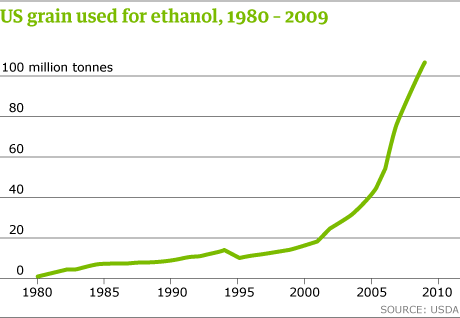
One-quarter of all the maize and other grain crops grown in the US now ends up as biofuel in cars rather than being used to feed people, according to new analysis which suggests that the biofuel revolution launched by former President George Bush in 2007 is impacting on world food supplies.

The 2009 figures from the US Department of Agriculture shows ethanol production rising to record levels driven by farm subsidies and laws which require vehicles to use increasing amounts of biofuels.

"The grain grown to produce fuel in the US [in 2009] was enough to feed 330 million people for one year at average world consumption levels," said Lester Brown, the director of the Earth Policy Institute, a Washington thinktank ithat conducted the analysis.

Last year 107m tonnes of grain, mostly corn, was grown by US farmers to be blended with petrol. This was nearly twice as much as in 2007, when Bush challenged farmers to increase production by 500% by 2017 to save cut oil imports and reduce carbon emissions.


Graph - US grain used to make ethanol

More than 80 new ethanol plants have been built since then, with more expected by 2015, by which time the US will need to produce a further 5bn gallons of ethanol if it is to meet its renewable fuel standard.

According to Brown, the growing demand for US ethanol derived from grains helped to push world grain prices to record highs between late 2006 and 2008. In 2008, the Guardian revealed a secret World Bank report that concluded that the drive for biofuels by American and European governments had pushed up food prices by 75%, in stark contrast to US claims that prices had risen only 2-3% as a result.

Since then, the number of hungry people in the world has increased to over 1 billion people, according to the UN's World Food programme.


["...the number of malnourished people in the world rose by 44 million in 2008," Oxfam said..."]


"Continuing to divert more food to fuel, as is now mandated by the US federal government in its renewable fuel standard, will likely only reinforce the disturbing rise in world hunger. By subsidising the production of ethanol to the tune of some $6bn each year, US taxpayers are in effect subsidising rising food bills at home and around the world," said Brown.

"The worst economic crisis since the great depression has recently brought food prices down from their peak, but they still remain well above their long-term average levels."

The US is by far the world's leading grain exporter, exporting more than Argentina, Australia, Canada, and Russia combined. In 2008, the UN called for a comprehensive review of biofuel production from food crops.

"There is a direct link between biofuels and food prices. The needs of the hungry must come before the needs of cars," said Meredith Alexander, biofuels campaigner at ActionAid in London. As well as the effect on food, campaigners also argue that many scientists question whether biofuels made from food crops actually save any greenhouse gas emissions.

But ethanol producers deny that their record production means less food. "Continued innovation in ethanol production and agricultural technology means that we don't have to make a false choice between food and fuel. We can more than meet the demand for food and livestock feed while reducing our dependence on foreign oil through the production of homegrown renewable ethanol," said Tom Buis, the chief executive of industry group Growth Energy.

Friday, 2 May 2008

tremonti: biofuels crime against humanity

Italy’s Tremonti Charges Al Gore’s Biofuels ‘Crime Against Humanity’

April 26, 2008 (EIRNS)—Incoming Italian Finance and Treasury Minister Giulio Tremonti yesterday denounced biofuels as « a crime against humanity, » and named Al Gore as the main political figure responsible for that crime.
Tremonti made these truthful remarks during a debate on Italian television on the end of globalization and the New Bretton Woods, with current Trade Minister Emma Bonino and Corriere della Sera editor Paolo Mieli. Both Tremonti and Bonino agreed that biofuels are a crime; however, when Bonino said « it was George W. Bush who pushed for that policy, » Tremonti replied:
« It seems to me that Al Gore is much more responsible for that policy. And by the way, people are important, but more important are ideologies. » Tremonti referenced « the head of an environmentalist cult in the United States, » giving the impression that he meant Al Gore.
Tremonti also continued his recent campaign on the urgency of calling a New Bretton Woods to establish a new international financial system, an idea recognized internationally as the brainchild of U.S. statesman Lyndon LaRouche.
« At the end of the war, political leaders, not technocrats, gathered together in Bretton Woods. They drafted a system of rules for the entire world. This system has functioned for forty years. There were trade rules, quotas, tariffs, etc. Let me remind you that for forty years, it was forbidden by us to import Japanese cars. Nevertheless, the Japanese industry developed. »
What was insane, was to introduce, first in 1995 and then in 2001, radical free-trade rules through the World Trade Organization (WTO), he said. We should have a new Bretton Woods conference. The Mount Washington Hotel is still there; you can see the pictures of the rooms in Google.
Against this, Emma Bonino felt compelled to say that as an EU Commissioner, she had introduced protective tariffs on shoes and electrical engines, in favor of Italian producers, but she went on to push depopulation as a solution to the food crisis, mentioning the « Soft Landing » organization of which she is a part, which calls for reducing the world’s population by more than two thirds, to only two billion!
Remarkably, Corriere della Sera editor Paolo Mieli, a British agent, recited a « mea culpa » on globalization, saying that he had been wrong to believe that something good could come out of « unbridled globalization. » Now, « I feel that we have an economic 9/11 coming, » he said, welcoming the fact that, with Tremonti now becoming Finance and Treasury Minister, this will be the main debate in Italy in the next five years.
Tremonti also used the occasion to relaunch his proposal for « European debt » to finance investments, quoting Alexander Hamilton on how the United States was built through state credit.

Tuesday, 8 April 2008

expect food riots says telegraph

daily telegraph

Soaring price of food ‘leads to riots’


By James Kirkup, Political Correspondent

2:45am BST 07/04/2008

Rising food prices threaten economic stability and could trigger riots, Gordon Brown has been warned.
The World Bank said this week that the price of staple foods has risen by 80 per cent in the past three years. For consumers in wealthy nations such as Britain soaring prices are squeezing household finances and keeping inflation up. But for developing nations they can lead to malnutrition and social disruption.
Food prices are being driven up by shortages of supply
- often caused by bad weather - and by rising demand.
advertisement
Mr Brown chaired the Progressive Governance Summit in Watford at the weekend and heard a string of warnings about the rising price of food.
António Guterres, the UN High Commissioner for Refugees, told the summit the cost of food is leading to riots. He said: « The biggest problem today is rising food prices in democratic countries everywhere. This can trigger social unrest. »
The summit drew together some of the world’s most important Left-of-centre politicians, including former US president Bill Clinton.
Many at the meeting blamed the price hikes on US and European Union moves to use biofuels such as ethanol to curb greenhouse gas emissions. Ethanol, an alternative to petrol, is made using corn and its increasing use has pushed up maize prices.
The EU wants biofuels to make up more than five per cent of transport fuel used by 2010, and the US may triple the amount of maize it uses for ethanol over the next decade.
But Mr Clinton said: « What’s really hurting the food markets is America moving into ethanol. People there are moving into corn and you have pasta riots in Italy related to what some people are doing in farming in America. »

Wednesday, 2 April 2008

hunger worldwide

A ‘perfect storm’ of hunger

The U.N.’s World Food Program is struggling as costs of food and fuel skyrocket while the numbers of people needing help surge across the globe. Millions are in danger.
By Edmund Sanders and Tracy Wilkinson, Los Angeles
Times Staff Writers

April 1, 2008

KHARTOUM, SUDAN—For 15 years, he’s been a « grocer » for Africa’s destitute. But he’s never seen anything like this.
Pascal Joannes’ job is to find grains, beans and oils to fill a food basket for Sudan’s neediest people, from Darfur refugees to schoolchildren in the barren south.

Lately Joannes has spent less time shopping and more time poring over commodity price lists, usually in disbelief.
« White beans at $1,160, » the white-haired Belgian, 52, cries in despair over the price of a metric ton. « Complete madness! I bought them two years ago in Ethiopia for $235. »
Joannes is head of procurement in Sudan for the World Food Program, the United Nations agency in charge of alleviating world hunger.
Meteoric food and fuel prices, a slumping dollar, the demand for biofuels and a string of poor harvests have combined to abruptly multiply WFP’s operating costs, even as needs increase. In other words, if the number of needy people stayed constant, it would take much more money to feed them. But the number of people needing help is surging dramatically. It is what WFP Executive Director Josette Sheeran calls « a perfect storm » hitting the world’s hungry.
The agency last month issued an emergency appeal for money to cover a shortfall tallied at more than half a billion dollars and growing. It said it might have to reduce food rations or cut people off altogether.
The most vulnerable are people like those in Sudan, whom Joannes is struggling to feed and who rely heavily, perhaps exclusively, on the aid. But at least as alarming, WFP officials say, is the emerging community of newly needy.
These are the people who once ate three meals a day and could afford nominal healthcare or to send their children to school. They are more likely to live in urban areas and buy most of their food in a market.
They are the urban poor in Afghanistan, where the government has asked for urgent help. They are families in Central America, who have been getting by on remittances from relatives abroad, but who can no longer make ends meet as the price of corn and beans nearly doubles.
« This is largely a new caseload, » John Aylieff, the emergency coordinator for the WFP’s assessment division, said at the agency’s Rome headquarters.
Aylieff and his staff assess the vulnerability of people in 121 countries. About 40 of the nations have been judged to be at risk of serious hunger, or already suffering from it.
The criteria include: how much does the country rely on imported food; how large is the urban population; what is the current rate of inflation, and what portion of their income do families spend on food (in Burundi, for example, it’s 77%; in the U.S. it’s 10%).
In the short term, officials predict food riots and political unrest, as has occurred in recent weeks in Pakistan, Indonesia and Egypt. In Egypt, shortages of government- subsidized bread recently triggered strikes, demonstrations and violence in which seven people died.
In the longer term, overall health worsens and education levels decline.
« Finally they end up selling their productive assets [and] that pretty much means they will remain economically destitute, even when things come back to normal, » said Arif Husain, senior program advisor for the assessment division, who recently moved to the WFP’s Rome headquarters after years in Sudan.
Countries are taking steps to avert widespread hunger. Some, like Egypt and Indonesia, have quickly expanded subsidies; others, like China, have banned exports of precious commodities.
Afghanistan was the first country to request urgent help. President Hamid Karzai in January asked the agency to feed an additional 2.5 million people, most of them urban poor, in addition to the 5 million rural people the agency already feeds.
In Kabul, the Afghan capital, Abdul Fatah and his wife Nooriya raise their five children on her teacher’s salary; he lost his government job a year ago.
« Life is getting harder day by day, » said Fatah, who is 45 but looks far older. « We cannot even buy meat once a month. »
The price of wheat in Afghanistan has risen by more than two-thirds in the last year. Because staples such as rice, oil and beans are also expensive, Fatah and his wife are sometimes unable to buy pens and notebooks for the children to use in school. Unable to afford both food and lamp oil, the household goes to sleep early.
Kabul homemaker Mahmooda Sharif, a mother of three, said that instead of eating meat twice a week, her family can now afford it only twice a month. The cost of food competes with school expenses and medical bills. She has delayed dental visits because she can’t afford them.
A world away in El Salvador, in hills that once yielded abundant harvests of coffee, signs of malnutrition are spreading.
Salvadorans need twice the money to buy the same amount of food they could purchase a year ago, meaning their nutritional sustenance is cut in half, the WFP says.
« My children ask for food, and how can I not feed them? They ask for some eggs, beans, and I give it to them, » said Maria De Las Mercedes Ramirez, a 41-year-old mother of five. « I, as the mother, will eat less. »
The Ramirezes are one of about 70 families living in shacks on a desolate coffee plantation near the town of Taltapanca, abandoned more than a decade ago when coffee prices took a dive. Most of the families are run by mothers; the fathers have left to find work in the Salvadoran capital, or out of the country.
Ramirez lives on about $80 a month that comes from wages her husband sends and the little she can eke from an occasional job pruning coffee plants. What Ramirez spends on corn has shot up more than 50% in the last few months, cooking oil is up 75%, and beans have doubled in price.
Many families rely heavily on schools that give students one meal a day.
« You can see a lot of concern in their faces when they come to pick up their kids, » principal Delsy Amilia Chavez said of the mothers. « And some of the mothers are anemic. They can’t afford to eat beans and aren’t getting the iron they need. »
The school meals are provided by the WFP, but the agency is transferring the program to the government and reports that some schools have been unable to continue them.
Carlo Scaramella, the WFP country director in El Salvador, said hurricanes and drought last year added an additional 160,000 people to the 100,000 that the agency was already feeding. One million are at risk, he said.
In Egypt, President Hosni Mubarak ordered army-owned bakeries that produce 1.2 million loaves a day to pour more bread onto the general market.
The government also allocated almost $1 billion to bread subsidies for 2008. It subsidizes 210 million loaves of flat round bread a day, the main item on most Egyptians’ daily menu. As commodity prices soared, subsidized bread became precious, and fights broke out in queues at bakeries and stores.
The price of unsubsidized bread has gone up 10 times, and rice doubled in a single week, said Farag Wahba Ahmed, an official with Egypt’s Chamber of Commerce.
In Sudan, where the WFP oversees the largest emergency food operation in the world, aid officials are drafting contingency plans for coping with a smaller supply. In Darfur, especially, they must tread carefully.
« There’s no way we can come in and say, ‘We have no more food,’ « Joannes said. « It would create riots. »
Darfur, the beleaguered region in western Sudan, accounts for three-fourths of the WFP’s operation here, which in total distributes 632,000 metric tons of food valued at $700 million to 5.6 million people (more than in Afghanistan, Bangladesh and Indonesia combined).
The WFP has sought to lower costs by turning to regional markets to buy food. Buying from local farmers helps the budget since it eliminates shipping costs. But because the WFP is such a big buyer, it has to be careful not to distort the market.
A 30% increase in costs in Sudan in the last four months is blamed chiefly on rising prices for locally produced sorghum. The WFP is already absorbing 6% of the national production and fears that buying more would destabilize the market.
Joannes boasts that he found a good deal recently on a mix of lentils from Ethiopia, buying them for only $700 a metric ton, far less than the going rate for white beans. But bargains are hard to find.
Back in Rome, Nicole Menage, head of the food procurement service, receives daily, sometimes hourly, reports on rising prices and falling reserves. It’s like a mammoth board game, with multiple moving pieces.
She and her associates last year managed to find in China 12,000 tons of maize needed urgently in nearby North Korea. Then, suddenly, China slapped on an export ban and the agency ended up finding the maize in Tanzania.
« The only tool we have is to stretch the net as far as possible, » she said.

edmund.sanders@latimes.com
wilkinson@latimes.com

Sanders reported from Khartoum and Wilkinson from Rome. Special correspondent M. Karim Faiez in Kabul, Noha El-Hennawy of The Times’ Cairo Bureau and special correspondent Alex Renderos in Taltapanca contributed to this report.

Saturday, 8 March 2008

food riots spread in africa, america and asia

The Times

March 7, 2008

Already we have riots, hoarding, panic: the sign of things to come?


Carl Mortished, World Business Editor

The spectre of food shortages is casting a shadow across the globe, causing riots in Africa, consumer protests in Europe and panic in food-importing countries. In a world of increasing affluence, the hoarding of rice and wheat has begun. The President of the Philippines made an unprecedented call last week to the Vietnamese Prime Minister, requesting that he promise to supply a quantity of rice.
The personal appeal by Gloria Arroyo to Nguyen Tan Dung for a guarantee was a highly unusual intervention and highlighted the Philippines’ dependence on food imports, rice in particular.
“This is a wake-up call,” said Robert Zeigler, who heads the International Rice Research Institute. “We have a crisis brewing in rice supply.” Half of the planet depends on rice but stocks are at their lowest since the mid1970s when Bangladesh suffered a terrible famine. Rice production will fall this year below the global consumption level of 430 million tonnes.
Street protests and rioting in West Africa towards the end of last year were a harbinger of bigger problems, the World Food Programme said. The global information and early warning system of the Food and Agricultural Organisation (FAO) has monitored outbreaks of rioting in Mexico, Morocco, Uzbekistan, Yemen, Guinea, Mauritania and Senegal. There have also been protests in Jakarta, the Indonesian capital, over government price increases.Population pressure and increased wealth are mainly to blame for the resurgence of food insecurity. More people are eating meat and dairy products in Asia, which increases the demand on the animal-feed industry. Milk powder prices rose from $2,000 to $4,800 per tonne last year as rising consumption of milk products in Asia coincided with shortages in the Western world. Drought in Australia has worsened the problem as have government policies in Europe and America to increase the use of biofuels.
Price rises feed through to shopping basket Biofuels cannot save the planet Mounting concern about rice has prompted the Indian Government to restrict exports of certain varieties. The measure triggered a surge in global rice prices, which have risen 50 per cent in a year, according to the FAO. The rice shortage is even felt in Britain where the price of basmati, the biggest-selling variety, is rising rapidly.
Wheat is suffering even greater pressures, with prices up 115 per cent in a year. A succession of droughts in Australia has put upward pressure on the cost of a food commodity that is already in short supply. Stocks are at a 40-year low and exports are being restricted from Beijing to Buenos Aires. Ukraine started closing its door to grain exports in June and Russia set a 40 per cent export tariff on wheat in January.
Argentina has delayed the reopening of its wheat export registry until April to protect domestic supplies, and China, a net exporter of corn, rice and wheat last year, has imposed export quotas on grain in order to stem runaway food price inflation. A surge in its inflation index in December was blamed entirely on rising food prices, notably pork, which rose 48 per cent.
Farmers worldwide are worried about feed costs. In Europe pig and poultry breeders are threatening to cut production unless they are paid higher prices.

Monday, 3 March 2008

biofuels leading to food shortages

.
Food and the spectre of Malthus


By Mark Thirlwell

Published: February 26 2008 17:53

February has been the month for revisiting old and unpleasant economic concepts. Last week, financial markets experienced that 1970s feeling, as a combination of rising inflation and unemployment in the US triggered unwelcome memories of the decade of stagflation that ended the postwar golden age and the Keynesian consensus. Then came this week’s report that the United Nations’ world food programme might have to ration food aid. Set against a backdrop of rising food prices worldwide – global food prices have now risen by more than 75 per cent since their lows of 2000, jumping more than 20 per cent in 2007 alone – the news revived fears from a much earlier era, conjuring up the Reverend Thomas Malthus.
Soaring food prices have also revived some more contemporary worries. When China’s annual inflation rate spiked to an 11-year high in January on the back of an 18 per cent increase in food prices, China-watchers found themselves casting their minds back to the food price rises of 1988 and the social disturbances, protests and civil unrest that followed. Inflation is often cited as one of the factors behind the major demonstrations in 1989.
This rise in prices is a consequence of both demand and supply trends. On the demand side, the key factor has been the strong consumption growth in emerging markets, which in turn has been powered by those countries’ impressive income gains. China, for example, has accounted for up to 40 per cent of the increase in global consumption of soyabeans and meat over the past decade. At the same time, a series of supply-side disruptions in key commodity markets ranging from drought to disease have been at work.
Perhaps the most important drivers of price gains over the past year are developments in world energy markets. High oil prices have encouraged a policy focus on biofuels, including lashings of generous financial support. Production has responded quickly to these incentives: the World Bank reports that the US has used 20 per cent of its maize production for biofuels and the European Union 68 per cent of its vegetable oil production. This change in usage has boosted prices, reduced the supply of these crops available for food and encouraged the substitution of other agricultural land from food to biofuel production.
This is not the first time in modern economic history that the Malthusian spectre of global food shortages has stalked the world economy. Surges in food prices in the 1970s and then again in the mid-1990s both prompted warnings that agricultural capacity was failing to keep pace with a growing world population. Each time, the prices jumped it proved to be temporary as supply responded. There are good reasons for believing that this latest bout of market disequilibrium will ultimately reach the same resolution. That said, however, there are two important caveats to set against such an optimistic reading of current circumstances.
First, the lag in supply response to the stimulus provided by higher prices may prove to be of greater duration than its predecessors, to the extent that the current changes in world energy markets – and hence the associated demand for biofuels – are likely to be lasting ones. With climate change and environmental degradation threatening agricultural capacity in several key regions, the elasticity of past supply responses may prove to be a poor guide to the future.
Second, during the extended period in which supply continues to lag behind demand there are likely to be significant social and economic costs. Three in particular stand out.
Most important, a period of protracted higher food prices will be bad news for many of the world’s poorest people and its poorest economies. While the share of food in the consumption basket of a rich country such as the US is relatively low, at about 10 per cent, it averages about 30 per cent in China and more than 60 per cent in sub-Saharan Africa. Those countries that are most vulnerable are the low-income net food importers. Higher food prices add more strain to import bills that have often already been stretched by higher energy prices. Several of the poorest economies fall into this category and are heavily dependent on food aid to meet their needs. But the worldwide volume of such aid has stagnated for the past two decades and, what is worse, the quantity of aid delivered tends to fall as prices rise, given that a large proportion comprises a fixed annual dollar amount.
Next, there are important social strains to be managed. These may be particularly problematic for those emerging markets that are already struggling to deal with the consequences of growing inequality. Granted, higher food prices are something of a two-edged sword here, since higher agricultural earnings could reduce rural-urban income disparities. But the big losers are likely to be the urban poor, typically a politically volatile group, while many of the rural poor will also suffer.
Finally, higher food prices will call for tighter monetary policy. Given the disparity in the share of food in consumption baskets, and the fact that rich country central banks tend to exclude food prices from their core inflation measures, the policy reaction will tend to be greater in developing economies. Authorities may also be tempted by price controls and other direct measures. However, rich country central banks will also have to keep a close watch on any spillover effects that tighter monetary policy could have on non-food prices.
The writer is director of the international economy
programme at the Lowy Institute for International
Policy in Sydney
Copyright The Financial Times Limited 2008

Friday, 8 February 2008

oil prices fuel famine

source: daily telegraph

Why the price of ‘peak oil’ is famine

By Ambrose Evans-Pritchard International Business
Editor

11:31am GMT 08/02/2008


Vulnerable regions of the world face the risk of famine over the next three years as rising energy costs spill over into a food crunch, according to US investment bank Goldman Sachs.
« We’ve never been at a point in commodities where we are today, » said Jeff Currie, the bank’s commodity chief and closely watched oil guru.
Global oil output has been stagnant for four years, failing to keep up with rampant demand from Asia and the Mid-East. China’s imports rose 14pc last year. Biofuels from grain, oil seed and sugar are plugging the gap, but drawing away food supplies at a time when the world is adding more than 70m mouths to feed a year.
« Markets are as tight as a drum and now the US has hit the stimulus button, » said Mr Currie in his 2008 outlook. « We have never seen this before when commodity prices were already at record highs. Over the next 18 to 36 months we are probably going into crisis mode across the commodity complex.
« The key is going to be agriculture. China is terrified of the current situation. It has real physical shortages, » he said, referencing China still having memories of starvation in the 1960s seared in its collective mind.
While the US housing crash poses some threat to the price of metals and energy, the effect has largely occurred already. The slide in crude prices over the past month may have been caused by funds liquidating derivatives contracts to cover other demands rather than by recession fears. Goldman Sachs forecasts that oil will be priced at $105 a barrel by the end of 2008.
advertisementThe current « supercycle » is a break with history because energy and food have « converged » in price and can increasingly be switched from one use to another.
Corn can be used for ethanol in cars and power plants, for plastics, as well as in baking tortillas. Natural gas can be made into fertiliser for food output. « Peak Oil » is morphing into « Peak Food ».
Land use for biofuels has shot up from 12m to more than 80m hectares worldwide over six years. Biofuel provides 3pc of global energy needs, which will rise to an estimated 10.6pc by 2030.
In a pure market, sugar cane would be the only viable
biofuel with a cost of $35 a barrel (oil equivalent). The others are sugar beet ($103), corn ($81), wheat ($145), rapeseed ($209), soybean ($232), cellulose ($305).
Subsidies drive the business. The US offers tax relief of $1 a gallon for biodiesel. The EU has a 10pc biofuel target by 2010.

The crop switch comes just as China and India make the leap to an animal-based diet, replicating the pattern seen in Japan and Korea, where people raised their protein intake nine-fold as they became rich. It takes 8.3 grams of soya or corn feed to produce a 1g weight gain in cattle - compared with 3.1g for pigs, 2g for chicken and 1.5g for fish.
Mr Currie said investment cycles in energy typically last about 10 to 12 years as producers struggle to catch up with demand. However, this cycle has been short-circuited by politicians after barely six years.
« The political environment is extremely hostile. The world is looking like the 17th century under mercantilism when countries saw economics as a zero-sum game. They exported as much as they could to get gold, and erected enormous barriers. China looks like that, so does Russia, the Mid-East and most of Africa and Latin America, » he said.
While the West has much of the skill for developing energy projects, it is blocked by nationalist petro-states from investing directly.

Monday, 14 January 2008

eu biofuels policy running dry

EU rethinks biofuels guidelines

By Roger Harrabin

Environment Analyst, BBC News

Europe’s environment chief has admitted that the EU did not foresee the problems raised by its policy to get 10% of Europe’s road fuels from plants. Recent reports have warned of rising food prices and rainforest destruction from increased biofuel production.
The EU has promised new guidelines to ensure that its target is not damaging.
EU Environment Commissioner Stavros Dimas said it would be better to miss the target than achieve it by harming the poor or damaging the environment.
Clampdown promised
A couple of years ago biofuels looked like the perfect get-out-of-jail free card for car manufacturers under pressure to cut carbon emissions.
Instead of just revolutionising car design they could reduce transport pollution overall if drivers used more fuel from plants which would have soaked up CO2 while they were growing.

The EU leapt at the idea - and set its biofuels targets.

Since then reports have warned that some biofuels barely cut emissions at all - and others can lead to rainforest destruction, drive up food prices, or prompt rich firms to drive poor people off their land to convert it to fuel crops.
« We have seen that the environmental problems caused by biofuels and also the social problems are bigger than we thought they were. So we have to move very carefully, » Mr Dimas told the BBC.
« We have to have criteria for sustainability, including social and environmental issues, because there are some benefits from biofuels. »

He said the EU would introduce a certification scheme for biofuels and promised a clampdown on biodiesel from palm oil which is leading to forest destruction in Indonesia.
Some analysts doubt that « sustainable » palm oil exists because any palm oil used for fuel simply swells the demand for the product oil on the global market which is mainly governed by food firms.
US expansion
Mr Dimas said it was vital for the EU’s rules to prevent the loss of biodiversity which he described as the other great problem for the planet, along with climate change.
On Monday, the Royal Society, the UK’s academy of science, is publishing a major review of biofuels. It is expected to call on the EU to make sure its guidelines guarantee that all biofuels in Europe genuinely save carbon emissions.
In the US the government has just passed a new energy bill mandating a major increase in fuel from corn, which is deemed by some analysts to be useless in combating rising carbon dioxide emissions.
The bill also foresees a huge expansion in fuel from woody plants but the technology for this is not yet proven.

http://news.bbc.co.uk/go/pr/fr/-/2/hi/europe/7186380.stm

Published: 2008/01/14 00:49:29 GMT
© BBC MMVIII

Thursday, 13 December 2007

food vs. energy

washingtonpost.com

Food vs. Fuel


By Robert J. Samuelson

Wednesday, December 12, 2007; A29

If people can’t eat, they can’t do much else. One of the great achievements of the past century has been the enormous expansion of food production, which has virtually eliminated starvation in advanced countries and has made huge gains against it in poor countries. Since 1961, world population has increased 112 percent; meanwhile, global production is up 164 percent for grains and almost 700 percent for meats. We owe this mainly to better seed varieties, more fertilizer, more mechanization and better farm practices. Food in most developed countries is so plentiful and inexpensive that obesity—partly caused by overeating—is a major social problem.
But the world food system may now be undergoing a radical break with this past. « The end of cheap food » is how the Economist magazine recently described it. During the past year, prices of basic grains (wheat, corn) and oilseeds (soybeans) have soared. Corn that had been selling at about $2 a bushel is now more than $3; wheat that had been averaging $3 to $4 a bushel has recently hovered around $9. Because feed grains are a major cost in meat, dairy and poultry production, retail prices have also risen. In the United States, dairy prices are up 13 percent in 2007; egg prices have risen 42 percent in the past year. Other countries are also experiencing increases.
Higher grocery prices obviously make it harder to achieve economic growth and low inflation simultaneously. But if higher food prices encouraged better eating habits, they might actually have some benefits in richer societies. The truly grave consequences involve poor countries, where higher prices threaten more hunger and malnutrition.
To be sure, some farmers in these countries benefit from higher prices. But many poor countries— including most in sub-Saharan Africa—are net grain importers, says the International Food Policy Research Institute, a Washington-based think tank. In some of these countries, the poorest of the poor spend 70 percent or more of their budgets on food. About a third of the population of sub-Saharan Africa is undernourished, according to the Food and Agriculture Organization of the United Nations. That proportion has barely changed since the early 1990s. High food prices make gains harder.
What’s disturbing is that the present run-up doesn’t seem to be temporary. Of course, farming is always hostage to Mother Nature, and drought in Australia has cut the wheat harvest and contributed to higher worldwide prices. But the larger causes lie elsewhere. One is growing prosperity in China, India, other Asian countries and Latin America. As people become richer, they improve their diets by eating more protein in the form of meat and dairy products. The demand for animal feed grains rises. This has been going on for years and, until recently, was met by the steady gains in agricultural output from improved technology and management.
It’s the extra demand for grains to make biofuels, spurred heavily in the United States by government tax subsidies and fuel mandates, that has pushed prices dramatically higher. The Economist rightly calls these U.S. government subsidies « reckless. » Since 2000, the share of the U.S. corn crop devoted to ethanol production has increased from about 6 percent to about 25 percent—and is still headed up.
Farmers benefit from higher prices. Up to a point, investors in ethanol refineries also gain from the mandated use of their output (though high corn prices have eroded or eliminated their profits). But who else wins is unclear. Although global biofuel production has tripled since 2000, it still accounts for less than 3 percent of worldwide transportation fuel, reports the U.S. Agriculture Department. Even if all U.S. corn were diverted into ethanol, it would replace only about 12 percent of U.S. transportation fuel (and less of total oil use), according to one study.
Biofuels became politically fashionable because they combined benefits for farmers with popular causes: increasing energy « security »; curbing global warming. Unfortunately, the marriage is contrived. Not only are fuel savings meager, so are the environmental benefits. Substituting corn-based ethanol for gasoline results in little reduction in greenhouse gases. Indeed, the demand for biofuels encourages deforestation in developing countries; the New York Times recently reported the clearing of Indonesian forests to increase palm oil production for biofuel. Forests absorb carbon dioxide, a greenhouse gas.
This is not a case of unintended consequences. A new generation of « cellulosic » fuels (made from grasses, crop residue or wood chips) might deliver benefits, but the adverse effects of corn-based ethanol were widely anticipated. Government subsidies reflect the careless and cynical manipulation of worthy public goals for selfish ends. That the new farm bill may expand the ethanol mandates confirms an old lesson:
Having embraced a giveaway, politicians cannot stop it, no matter how dubious.

Thursday, 29 November 2007

hicups with ethanol and biofuels

http://online.wsj.com/article/SB119621238761706021.html

Ethanol Craze Cools As Doubts Multiply

Claims for Environment, Energy Use Draw Fire; Fighting on the Farm


Little over a year ago, ethanol was winning the hearts and wallets of both Main Street and Wall Street, with promises of greater U.S. energy independence, fewer greenhouse gases and help for the farm economy. Today, the corn-based biofuel is under siege.

In the span of one growing season, ethanol has gone from panacea to pariah in the eyes of some. The critics, which include industries hurt when the price of corn rises, blame ethanol for pushing up food prices, question its environmental bona fides and dispute how much it really helps reduce the need for oil.

[chart]

A recent study by the Organization for Economic Cooperation and Development concluded that biofuels "offer a cure [for oil dependence] that is worse than the disease." A National Academy of Sciences study said corn-based ethanol could strain water supplies. The American Lung Association expressed concern about a form of air pollution from burning ethanol in gasoline. Political cartoonists have taken to skewering the fuel for raising the price of food to the world's poor.

Last month, an outside expert advising the United Nations on the "right to food" labeled the use of food crops to make biofuels "a crime against humanity," although the U.N. Food and Agriculture Organization later disowned the remark as "regrettable."

The fortunes of many U.S. farmers, farm towns and ethanol companies are tied to corn-based ethanol, of which America is the largest producer. Ethanol is also a cornerstone of President Bush's push to reduce dependence on foreign oil. But the once-booming business has gone in the dumps, with profits squeezed, plans for new plants shelved in certain cases, and stock prices hovering near 52-week lows.

Now the fuel's lobby is pleading with Congress to drastically boost the amount of ethanol that oil refiners must blend into gasoline. But formidable opponents such as the livestock, packaged-food and oil industries also have lawmakers' ears. What once looked like a slam-dunk could now languish in pending energy legislation that might not pass for weeks, if ever.

Ethanol's problems have much to do with its past success. As profits and production soared in 2005 and 2006, so did the price of corn, gradually angering livestock farmers who need it for feed. They allied with food companies also stung by higher grain prices, and with oil companies that have long loathed subsidies for ethanol production.

The U.S. gives oil refiners an excise-tax credit of 51 cents for every gallon of ethanol they blend into gasoline. And even though it's the oil industry that gets this subsidy, the industry dislikes being forced to use a nonpetroleum product. The U.S. ethanol industry is further protected by a 54-cent tariff on every gallon of imported ethanol.

Ethanol prices peaked at about $5 a gallon in some markets in June 2006, according to Oil Price Information Service. The price soon began to slide as the limited market for gasoline containing 10% ethanol grew saturated. New plants kept coming online, increasing supply and dropping prices further. Today, the oil refiners that purchase ethanol to blend in need pay only about $1.85 a gallon for it.

The low ethanol prices help some oil refiners. "I'd pay a hell of a lot more for ethanol than I am right now.... I'm getting a windfall because it's priced so much less than its value to me," Lynn Westfall, chief economist for refiner Tesoro Corp., told investors recently. The ethanol tax credit will bring refiners an estimated $3.5 billion this year. Some oil companies use ethanol to stretch gasoline supplies or meet state requirements to make gasoline burn more cleanly. Ethanol that's voluntarily blended into gasoline reached a high this month, according to the Energy Information Administration.

The low prices reflect soaring output. Global ethanol production has grown to a projected 13.4 billion gallons this year, from 10.9 billion gallons in 2006, according to the International Energy Agency. The U.S. production is more than half of that total, or about seven billion gallons this year, up 80% in two years. It equals less than 4% of U.S. gasoline consumption.

Analysts expect U.S. production capacity to keep growing, encouraged both by high oil prices and by the hope that Congress will stiffen the mandate for refiners to use ethanol. Some observers regard the profit squeeze as part of an ordinary industry shakeout that will ultimately leave the best producers in a position to thrive. As ethanol prices were pushed lower and corn prices stayed high, ethanol profit margins dropped from $2.30 per gallon last year to less than 25 cents a gallon.

Turning Up the Heat

This year, even as the production glut was driving down ethanol's price, critics and opposing lobbyists were turning up the heat. Environmentalists complained about increased use of water and fertilizer to grow corn for ethanol, and said even ethanol from other plants such as switchgrass could be problematic because it could mean turning protected land to crop use. Suddenly, environmentalists, energy experts, economists and foreign countries were challenging the warm-and-fuzzy selling points on which ethanol rose to prominence.

"Our love affair with ethanol has finally ended because we've taken off the makeup and realized that, lo and behold, it's actually a fuel," with environmental and various other drawbacks, says Kevin Book, an analyst at Friedman, Billings, Ramsey Group Inc.

[Bob Dinneen]

Against all the criticism and lobbying, "we're David in this fight," says Bob Dinneen, the ethanol industry's top lobbyist. Mr. Dinneen says the industry has been made a scapegoat for food price increases that are due to many factors, including higher oil prices and growing overseas demand for grain. He also faults the lack of a mature U.S. distribution network that would make it easier for consumers to get ethanol. His group, called the Renewable Fuels Association, and the National Corn Growers Association have formed a coalition to "unify the voices" in the ethanol community, he says.

Back in early 2005, President Bush gave ethanol a boost in his State of the Union speech by calling for "strong funding" of renewable energy. Energy legislation that summer required oil companies to blend a total of 7.5 billion gallons of "renewable" fuels into the nation's fuel supply by 2012. The legislation also effectively extinguished ethanol's chief competitor as a clean-burning additive, methyl tertiary-butyl ether, which had groundwater-pollution issues. The bill anointed ethanol as the default additive and instantly created demand nearly double what was produced that year.

"That was when the floodgates started coming open," says attorney Dan Rogers of the Atlanta law firm King & Spalding LLP, which arranges financing for ethanol plants. Hedge funds, private-equity investors and East Coast bankers started pouring money into ethanol. Producers such as VeraSun Energy Corp. and Pacific Ethanol Inc. went public. Mr. Dinneen, the lobbyist, hopscotched the country attending ribbon-cuttings at new plants that popped up in corn-growing states.

Local farmers who'd invested soon were cashing handsome dividend checks, even as new demand pushed up the price of corn. After languishing roughly in the $2-a-bushel range for three decades, corn jumped to above $4 early in 2007. So far this year, it's averaging $3.35.

In the past, livestock farmers supported ethanol because it was good for the overall farm economy. But now they began to complain that the higher corn price cut sharply into their profits. A meat-producer trade group called the American Meat Institute took a stand against federal support for biofuels last December, joined soon after by the National Turkey Federation and the National Cattlemen's Beef Association.

The farm fissure widened when livestock, meat and poultry groups started coordinating their lobbying with the oil industry, in discussions helped along by former Texas Congressman Charles Stenholm, who now lobbies for both industries.

Packaged-food companies, too, began pushing back, as one after another blamed biofuels' effect on grain costs for hurting earnings. In June, Dean Foods Co., H.J. Heinz Co., Kellogg Co., Nestle USA, PepsiCo Inc. and Coca-Cola Co. sent a letter to senators saying that requiring greater use of ethanol would affect their "ability to produce competitively available, affordable food."

Ethanol's opponents also began to highlight reasons why ethanol might not be such a boon to the environment, citing some recent research studies.

Strain on Water Supplies

One by the National Research Council said additional ethanol production could strain water supplies and impair water quality. A spring 2007 report by the Environmental Protection Agency said that "ozone levels generally increase with increased ethanol use."

A study coauthored by Nobel-prize-winning chemist Paul Crutzen said corn ethanol might exacerbate climate change as the added fertilizer used to grow corn raised emissions of a very potent greenhouse gas called nitrous oxide. The ethanol industry replies to that one with an Energy Department study concluding that use of ethanol reduces greenhouse-gas emissions by 18% to 28% on a per-gallon basis, provided that coal isn't used to run ethanol plants.

Opponents of ethanol also have hammered on an Agriculture Department projection that by 2010, less than 8% of the U.S. gasoline supply will come from corn-based ethanol -- and 30% of the corn crop will be used to make it. That suggests to some that the tradeoff between food and fuel is unbalanced.

At the same time, some foreign countries have been increasingly questioning ethanol. Mexico blamed it in part for contributing to rising prices of corn-based tortillas. China barred new biofuel plants from using corn, and Malaysia trimmed its biofuels production mandates. Cuban President Fidel Castro has called using food crops for fuel a "sinister idea." President Hugo Chávez of Venezuela ordered troops to secure his oil-producing nation's grain supplies, saying corn was to be used for food, not fuel.

The government of Quebec, which has offered loan guarantees for corn ethanol plants, recently decided not to initiate any new ones. Instead it will turn its attention to so-called cellulosic ethanol, which would be made from switchgrass, wood chips or other plant matter. It concluded that "the environmental costs of corn ethanol are higher than expected," says a spokesman for the province's minister of natural resources.

In recent months, U.S. lawmakers appear to have become more receptive to the anti-ethanol arguments. "People never thought they would have to make a trade between energy security and food security," says Jesse Sevcik, a lobbyist for the ethanol-opposing American Meat Institute.

The ethanol industry, accustomed to getting its way in Washington, hadn't faced such opposition before. It may not have helped that Mr. Dinneen, in a close echo of former Vice President Spiro Agnew's famous line, for months brushed off his foes as "nattering nabobs of negativity."

Mr. Dinneen says arguments about ethanol driving up food costs are overblown, in part because corn farmers will produce so much grain that corn prices will ease. But even though U.S. farmers this year planted their biggest crop since World War II, prices have stayed well above $3 a bushel, thanks to rising demand in developing countries and poor weather in some grain-growing nations. The price is expected to stay well above $3 next year as farmers shift some land from corn to two other crops whose prices have risen sharply, wheat and soybeans.

Bigger Plants

New and bigger ethanol plants, spurred by money from investors far from the Corn Belt, have contributed to production capacity that's expected to approach 12 billion gallons next year. But annual U.S. demand stands at just under 7 billion gallons.

So it's easy to see why the industry supports the Senate version of pending energy legislation, which includes a requirement that gasoline blenders use 36 billion gallons of renewable fuels by 2022. Up to 15 billion gallons of this would come from corn-based ethanol. The rest would come from cellulosic ethanol -- an industry that now barely exists -- or other fuels. A similar bill passed in the House has no such provision.

Mr. Dinneen, who has been lobbying on ethanol so long he's known as the "reverend of renewable fuels," says he's "reasonably confident" Congress will raise the ethanol mandate. He says he's talking with the military, labor groups, Southern black churches and others about how ethanol can help them. "We've got to build the biggest, baddest coalition we can."

[chart]

Write to Lauren Etter at lauren.etter@wsj.com

Hyperlinks in this Article:
(1) http://forums.wsj.com/viewtopic.php? t=1023
(2) http://forums.wsj.com/viewtopic.php? t=1023
(3) mailto:lauren.etter@wsj.com


Copyright 2007 Dow Jones & Company, Inc. All Rights Reserved This copy is for your personal, non-commercial use only.