Will the current crisis in Kyrgyzstan lead to greater instability, and perhaps an expansion of the current conflict in Central Asia? There are good reasons to be concerned. Deep forces, not adequately understood, are at work there; and these forces have repeatedly led to major warfare in the past.
The pattern of events unfolding in Kyrgyzstan is ominously reminiscent of how America became involved in Laos in the 1960s, and later in Afghanistan in the 1980s. American covert involvement in those countries soon led to civil wars producing numerous casualties and refugees. It will take strenuous leadership from both Obama in Washington and Medvedev in Moscow to prevent a third major conflict from breaking out in Kyrgyzstan.
I call the pattern I refer to “a Laotian syndrome” of coups, drugs, and terror, since it was first clearly illustrated by American interventions in Laos in the late 1950s and 1960s. The syndrome involves a number of independent but interactive elements whose interconnection in the past has not generally been recognized. What it reflects is not a single agenda, but a predictable symbiosis of divergent groups, responding to the powerful forces that the drug traffic creates.
In this syndrome, something like the following pattern emerges.
1) Covert U.S. activity results in the ousting of a moderate government, and its replacement by a more corrupt and unpopular one, unsupported by the culture of the country on which it is imposed.
2) A successor regime, to maintain its uncertain grip on power, intensifies its control over the local drug traffic.
3) This control involves collaboration with local drug mafias, leading to their expansion.
4) The flow of drugs from the country (or through, in the case of Kyrgyzstan) increases significantly.
5) Eventually, in the context of weakened legitimacy and strengthened illegitimacy, a successor government is ousted.
6) What ensues is a violent civil war.
7) The final outcome is a government not to America’s liking.
The pattern does not repeat itself identically. In Laos, CIA intrigue and money in 1959 produced an unpopular pro-American regime under right-wing general Phoumi Nosavan, which lasted eighteen months.1 Similar CIA intrigues in Afghanistan two decades later completely backfired, and produced instead an equally unpopular anti-American regime under Nur Mohammed Taraki, which lasted sixteen months.2
But the root problem was the same: the CIA’s gratuitous destabilization of an inoffensive country encouraged local intrigues and paranoia, and soon produced an unstable and divisive government without a popular base. Eventually a resulting weakened government (the next in Laos, a little later in Afghanistan) favored both drug and terrorist activity in its territory, as predictably as a pine forest weakened by drought will invite an infestation of beetles.
The longer-term result was a country where civil politics had been replaced by civil war. In the case of Laos and Afghanistan U.S. covert activity, waged as part of the Cold War, produced Soviet military and intelligence responses. (It may, in the case of Afghanistan, have been designed to produce such responses.) Former Carter advisor Zbigniew Brzezinski, who authorized the CIA’s covert Afghan operations of 1978-79, later boasted to a French newspaper:
The secret operation was an excellent idea. It drew the Russians into the Afghan trap and you want me to regret it? On the day that the Soviets officially crossed the border, I wrote to President Carter, saying, in essence: 'We now have the opportunity of giving to the USSR its Vietnam War.'"...
When asked whether Islamic fundamentalism represented a world menace, Brzezinski replied, "Nonsense!"3
The last decade of Kyrgyz history suggests that U.S. and Russian covert operators have continued to tussle in the “great game” of dominating the Central Asian heartland. And once again, while the leaders of both countries to evolve common policies for Kyrgyzstan, there may be bureaucrats below them who harbor more belligerent intentions.
Central Asia
To the general public, it would seem obvious that none of these developments have been in the interests of either America or the world. Yet American agencies have still not learned from the obvious fiasco of their Laotian venture, which resulted in a huge increase in opium production, before this peaceful Buddhist nation ceased (thanks to American efforts) to be neutralist, and instead became nominally Communist.
America’s destabilization of remote Laos, a neutral and harmless nation, was in accordance with the ideological doctrine being peddled in a book by three policy hawks at the time: A Forward Strategy for America, by Robert Strausz-Hupé. William R. Kintner and Stefan T. Possony. The book rejected coexistence as a foreign policy, and argued for “a strategy of active pressures directed against the communist bloc,” wherever it was seen to be vulnerable.
The American sponsored “Tulip Revolution” in Kyrgyzstan (March 2005) is a conspicuous product of the forward strategy doctrine. This is no accident: it came at a time when George W. Bush repeatedly spoke of a “forward strategy of freedom,” or a “forward strategy for freedom.”4 But by the 21st century the forward strategy in countries with drug economies had a track record, which its advocates in Washington might well have reviewed before advocating an intervention so close to both Russia and China.
In 1959 the CIA attempted to impose a right-wing government in Laos: after a decade and a half of expanding drug trafficking and a futile, bloody, drug-financed war, Laos became (at least nominally) a communist nation. Undeterred by the dismal outcome in Laos, in 1978-79 Zbigniew Brzezinski, Robert Gates, and the CIA mobilized right-wing elements again in Afghanistan, another nation contiguous to the then Soviet Union.5 The immediate result was the same as Laos: the replacement of a neutralist regime by a radical and polarizing one (in this case communist), followed by another radical increase in drug trafficking, and another decade of bloody and unsuccessful war.
What were the forward strategists hoping for in Kyrgyzstan? In April of this year the unpopular regimeinstalled by the 2005 Tulip Revolution was itself replaced. Although it is too early to predict the outcome of these dislocations, thousands of lives have been lost in the ethnic violence of June 2010, and drug traffickers are apparently profiting from the near anarchy to consolidate their hold on southern Kyrgyzstan. That is just what happened to Laos in 1959; it is what Jimmy Carter’s drug advisor David Musto warned would happen in Afghanistan in 1980.6 Did someone want it to happen again?
All in all, the coup-drug-terror syndrome in Kyrgyzstan well illustrates the Marxist dictum that history repeats itself, first as tragedy (Afghanistan in 1978-80), and the second time as farce.
The Coup-Drug-Terror Syndrome in Kyrgyzstan
After the break-up of the former Soviet Union in 1991, Kyrgyzstan, under the leadership of Askar Akayev, was relatively the most moderate and open government among the six post-Soviet “stans” of Central Asia. Alone among the successor strong men, Akayev was not a long-time Communist Party apparatchik, but an intellectual who read Heine, a physicist, “a researcher in St Petersburg and an associate of legendary Russian physicist and dissident Andrei Sakharov.”7
It is true that Akayev’s initial efforts to make Kyrgyzstan an open and pluralistic democracy did not last long: an on-going economic crisis made his regime increasingly unpopular.8 Meanwhile he soon came under pressure from neighboring Uzbekistan, Kazakstan, and China to crack down on the dissidents who were using Kyrgyzstan as a base for mobilizing against their home countries.9 Eventually the country’s economic problems led to popular protests and their brutal suppression.
But in international policy Akayev managed at first to maintain good relations with both the U.S. and Russia. In December 2001, following 9/11, he granted America a vital base at Manas, for support of its war effort in land-locked Afghanistan. Almost immediately, the Pentagon awarded the Akayev family payoffs on fuel supplies to Manas, via two Gibraltar-based companies (named Red Star and Mina) set up by a retired U.S. Army lieutenant colonel.10 American dollars proceeded to accelerate government corruption, just as they had earlier in Laos and Afghanistan.
Then in October 2003 Akayev allowed Putin to reopen an old Soviet base in Kant, as what was described as “a deterrent to international terrorism” in nearby Uzbekistan and Tajikistan.11 This move was not well received.
Though [Kant was] less than a quarter of the size of Manas, Akayev’s decision landed him on America’s “watch list” and increased aid flowed to the Kyrgyz opposition via American NGOs. In 2004 Washington in assisting the democratic process directed $12 million, an amount six times the ‘formal” rent for Manas, into Kyrgyzstan in the form of scholarships and donations, while the State Department even funded TV station equipment in the restive southern provincial town of Osh. George Soros through his various foundations also helped fund the opposition, while Freedom House operated a printing press in Bishkek.12
The So-Called Tulip Revolution of 2005
For the reasons cited above, Akayevlost acceptance in Washington, just like the neutralist Prince Souvanna Phouma in Laos in the 1950s, or Mohammed Daud in Afghanistan in the 1970s. Akayev was overthrown in the so-called “Tulip Revolution” of March 2005, by far the bloodiest and least democratic of all the so-called “color revolutions” that had already changed governments in Serbia (2002), Georgia (2003), and the Ukraine (2004). Those regime changes had been essentially nonviolent. In the Tulip Revolution, however, the London Independent reported on March 26, 2005 that, “According to hospital officials, two people had been killed and 360 wounded in the violence, and 173 were still in hospital.”13
In truth the so-called Tulip Revolution was no revolution in the true sense at all, but a palace coup, replacing the northern Kyrgyz coterie behind Akayev with a new southern coterie behind his replacement, Kurmanbek Bakiyev.Craig Smith in the New York Times acknowledged as much even before the coup was over:
A malaise is settling over this country as the uprising a week ago begins to look less like a democratically inspired revolution and more like a garden-variety coup, with a handful of seasoned politicians vying for the spoils of the ousted government.
''Let's not pretend that what happened here was democratic,'' said Edil Baisalov, one of the country's best-known democracy advocates, speaking to clearly disheartened students beneath huge Soviet-era portraits of Lenin, Marx and Engels in the auditorium of what has been the American University since 1997.
Mr. Baisalov bemoaned what he said Kyrgyzstan lost out on when the presidential palace was stormed and President Askar Akayev fled: the kind of cathartic national experience that he witnessed in Ukraine as its Orange Revolution unfolded. That was a slow-building, well-organized event that took two months to reach a successful conclusion.
''What Ukraine went through was very important to their democratic development,'' he said. ''We didn't have that great emotional experience of civic education.''14
As a symptom that the deep politics of Kyrgyzstan were unchanged, the U.S. Manas supply contracts, which earlier benefited Akayev’s family, were promptly taken over by Bakiyev’s son Maksym.
Nevertheless Ariel Cohen claimed in the Washington Times that “the people of Kyrgyzstan have won their freedom;” and he attributed the changeover, with good reason, to President George W. Bush's words spoken in his Inaugural Address and State of the Union speech.”15
President Bush himself gave an imprimatur to the changeover. Visiting Georgia in May 2005, he told Georgian President Saakashvili,
Georgia will become the main partner of the United States in spreading democracy and freedom in the post-Soviet space. This is our proposal. We will always be with you in protecting freedom and democracy….. You are making many important contributions to freedom’s cause, but your most important contribution is your example. Hopeful changes are taking places from Baghdad to Beirut and Bishkek [Kyrgyzstan].16
And indeed it was true that, as the right-wing Jamestown Foundation in Washington revealed, “three Georgian parliamentarians, once active engineers of Georgia's Rose Revolution, had paid an unofficial visit to Kyrgyzstan to support the attempted ‘Tulip Revolution’ there.”17
But this was only one aspect of a U.S.-coordinated effort. According to Der Spiegel in April 2005,
As early as February, Roza Otunbayeva [one of Bakiyev’s co-conspirators in 2005] pledged allegiance to a small group of partners and sponsors of the Kyrgyz revolution, to 'our American friends' at Freedom House (who donated a printing press in Bishkek to the opposition), and to George Soros, a speculator who previously helped unseat Edward Shevardnadze's government in Georgia. Trying to help the democratic process, the Americans poured some $12 million into Kyrgyzstan in the form of scholarships and donations.18
The Post-Tulip Bakiyev Government – and Drugs
There seems little doubt that although the Akayev government had been corrupt, corruption only increased under the new post-Tulip Bakiyev regime. In the words of Columbia University Professor Alexander Cooley, the Bakiyev family "ran the country like a criminal syndicate."19
Bakiyev and Rumsfeld
More specifically, the Bakiyevfamily, according to Peter Leonard of Associated Press, took complete control of the drug traffic transiting the country.
Authorities and analysts have little doubt that Bakiyev and his relatives are at the heart of the drug trade.
"The whole Bakiyev family is involved in drug trafficking," said Alexander Knyazev, a respected independent political analyst in Bishkek, the Kyrgyz capital.
"After Kurmanbek Bakiyev came to power, all drug lords were killed, and (his elder brother) Zhanybek Bakiyev consolidated most of the drug trafficking in his hands."
Acting deputy prime minister and general prosecutor Azimbek Beknazarov also endorses the view that Bakiyev and his family have interests in the drug trade, although no specific criminal probes have yet been initiated into those allegations.20
In October 2009 Bakiyev abolished the Kyrgyz Drug Control Agency, leading the Jamestown Foundation to speculate that Bakiyev was “centralizing illegal control over the drug economy, [and was] disinterested in international initiatives to control narcotics.” It added that
Overall, roughly five identifiable criminal groups control drug transit through Kyrgyzstan. Although they are known to the security structures, these groups have ties to the government, or at times represent government and therefore are free to carry out their activities with impunity.21
In May 2010 former Kyrgyz Deputy Security Council Secretary Alik Orozov told a Bishkek newspaper that the Drug Control Agency had been closed by Janysh Bakiyev, who wished to take full control over drug trafficking. The charge was endorsed by the former deputy head of the former Drug Control Agency, Vitaliy Orozaliyev, who added that
problems started to emerge at the level of the US Department of State. All initiatives to extend the financing of the Drug Control Agency were axed exactly there. All previous US ambassadors were regular guests of the Drug Control Agency. However, with the arrival of [US ambassador to Kyrgyzstan] Tatiana Gfoeller [in 2008], all contacts were cut as if they were cut with a knife. She demonstrated full indifference to the agency, she fully distanced herself from this project and she did not accept our invitations. She even did not want to give accommodation to our US colleagues [in the DEA] - who wanted to set up something like a bureau of their own in Bishkek - in the territory of the US embassy. What caused such a sharp turn in US diplomacy to the problems of fighting drug-related crimes in Kyrgyzstan is only anyone's guess.22
The Counter-Coup of April 2010
Bakiyev’s drug involvement does not appear to have aroused any protest in Washington. But in February of 2009 Kyrgyzstan’s parliament voted 78-1 to close the U.S. air base at Manas, and in the same month Bakiyev announced in Moscow that he would close Manas and accept more than $2 billion in emergency assistance and investments from Russia. However,
the Kyrgyz government ended up double-crossing Moscow by accepting an initial $300 million payment before it renegotiated a higher rent with the United States for the renamed "Manas Transit Center." As a result, relations between Moscow and Bishkek plummeted to an all-time low, while Bakiyev's government gleefully cashed in the new checks provided by both Moscow mostly minority Uzbeks, say they were attacked by the Kyrgyz military and the police, and their accounts have been backed up by independent observers.23
But Bakiyev’s glee was short-lived. His political opponents, aware of and appalled by his mercenary manipulations, united in April 2010 in a successful, Russian-supported effort to overthrow him. According to the Christian Science Monitor,
Many believe the coup in Kyrgyzstan was staged by the Russians, who were quietly unhappy with the previous leader. The Kremlin considered Mr. Bakiyev not loyal enough, as he appeared reluctant to close America’s Manas air base, which plays a critical role in resupplying US troops in nearby Afghanistan.24
Russia’s displeasure with Bakiyev was also spelled out by a writer for the PNAC-linked Jamestown Foundation:
Medvedev was uncompromising in asserting Russian domination of the post-Soviet space. He insisted that the government of the Kyrgyz President, Kurmanbek Bakiyev, was overthrown in a bloody revolution last week that left over 80 dead and some 1,500 wounded, due to Bakiyev’s inconsistency in opposing the US military presence in Central Asia. According to Medvedev, Bakiyev first ordered the US and its allies to leave the airbase, Manas, near the Kyrgyz capital Bishkek. Then he allowed the Americans to continue to use Manas to transfer personnel and supplies into Afghanistan, renaming the airbase into “a transit center” and increasing payments for the lease. Now, Medvedev joked, all may see the results of “such a consistent policy” (www.kremlin.ru, April 14).
The message sent to the Washington elite is obvious: keep out of Moscow’s sphere of influence. Medvedev insisted the US “must not teach Russia how to live” (RIA Novosti, April 14).25
Deep Forces and the Kyrgyz crisisof June 2010
It is too early to speak with confidence about who was responsible for the major ethnic violence of June 2010, with more bloodshed than in the previous episode of 1990. There seems no reason however to doubt the finding of UN observers that the fighting was not spontaneous, but “’orchestrated, targeted and well-planned’ — set off by organized groups of gunmen in ski masks.”26
Since the June events, the new Kyrgyz regime has charged that they were fomented by the Bakiyev family, in conjunction with at least one drug lord and representatives of the jihadi Islamic Movement of Uzbekistan (IMU):
The head of Kyrgyzstan’s State Security Service, Keneshbek Duishebaev, is claiming that relatives of former president Kurmanbek Bakiyev conspired with Islamic militants to destabilize southern Kyrgyzstan.
According to Duishebaev, Maxim Bakiyev, the son of ousted president Bakiyev, met with representatives of the Islamic Movement of Uzbekistan (IMU) in Dubai, while the former president’s brother Janysh brokered deals with Afghan Taliban and Tajik fighters. “The transfer of militants to the south of the republic was made on the eve of the June events from Afghanistan’s Badakhshan province via Tajikistan’s Khorog and Murghab districts. Cooperation in transferring [the militants] was made by a former Tajik opposition commander and drug baron, whose contact was Janysh Bakiyev,” Duishebaev said.
Taliban, Tajik, IMU, and Islamic Jihad Union (IJU) fighters were offered $30 million in payment, he added..... Duishebaev warned that Islamic militants are seeking to exploit the unrest in southern Kyrgyzstan. “Recently, IMU leaders and warlords held a meeting in south Waziristan, Pakistan. The participants of the meeting concluded the current situation in Osh and Jalal-abad provinces are favorable for sparking destructive activities across the all over the region,” he said.27
The Times (London) reported these charges, and added:
The interim president, Roza Otunbayeva, said that "many instigators have been detained and they are giving evidence on Bakiyev's involvement in the events". Kyrgyzstan's deputy security chief, Kubat Baibalov, claimed that a trained group of men from neighbouring Tajikistan had fired indiscriminately at Uzbeks and Kyrgyz last week from a car with darkened windows to provoke conflict."28
According to many sources, the IMU is a network grouping ethnic Uzbeks from Kyrgyzstan, Tajikistan, and Uzbekistan, and relying heavily on narcotics to finance its anti-government activities.29
However the new government’s charges against Bakiyev and the IMU may have been self-serving. It has become increasingly clear that the victims of the massacre were “mostly minority Uzbeks [who] say they were attacked by the Kyrgyz military and the police, and their accounts have been backed up by independent observers.”30 The Uzbek neighborhoods were left in ruins, while ethnic Kyrgyz areas were largely untouched.31 It may emerge that the violence grewout of a prior conflict in May involving local mafia leaders, in the wake of the April 2010 coup.32 This led in late May to riots that former President Bakiyev was suspected of organizing.33
The situation calls for an impartial international investigation. If the current conflict is not thoroughly resolved, it is likely that both Islamic extremists and local drug traffickers will be drawn into it.34
The Kyrgyz Crisis and TransnationalTerror-Drug Mafias
One cannot lightly dismiss the Kyrgyz government charge that the IMU had met in South Waziristan to plan violence in Central Asia. Even before the June riots, there had been a disturbing report that the IMU (and its Turkic split-off, the Islamic Jihad Union or IJU) had established control over parts of South Waziristan, and were planning and training for extended activities in Central Asia.35 Of particular concern was the following paragraph:
The News International recently reported that affluent settlers from the Uzbek and Tajik areas of Afghanistan had come to Waziristan and Tank and had established mini-states. The Uzbek- and Tajik-Afghans were growing in both numbers and wealth, posing a threat to local tribesmen, the story said.36
This raises the crucial question of the source of this jihadi wealth. Was it just from wealthy jihadi sympathizers in Saudi Arabia and the Gulf states, as has been alleged of the IMU?37 Was it also a by-product of the heroin traffic, as others have surmised? Were external intelligence agencies exploiting the situation for their own political agendas? Or, most alarming of all, was it from a milieu fusing jihadi activity, the actions of intelligence networks, and the alarming heroin traffic?38 Whatever the answer, it is obvious that the current disturbances in Kyrgyzstan, and corresponding breakdown of weak central authority, are a boon to extremism and drug trafficking alike.
The last possibility, that there is a deep force behind drug, intelligence, and jihadi activity, would be consistent with the legacy of the CIA’s earlier interventions in Afghanistan, Laos, and Burma, and with America’s overall responsibility for the huge increases in global drug trafficking since World War II. It is important to understand that the more than doubling of Afghan opium drug production since the U.S. invasion of 2001 merely replicates the massive drug increases in Burma, Thailand, and Laos between the late 1940s and the 1970s. These countries also only became major sources of supply in the international drug traffic as a result of CIA assistance (after the French, in the case of Laos) to what would otherwise have been only local traffickers.
As early as 2001 Kyrgyzstan’s location had made it a focal point for transnational trafficking groups. According to a U.S. Library of Congress Report of 2002,
Kyrgyzstan has become a primary center of all aspects of the narcotics industry: manufacture, sale, and drug trafficking. Kyrgyzstan’s location adjacent to major routes across the Tajik mountains from Afghanistan combines with ineffectual domestic smuggling controls to attract figures from what a Kyrgyz newspaper report characterized as “an international organization uniting an unprecedentedly wide circle of members in the United States, Romania, Brazil, Russia, Belarus, and Kazakhstan...These are no half-literate Tajik-Afghan drug runners, but professionals who have passed through a probation period in the mafia clans of the world narcotics system...”39
Others, notably Sibel Edmonds in the United States, have alleged that there is a network of drug-financed and intelligence-related terror activities stretching from Kyrgyzstan to Azerbaijan, Chechnya, and Turkey.40
It is because of this possible convergence of disparate elements on the Kyrgyz intelligence-terror-drug scene that I have described the topic of this paper as a syndrome, not as a single-minded scheme or stratagem. Some of the possible components in this syndrome are barely visible. In his monumental book Descent into Chaos, Ahmed Rashid refers to the existence of a “Gulf mafia,” to which the Taliban by 1998 was selling drugs directly.41 A search of Lexis-Nexis yields no results for “gulf mafia,” and there is no other hit in Google Books. Yet there is abundant evidence for such a mafia or mafias, even if little is known about it or them.42
Perhaps the most notorious example of such a drug mafia in the Persian Gulf is the D-Company of Dawood Ibrahim Kaskar, one of the two men (the other is Mexico’s Joaquin Guzman) to be listed both on the Forbes' Most Wanted Fugitives list and also on the Forbes list of billionaires. Dawood Ibrahim merits a special section in a recent Congressional Research Service report on the nexus between criminal syndicates and terrorist groups. Entitled "International Terrorism and Transnational Crime: Security Threats, U.S. Policy, and Considerations for Congress," the report described Dawood’s involvement with al Qaeda, the Lashkar-e-Taiba, and Pakistan's Inter-Services Intelligence agency (ISI).43 This detailed report did not mention the allegation by Yoichi Shimatsu, former editor of the Japan Times, that Ibrahim had “worked with the U.S. to help finance the Afghan mujahideen during the 1980s, and that because he knows too much about the America’s ‘darker secrets’ in the region, Pakistan could never turn him over to India.’”44
The Congressional Research Service Report cites Dawood Ibrahim’s D-Company as its prime example of what it calls a fusion crime-terror organization (its next example is the FARC in Colombia). It is possible that the leading Mexican cartels should also be regarded as fusion networks, since their practice of terroristic violence has become such an integral part of the political process in Mexico. We can perhaps predict that such fusion networks will continue to dominate both the heroin and the cocaine traffics, because terrorism and trafficking are so useful to each other. Terrorism creates the kind of anarchy that favors drug production and trafficking, while drug trafficking provides the most convenient and local source of funds for terrorism. Add the demonstrated interest of ISI and other intelligence agencies in both activities, and you have the right environment to foster what I have called the coup-drug-terror syndrome.
In all there are many discrete components of the coup-drug-terror syndrome, beginning with the naïve American belief that imposing American political values on distant countries benefits all concerned, including the peace and security of the globe. The various elements do not have to collude together. But past experience suggests what are the likely outcomes of ill-considered policies that may have been meant to achieve something quite different.
Moscow, Washington, and the Kyrgyz Crisis
What is particularly alarming about this syndrome is that, both in Laos and in Afghanistan, the outcome was a decade of devastating and incompletely settled war. At present there are no signs that Moscow and Washington are willing to fight over Kyrgyzstan. Fortunately the new leader for the moment, Roza Otunbayeva, has good relations with both capitals, and they are promising her support.
Yet there are signs that in both capitals there is tension between the dominant policy and militant factions less willing to compromise. In Washington, for example, Michael McFaul, Obama's senior director for Russian affairs, said of Bakiyev’s overthrow in April: "This is not some sponsored-by-the-Russians coup, there's just no evidence of that."45 As previously noted, there were many in Washington who disagreed, including the ideologically motivated Jamestown Foundation. Fred Weir has since described the April events in the Christian Science Monitor as “a Moscow-backed coup d'etat that was thinly disguised as a popular revolt.”46
In Moscow too there are signs that some desire a more militant approach to the Kyrgyz crisis than that advocated by President Medvedev. When Roza Otunbayeva appealed to Medvedev for Russian troops to help quell the spiraling ethnic crisis in Osh, Medvedev turned her down: “’"It is an internal conflict, and so far Russia doesn't see conditions for participating in its resolution,’ Russian presidential press secretary Natalia Timakova said.”47 Medvedev’s caution reflected his underlying concern about the treacherous instability of Kyrgyzstan, and his concern not to involve in the conflict the ethnic Russians in Kyrgyzstan. (Russia did dispatch a paratrooper battalion to its base at Tank in the north of the country where most ethnic Russians reside.)48 As Medvedev warned Washington in April, “Kyrgyzstan risked splitting into North and South. If that happens, extremists might start flowing in, turning the country into a second Afghanistan.“49
The approach of Viktor Ivanov, a senior advisor to Putin, was more interventionist. He told a Russian newspaper on June 20 of this year that the Osh area was a major region of Islamist-controlled drug trafficking, and thus a Russian military base should be established there.50 Nevertheless, in Washington four days later, Medvedev repeated to Obama that, “I think that the Kyrgyz Republic must deal with these problems itself. Russia didn’t plan and is not going to send contingent of peacekeeping forces though consultations on this issue were held.”51 Later Nikolay Bordyuzha, Secretary-General of the Russian-dominated Collective Security Treaty Organization (CSTO), asserted that "there was no decision made on setting up a Russian military base in Kyrgyzstan, particularly, near Osh.”52
Viktor Ivanov wears two hats: he is both a senior member of Russia's National Antiterror Committee, and he also heads Russia's Federal Service for the Control of Narcotics. For some time he has been in the forefront of those Russian officials expressing frustration at the American failure to limit Afghan drug production.53 He is far from alone in his concern about the virtual explosion of Afghan drugs reaching Russia since 2001, which many Russian observers have labeled “narco-aggression.”
As early as February 2002, Russian Defense Minister Sergei Ivanov raised the issue of “narco-aggression” with the Organization for Security and Co-operation in Europe, telling them that whereas Russian border guards seized only 2 kg of heroin in 1996 on the Afghan-Tajik border, and about 800 kg in 2000, in 2001 more than five metric tons of drugs were seized, and half of the drugs were heroin.54
According to Sergei Blagov, a reporter in Moscow for ISN Security Watch,
Russian officials have estimated that the country's drug addiction rates have increased several fold since the US-led invasion and the offensive against the Taliban's in 2002, which was followed by hikes in Afghan opium production. Russia is now the largest heroin consumer in the world, with an estimated 5 million addicts.
Facing what it perceives as western willingness to allow opium production to flourish in Afghanistan, Russia's top officials have described the situation as “narco-aggression” against Russia and a new "opium war." They also suggest that the international alliance undertake aerial spraying against Afghanistan’s poppy fields.
The Russian press has been even less diplomatic, claiming that US and NATO forces were directly involved in the drug trade. Russian media outlets allege that the bulk of the drugs produced in Afghanistan’s southern and western provinces are shipped abroad on US planes.
Not surprisingly, Russia regards with resentment NATO’s liberal approach toward the Afghan drug industry and the alliance’s reluctance to cooperate in fighting the drug trade. Continued NATO inaction on the drug issue could potentially undermine Russia's security cooperation with the West on crucial matters such as strategic arms reduction and non-proliferation.55
Repeatedly Viktor Ivanov has appealed to America to eradicate poppy fields in Afghanistan as systematically as it has attacked coca plantations in Colombia, and for the international community to join Russia in this appeal.56 On June 9, 2010, both he and President Medvedev addressed an International Forum on Afghan Drug Production (which I attended), in an effort to muster this international support.57 I myself share the American conclusion that spraying opium fields would be counterproductive, because it would fatally weaken efforts to woo Afghan farmers away from the Taliban. But I do think that the interests of peace and security in Central Asia would be well served if America brought Russia more closely into joint activities against the global drug trade.
And as a researcher, I believe that Russia has a legitimate grievance against America’s current Afghan strategy, which has left wide open a major drug corridor into Russia from the northeastern Afghan province of Badakhshan.
“Narco-Aggression” and America’s Skewed Opiate Strategy in Afghanistan
For this reason America should revise its skewed drug interdiction strategy in Afghanistan. At present this is explicitly limited to attacking drug traffickers supporting the insurgents, chiefly the Pashtun backers of the Taliban in the southern provinces of Helmand and Kandahar.58 Such strategies have the indirect effect of increasing the drug market share of the north and northeastern provinces.
These provinces support the past and present CIA assets in the Karzai regime (headed by Hamid Karzai, a former CIA asset),59 including the president’s brother Ahmed Wali Karzai, an active CIA asset, and Abdul Rashid Dostum, a former CIA asset.60 In effect America has allied itself with one drug faction in Afghanistan against another.61
United Nations Department of Safety and Security, map of 2007-08 drug cultivation and security situation in Afghanistan by province. Link This strategy has seen repeated attacks on the poppy fields and markets of the southern provinces. Meanwhile production in the northeastern province of Badakhshan, the home of the Tajik-dominated Northern Alliance, has continued, despite denials, to dominate the economy of that province.62
(The statistics for Badakhshan, the most inaccessible of the Afghan provinces, have been much contested. A UN map of Afghan poppy production for 2007-2008 showed Badakhshan as the provincewith the least opium cultivation: 200 hectares, as opposed to 103,590 for Helmand.63 But LonelyPlanet.com posted an article in 2009, claiming that “Badakhshan is second only to Helmand for opium production. Controlled by Northern Alliance, opium is the backbone of the local economy.“64
And a detailed article in 2010 reported,
The biggest economic asset of the province, the one business most of the would-be Badakhshan VIPs find necessary and profitable to enter into sooner or later, is in fact cross-border smuggling. Actually, some sources claim that the local control of routes and border crossings in Badakhshan corresponds to the map of political power grouping in the province. Even if Badakhshan has lost its former status as one of the principal opium producing regions in Afghanistan, the local expertise and trade links have been maintained. Many laboratories for heroin processing are active in the province...65
Meanwhile there have also been occasional reports over the last decade of IMU terrorist movements from South Waziristan through both Afghan and Tajik Badakhshan.
The Badakhshan drug corridor is a matter of urgent concern for Russia. The Afghan opiates entering Russia via Tajikistan and Kyrgyzstan, the chief smuggling route, come from Badakhshan and other northeastern provinces. The reductions of the last three years in Afghan drug production, while inadequate overall, have minimally impacted the northeast, allowing opiate imports into Russia to continue to grow. Meanwhile the much-touted clearing of opium poppy from the Afghan northern provinces has in some cases simply seen a switch “from opium poppies to another illegal crop: cannabis, the herb from which marijuana and hashish are derived.”66
As a result, according to U.N. officials, Afghanistan is now also the world's biggest producer of hashish (another drug inundating Russia).67 This has added to the flow of drugs up the Badakhshan-Tajik-Kyrgyz corridor. In short, the political skewing of America’s Afghan anti-drug policies is a significant reason for the major drug problems faced by Russia today.
What are the reasons for America’s relative inactivity against Badakhshan drug flows? Some observers, not only Russian, have wondered if there is a larger strategy directed against Russia itself. An article in India’s major journal The Hindu, entitled “Russia: victim of narco-aggression,”included the following suggestive reference by John MacDougall, writing for Agence France-Presse:
In 1993, Russian border guards returned to Tajikistan in an effort to contain the flow of drugs from opium-producing Afghanistan. In 2002 alone they intercepted 6.7 tonnes of drugs, half of them heroin. However, in 2005 Tajik President Imomali Rakhmon, hoping to win financial aid from the U.S., asked the Russian border guards to leave, saying Tajikistan had recovered enough from a five-year civil war (from 1992-97) to shoulder the task. Within months of the Russian withdrawal, cross-border drug trafficking increased manifold.68
And we have already noted the Kyrgyz charge that in 2009 the U.S. Ambassador to Kyrgyzstan, Tatiana Gfoeller, “demonstrated full indifference” as Kurmanbek Bakiyev’s brother Janysh closed down the Drug Control Agency there.69
Whatever the causes for the spectacular drug flow, it should be both a global priority and an American priority to address this crisis more vigorously. The reasons for doing so are not just humanitarian. Earlier this year Ivanov told Newsweek,
I have no doubts that drug traffic feeds terrorism in Russia. Huge amounts of illegal money flow to radical groups from the drug trade. At a recent meeting of the Security Council in Mineralniye Vody [in the North Caucasus], we saw reports that the drug traffic coming to Dagestan has increased by 20 times over the last year. That is what fuels terrorism, because terrorists buy their communication equipment and weapons with drug money.70
Conclusion: The Global Banking System and the Global Drug Trade
I believe that Ivanov is correct in linking terrorism to local drug money. I fear also that there might be an additional dimension to the problem that he did not mention: transnational deep forces tapping into the even more lucrative market for drugs in western Europe and America. Undoubtedlyproceeds from the global opiate traffic (estimated at $65 billion in 2009), are systematically channeled into major banks, as has also been well documented for the profits from cocaine trafficking into U.S. banks. When just one U.S. bank – Wachovia – admits that it violated U.S. banking laws to handle $378 billion in illicit cocaine funds, this supplies a measure of how important is the transnational dimension underlying local fusion drug-terror networks, whether in Dagestan or the Persian Gulf.71
Antonio Maria Costa, head of the UN Office on Drugs and Crime, has alleged that “Drugs money worth billions of dollars kept the financial system afloat at the height of the global crisis.” According to the London Observer, Costa
said he has seen evidence that the proceeds of organised crime were "the only liquid investment capital" available to some banks on the brink of collapse last year. He said that a majority of the $352bn (£216bn) of drugs profits was absorbed into the economic system as a result... Costa said evidence that illegal money was being absorbed into the financial system was first drawn to his attention by intelligence agencies and prosecutors around 18 months ago. "In many instances, the money from drugs was the only liquid investment capital. In the second half of 2008, liquidity was the banking system's main problem and hence liquid capital became an important factor," he said.72
As a former diplomat, I sincerely hope that the U.S. and Russian governments will collaborate to address these drug-related problems together, in Kyrgyzstan, in Afghanistan, and on the level of curbing? a venal global banking system.
As a researcher, I have to say that I see the U.S. Government as part of the problem, not as a very likely solution to it. We have too often seen the U.S. habit of turning to drug traffickers as covert assets in areas where it is weak, from Burma in 1950 right down to the U.S. invasion of Afghanistan in 2001.73
I conclude that some other major force will have to be assembled to force a change in U.S. government behavior. Russia is right in bringing this problem to the attention of the Security Council, but this is a problem transcending governments. Perhaps religious organizations around the world could be one place to start mobilizing an extra-governmental force. Journalists and other researchers could also supply a component. Somehow the world must be made aware that it does indeed face a triple threat: the threat of drugs, the threat of drug-financed terrorism, and eventually the threat of war.
Meanwhile it is far too early to predict what may eventually transpire between America and Russia in Kyrgyzstan. But it is none too soon to assert that history is repeating itself in an alarming and predictable way, and to recall that the ingredients of the coup-drug-terror syndrome have led to major warfare in the past.
My personal conclusion is that deep forces, not fully understood, are at work now in Kyrgyzstan, as they have been earlier in Afghanistan and other drug-producing countries. My concern is heightened by my increasing awareness that for decades deep forces have also been at work in Washington.
This was demonstrated vividly by the U.S. government’s determined protection in the 1980s of the global drug activities of the Bank of Credit and Commerce International (BCCI), which has been described as “the largest criminal corporate enterprise ever.”74 A U.S. Senate Report once called BCCI not just a “rogue bank... but a case study of the vulnerability of the world to international crime on a global scope that is beyond the current ability of governments to control.”75 Governments indeed long failed to regulate BCCI, because of its ability to influence governments; and when BCCI was finally brought down in 1991, it was as the result of relative outsiders like Robert Morgenthau, District Attorney of New York:
In going after BCCI, Morgenthau's office quickly found that in addition to fighting off the bank, it would receive resistance from almost every other institution or entity connected to BCCI [including] the Bank of England, the British Serious Fraud Office, and the U.S. government.”76
I have tried to show elsewhere that BCCI was only one in a series of overlapping banks with similar intelligence connections, dating back to the 1940s.77
When I first wrote about Washington’s protection of BCCI, I assumed that the BCCI benefited from its status as an asset or instrument for covert U.S.and British intelligence strategies. Since then I have come to wonder if CIA and BCCI were not both alike instruments for some deeper force or forces, embedded in the state but not confined to it, which has or have been systematically exploiting the drug traffic as a means to global power.
Not until there is a more general awareness of this deep force problem can we expect Washington to respondwith a more rational drug policy. My hope in this essay is to provide a further step in the effort to clarify just what these deeper forces are, and the extent to which they are responsible for America’s current, grave, constitutional crisis.
Peter Dale Scott, a former Canadian diplomat and English Professor at the University of California, Berkeley, is the author of Drugs Oil and War, The Road to 9/11, The War Conspiracy: JFK, 9/11, and the Deep Politics of War. His American War Machine: Deep Politics, the CIA Global Drug Connection and the Road to Afghanistan is in press, due in fall 2010 from Rowman & Littlefield.
He wrote this article for The Asia-Pacific Journal.
Recommended citation: Peter Dale Scott, "Kyrgyzstan, the U.S.and the Global Drug Problem: Deep Forces and the Syndrome of Coups, Drugs, and Terror," The Asia-Pacific Journal, 28-3-10, July 12, 2010.
Notes
1 Martin Stuart-Fox, A History of Laos (Cambridge: Cambridge University Press, 1997), 112-26.
2 Peter Dale Scott, The Road to 9/11, 77-78; Diego Cordovez and Selig S. Harrison, Out of Afghanistan: the Inside Story of the Soviet Withdrawal (New York: Oxford University Press, 1995), 16.
3 Le Nouvel Observateur, January 15-21, 1998. In his relentless determination to weaken the Soviet Union, Brzezinski also persuaded Carter to end U.S. sanctions against Pakistan for its pursuit of nuclear weapons (David Armstrong and Joseph J. Trento, America and the Islamic Bomb: The Deadly Compromise (Hanover, N.H.: Steerforth Press, 2007). Thus Brzezinski’s obsession with the Soviet Union helped produce, as unintended byproducts, both al Qaeda and the Islamic atomic arsenal.
4 For instance, President Bush, State of the Union address, January 20, 2004; and, President Addresses American Legion, February 24, 2006: [W]e’re advancing our security at home by advancing the cause of freedom across the world, because, in the long run, the only way to defeat the terrorists is to defeat their dark vision of hatred and fear by offering the hopeful alternative of human freedom. . . . [T]he security of our nation depends on the advance of liberty in other nations.”
5 Scott, Road to 9/11, 71-73, 77; Robert Dreyfuss, Devil's Game: How the United States Helped Unleash Fundamentalist Islam (New York: Metropolitan Books/Henry Holt, 2005), 254.
6 McCoy, Politics of Heroin, 461-62.
7 “Touching Base,” AsiaTimesOnLine, November 15, 2003. Even America’s Freedom House, which helped to overthrow Akayev, described him in 2002 as “Once regarded as Central Asia's most democratically minded leader and a self-professed admirer of Russian human rights advocate Dr. Andrei Sakharov” (Press release of September 20, 2002).in 2005
8 According to the Akayev government's statistics from 2002, more than four-fifths of Kyrgyz families lived below the poverty line, while nearly 40 percent of the country's 5 million inhabitants lived on less than $3 per month. From 1990-96 economic growth declined 49 percent (John C.K. Daly, “Sino-Kyrgyz relations after the Tulip Revolution,” Association for Asian Research, June 7, 2005).
9 Ahmed Rashid, Jihad (New Haven: Yale University Press, 2002), 70-71, 198-99.
10 Aram Roston, Nation, April 21, 2010: “Red Star had the same London address and phone number as Iraq Today, a purportedly independent and short-lived newspaper launched in the wake of the invasion of Iraq. The paper had been set up by a former journalist who worked with Mina Corp.“
11 “Touching Base,” AsiaTimesOnLine, November 15, 2003. A year later Akayev proclaimed at a public event that all Kyrgyzstan was “firmly and forever devoted to friendship with great Russia” (Kyrgyz Television Channel One, in BBC Sumary of World Broadcasts, October 12, 2004).
12 John C.K. Daly, “Kyrgyzstan: Business, Corruption and the Manas Airbase,” OilPrice, April 15, 2010. A parenthetical aside: in 2005 Kyrgyzstan had a population of 5.5. million and the capital Bishkek less than 800,000. One wonders what might have happened if the U.S. had devoted $12 million to reinforcing the nascent democracy first fostered by Akayev, instead of spending it later to overthrow him. But that is a utopian thought.
13 “Kyrgyzstan’s Leaders Struggle to Cope with Rioting and Looting,” Independent (London), March 26, 2005.
14 Craig S. Smith, “Kyrgyzstan's Shining Hour Ticks Away and Turns Out To Be a Plain, Old Coup,” New York Times, April 3, 2005, 6.
15 Ariel Cohen, “Kyrgyzstan’s Tulip Revolution,” Washington Times, March 27, 2005, B3. In his Second Inaugural Address Bush had proclaimed: “The survival of liberty in our land increasingly depends on the success of liberty in other lands. The best hope for peace in our world is the expansion of freedom in all the world... So it is the policy of the United States to seek and support the growth of democratic movements and institutions in every nation and culture, with the ultimate goal of ending tyranny in our world” (Second Inaugural Address of U.S. President George W. Bush, January 20, 2005).
16 “Bush: Georgia’s Example a Huge Contribution to Democracy,” Civil Georgia, May 10, 2005. Likewise Zbigniew Brzezinski was quoted by a Kyrgyz news source as saying “I believe revolutions in Georgia, Ukraine and Kyrgyzstan were a sincere and snap expression of the political will” (Link, March 27, 2008).
17 “Georgian Advisors Stepping Forward in Bishkek,” Jamestown Foundation, Eurasia Daily Monitor, March 24, 2005: “These members of parliament are Givi Targamadze, chair of parliament's committee for defense and security; Kakha Getsadze, a delegate from the ruling United National Movement Party's faction, and Temur Nergadze, a legislator from the Republican Party.”
18 "Revolutions Speed Russia's Disintegration,” Der Spiegel, April 4, 2005. cf. F. William Engdahl, “Revolution, geopolitics and pipelines,” AsiaTimesOnLine, June 30, 2005. I have written elsewhere about the role of the Albert Einstein Institution in the Georgian “Rose Revolution,” in "The Global Drug Meta-Group: Drugs, Managed Violence, and the Russian 9/11", Lobster, October 31, 2005.
19 Owen Matthews, “Despotism Doesn’t Equal Stability,” Newsweek, April 7, 2010.
20 Peter Leonard, “Heroin trade a backdrop to Kyrgyz violence,” San Francisco Chronicle, June 24, 2010.
21 “Kyrgyzstan Relaxes Control Over Drug Trafficking,” Jamestown Foundation, Eurasia Daily Monitor, 7:24, February 4, 2010.
22 “Kyrgyz ex-drug official says ousted leader's brother behind abolishing agency,” BBC Worldwide Monitoring, July 3, 2010; citing Delo [Bishkek], May 19, 2010, June 2, 2010.
23 Alexander Cooley, “Manas Hysteria: Why the United States can't keep buying off Kyrgyz leaders to keep its vital air base open,” Foreign Policy, April 12, 2010.
24 Dmitry Sidorov, “To make progress on Afghanistan and Russia, Obama must get Kyrgyzstan right,” Christian Science Monitor, June 24, 2010.
25 Pavel Felgenhauer, “Moscow Opens the Prospect of an Iranian Arms Embargo,” Jamestown Foundation, Eurasia Daily Monitor, 7:73, April 15, 2010.
26 'Violence in Kyrgyzstan orchestrated and well-planned,” Ummid.com, June 16, 2010: “The declaration by the U.N. that the fighting was "orchestrated, targeted and well-planned" — set off by organized groups of gunmen in ski masks — bolsters government claims that hired attackers marauded through Osh, shooting at both Kyrgyz and Uzbeks to inflame old tensions. Rupert Colville, spokesman for the UN High Commissioner for Human Rights, said, "It might be wrong to cast it, at least in origin, as an inter-ethnic conflict. There seems to be other agendas driving it initially."
27 Deirdre Tynan, “Kyrgyz Provisional Government Alleges Bakiyev-Islamic Militant Link,” EurasiaNet, June 24, 2010. General Abdullo Nazarov, head of the National Security Ministry office in the Tajik region of Badakhshan, later denied “reports by some media outlets that Nazarov met in Tajikistan with Janysh Bakiev, former Kyrgyz President Kurmanbek Bakiev's brother, before the violence broke out in Kyrgyzstan.” He “blamed the ethnic clashes on some `superpowers’ who he said wanted to `ignite a fire’ in Kyrgyzstan in order to embed themselves in the region's affairs” (“Tajik General Denies Involvement In Kyrgyz Violence,” Radio Free Europe/Radio Liberty, July 1, 2010).
28 Tony Halpin, “Snipers and dread linger in aftermath of pogrom,” Times (London), June 16, 2010.
29 E.g. “Involvement of Russian Organized Crime Syndicates, Elements in the Russian Military, and Regional Terrorist Groups in Narcotics Trafficking in Central Asia, the Caucasus, and Chechnya,” Federal Research Division, Library of Congress, October 2002, 1: “The Islamic Movement of Uzbekistan (IMU) is known to rely heavily on narcotics trafficking over a number of Central Asian routes to support its military, political, and propaganda activities. That trafficking is based on moving heroin from Afghanistan through Tajikistan, Uzbekistan, and Kyrgyzstan, into Russia, and then into Western Europe.”
30 Andrew E. Kramer, “After Kyrgyz Unrest, a Question Lingers: Why?” New York Times, June 27, 2010.
31 Andrew E. Kramer, “Investigation by Kyrgyz police said to be corrupted; Uzbeks are being blamed for violence that targeted them, rights groups say,” International Herald Tribune, July 2, 2010.
32 Sanobar Shermatova, “Kyrgyz South and Uzbek issue,” Ferghana.ru, June 9, 2010. The story did not identify the mafia leaders. On April 21, Radio Free Europe reported that the Kyrgyz interim government was seeking to arrest a naturalized American citizen, Yevgeniy Gurevich, for embezzling state money together with Kurmanbek Bakiyev's son, Maksim. One month earlier, Italian authorities announced that Gurevich was wanted in Rome for embezzling some $2.7 billion from divisions of Telecom Italia and the Fastweb telecom company (“Kyrgyzstan Wants Business Partner Of Ex-President's Son Arrested,” Radio Free Europe/Radio Liberty, April 21, 2010; cf. “Business Associate Of Kyrgyz President's Son Wanted By Italy,” Radio Free Europe/Radio Liberty, March 10, 2010). Rosa Otunbaeva, then in opposition, denounced Gurevich as “an accountant for the Italian mafia” (“Kyrgyz Opposition Party Demands President And His Son Resign,” Radio Free Europe/Radio Liberty, March 12, 2010). Cf. John Daly, OilPrice.com, July 2, 2010: “On 9 March, the Italian media reported that Judge Aldo Mordzhini in Rome had issued an arrest warrant for Gurevich on charges of embezzling $2.7 billion from Italian telecom companies, money laundering and ties to the Mafia.”
33 Aleksandr Shustov, “South Kyrgyzstan: An Epicenter of Coming Conflicts?” Strategic Cultural Foundation, May 25, 2101. Shustov astutely predicted the June massacres, warning that “the tensions are likely to evolve into a conflict similar in character to a civil war.” Cf. Kramer, New York Times, June 27, 2010: “Former government officials say the new leaders stumbled early in their rule by failing to win over the police or oust commanders appointed by the former president. Bolot E. Sherniyazov, the interior minister, acknowledged difficulties assuming command of the police, but he said in an interview on Saturday that he was now largely in control. ‘I am in command of 80 percent of the Ministry of Interior,'' he said. ‘The other 20 percent is still waffling.’ The problems first emerged as early as May 13, they say, in a little-noticed but in hindsight critical confrontation after supporters of Mr. Bakiyev seized a provincial government building in Jalal-Abad, a city in the south. Faced with a regional revolt and unable to appeal to the police, members of the government asked a leader of the Uzbek minority in the south, Kadyrzhan Batyrov, a businessman and university director, to help regain control with volunteer gunmen, which he did. In the tinderbox of ethnic mistrust in the south, this decision turned out to be a fateful error, according to Alikbek Jekshenkulov, a former foreign minister, recasting the political conflict in ethnic terms. ‘They got the Uzbeks involved in a Kyrgyz settling of scores,’ Mr. Jekshenkulov said. The next day, a crowd of thousands of Kyrgyz gathered to demand that the interim government arrest Mr. Batyrov. ‘Instead of standing up to this mob, they opened a criminal case against Batyrov,’ even though he had been responding to the government's plea for help, said Edil Baisalov, who served as Ms. Otunbayeva's chief of staff until he resigned this month.”
34 Aleksandr Shustov, who in May foresaw the June ethnic riots, warned further: “In case a new conflict erupts, Uzbekistan - and, possibly Tajikistan... would inevitably be drawn into it, and thus the escalation... would breed broader hostilities between three of the five Central Asian republics and a serious threat to the region's overall stability” (Shustov, “South Kyrgyzstan: An Epicenter of Coming Conflicts?”).
35 Javed Aziz Khan, “Foreign Militants Active in Waziristan,” CentralAsiaOnline, May 27, 2010. Cf. Einar Wigen (2009) Islamic Jihad Union: al-Qaida’s Key to the Turkic World?
36 Ibid.
37 Poonam Mann, “Islamic Movement of Uzbekistan: Will It Strike Back?” Strategic Analysis, 26:2, Apr-Jun 2002: ‘The IMU also gets funds from the Uzbek émigré community in Saudi Arabia. ‘These Uzbek Saudis are very rich, they hate Karimov and they have enlisted Arabs across the Gulf States to help Namangani’, says a Tajik politician and friend of Namangani.”
38 Experts differ as to whether the forces underlying jihadism and the drug traffic are the same or different. Russian drug tsar Viktor Ivanov has alleged that “Not a single [instance of] drug trafficking goes on [in Kyrgyzstan] that is not controlled by this terrorist network" of fundamentalist organizations. (“Russian drugs tsar suggests setting up military base in Kyrgyzstan,” BBC Worldwide Monitoring, June 21, 2010). Contradicting him, his deputy Nikolay Tsvetkov has asserted, “In general, drugs and political extremism, just as drugs and terrorism, are separate major topics. Obviously, drugs, or more to the point, the billions of drug-dollars are being used to finance and arm bandits in a great variety of ‘ideological’ hues” (“Russian narcotics service official views 9-10 June forum on Afghan drug industry.” Interview by Igor Yavlyanskiy of Nikolay Tsvetkov, deputy chief of Russia's Anti-Drug Service, BBC Worldwide Monitoring, June 20, 2010).
39 “Involvement of Russian Organized Crime Syndicates, Elements in the Russian Military, and Regional Terrorist Groups in Narcotics Trafficking in Central Asia, the Caucasus, and Chechnya,” Federal Research Division, Library of Congress, October 2002, 26; citing
Aleksandr Gold, “Bishkek, Heroin, Interpol?” Vecherniy Bishkek [Bishkek], 28 December 2001 (FBIS Document CEP 20020107000187).
40 Sibel Edmonds, American Conservative, November 2009.
41 Ahmed Rashid, Descent into Chaos: The United States and the Failure of Nation Building in Pakistan, Afghanistan, and Central Asia (New York: Viking, 2008), 320.
42 See for example the abundant references on the Internet to Dawood Ibrahim, discussed also in Gretchen Peters, Seeds of Terror: How Heroin Is Bankrolling the Taliban and Al Qaeda (New York: Macmillan, 2009), 165ff.
43 Congressional Research Service, "International Terrorism and Transnational Crime: Security Threats, U.S. Policy, and Considerations for Congress,” January 5, 2010, 15; cf. Bill Roggio, “Dawood Ibrahim, al Qaeda, and the ISI,” Longwarjournal.org, January 7, 2010: “D-Company is believed to have both deepened its strategic alliance with the ISI and developed links to Lashkar-e-Tayyiba (LeT), which was designated by the United States as a foreign terrorist organization (FTO) in 2001. During this time period, some say D-Company began to finance LeT’s activities, use its companies to lure recruits to LeT training camps, and give LeT operatives use of its smuggling routes and contacts.66 Press accounts have reported that Ibrahim’s network might have provided a boat to the 10 terrorists who killed 173 people in Mumbai in November 2008.67 The U.S. government contends that D-Company has found common cause with Al Qaeda and shares its smuggling routes with that terrorist group.68 The United Nations has added Ibrahim to its list of individuals associated with Al Qaeda.” A rising successor to D-Company is the split-off Ali Budesh gang, now based in Bahrain. In March 2010 Ali Budesh declared an open war, “Operation D,” against Dawood Ibrahim and D-company.
44 Jeremy Hammond, “Role of Alleged CIA Asset in Mumbai Attacks Being Downplayed,” Foreign Policy Journal, December 10, 2008. Cf. Peter Dale Scott, American War Machine: Deep Politics, the Global Drug Connection, and the Road to Afghanistan (Lanham, MD: Rowman & Littlefield, 2010), forthcoming.
45 Guardian, April 10, 2010.
46 Christian Science Monitor, June 28, 2010.
47 Sergei L. Loiko, “Kyrgyz riot toll rises to 77: Russia rejects a plea to send troops to quell ethnic clashes in the ex-Soviet republic,” Los Angeles Times, June 13, 2010, A4. According to Steve LeVine, “Before Kyrgyzstan turned to Russia, it informally asked Washington for military assistance including a supply of rubber bullets to quell ethnic bloodletting in the south of the country, but was turned down” (“Kyrgyzstan requested U.S. military aid and rubber bullets but was turned down,” Foreign Policy, June 13, 2010).
48 Canberra Times (Australia), June 17, 2010.
49 “Kyrgyzstan Risks Turning Into Second Afghanistan – Medvedev,” Voice of Russia, reissued on GlobalResearch.ca, April 14, 2010.
50 ФСКН обвиняет наркобаронов в событиях в Киргизии,” Commersant.ru, June 21, 2010. Cf. “Russian drugs tsar suggests setting up military base in Kyrgyzstan,” BBC Worldwide Monitoring, June 21, 2010: “ITAR-TASS quoted Ivanov as saying that drug trafficking was one of the causes of instability in Kyrgyzstan. ‘A massive flow of drugs from Afghanistan is going through Kirgizia. Osh, the Kirgiz [city of] Dzhalal-Abad, the Fergana valley - that is the region which is unfortunately involved in drug trafficking,’ he said. ‘Not a single [instance of] drug trafficking goes on that is not controlled by this terrorist network" of fundamentalist organizations, Ivanov went on.’
51 Daniyar Larimov, “Dmitry Medvedev: Kyrgyzstan has to settle order itself,” Bishkek News Agency, June 25, 2010. Ivanov’s proposal was also strongly opposed in Moscow on June 28 by the anti-Kremlin Russian current affairs website Yezhednevnyy Zhurnal (BBC Worldwide Monitoring, June 29, 2010).
52 RIANovosti, July 1, 2010, supplied by BBC Worldwide Monitoring.
53 Sergei Blagov, “Moscow Accuses West of 'Narco-Aggression,’” International News and Security Network, April 1, 2010.
54 “Russian defence minister calls for fight against drug trafficking,” BBC Summary of World Broadcasts, February 3, 2002. Cf. “The Drug Flow from Afghanistan Is Skyrocketing!” Website report from Delo [Bishkek], April 24, 2002 (FBIS Document CEP20020425000145).
55 Sergei Blagov, “Moscow Accuses West of 'Narco-Aggression,’” International News and Security Network, April 1, 2010.
56 “Afghan drug trade threat to global stability - Russian drug chief,” RIANovosti, June 8, 2010; “Viktor Ivanov: The real price of Afghanistan,” Independent (London), June 10, 2010.
57 See Andrei Areshev, “The Afghan Drug Industry — a Threat to Russia and an Instrument of Geopolitical Gains,” The Global Realm, June 15, 2010.
58 James Risen, “U.S. to Hunt Down Afghan Lords Tied to Taliban,” New York Times, August 10, 2009: ”United States military commanders have told Congress that... only those [drug traffickers] providing support to the insurgency would be made targets.”
59 Nick Mills, Karzai: the failing American intervention and the struggle for Afghanistan (Hoboken, NJ: John Wiley, 2007), 79.
60 New York Times, October 27, 2009.
61 See Matthieu Aikins, “The master of Spin Boldak: Undercover with Afghanistan's drug-trafficking border police,” Harper’s Magazine, December 2009. Cf. Richard Clark, “United States of America, Chief Kingpin in the Afghanistan Heroin Trade?” OpEdNews, December 4, 2009, (no longer viewable at http://www.opednews.com/author/author8235.html): “What we have is essentially a drug war in Afghanistan, and US forces are simply helping one side against the other. Unbeknownst to American taxpayers, drug lords collaborate with the U.S. and Canadian officers on a daily basis. This collaboration and alliance was forged by American forces during the U.S. invasion of Afghanistan in 2001, and has endured and grown ever since. The drug lords have been empowered through U.S. money and arms to consolidate their drug business at the expense of drug-dealing rivals in other tribes, forcing some of them into alliance with the Taliban.”
62 This route is of major concern to Russia. It is however secondary in importance to the so-called “golden route” that “goes overland from Pakistan's Balochistan province across the border into Iran, then passes through the northwestern region, which is inhabited by Kurds, and finally into laboratories in Turkey, where the opium is processed” (Syem Saleem Shahzad, “Opium gold unites US friends and foes,” Asia Times Online, September 2, 2005). Some of this heroin also reaches Russia through the Caucasus.
63 Cf. “Narcotics,” Institute for the Study of War (2009): “Poppy cultivation is now exclusively limited to the particularly Pushtun provinces in south and southwest, particularly Farah, Nimroz, Hilmand, Kandahar, Uruzgan and Zabul.”
64 “Introducing Badakhshan,” Lonely Planet, February 17, 2009.
65 Fabrizio Foschini, “Campaign Trail 2010 (1): Badakhshan – drugs, border crossings and parliamentary seats,” Afganistan Analysts Network, June 19, 2010.
66 Kiurk Semple, “The War on Poppy Succeeds, but Cannabis Thrives in an Afghan Province,” New York Times, November 4, 2007.
67 Vivienne Walt, “Afghanistan's New Bumper Drug Crop: Cannabis,” Time, April 1, 2010.
68 Vladimir Radyuhin , “Russia: victim of narco-aggression,” The Hindu, February 4, 2008; quoting John MacDougall, “Russia, facing a catastrophic rise in drug addiction, accuses the U.S. military of involvement in drug trafficking from Afghanistan,” Agence France-Presse, February 23, 2008, emphasis added.
69 “Kyrgyz ex-drug official says ousted leader's brother behind abolishing agency,” BBC Worldwide Monitoring, July 3, 2010.
70 “Moscow’s Terror Fighter,” Newsweek, April 1, 2010.
71 Michael Smith, “Banks Financing Mexico Gangs Admitted in Wells Fargo Deal,” Bloomberg, June 29, 2010: “Wachovia admitted it didn’t do enough to spot illicit funds in handling $378.4 billion for Mexican-currency-exchange houses from 2004 to 2007. That’s the largest violation of the Bank Secrecy Act, an anti-money-laundering law, in U.S. history -- a sum equal to one-third of Mexico’s current gross domestic product. ‘Wachovia’s blatant disregard for our banking laws gave international cocaine cartels a virtual carte blanche to finance their operations,’ says Jeffrey Sloman, the federal prosecutor who handled the case.”
72 Rajeev Syal, “Drug money saved banks in global crisis, claims UN advisor,” Observer, December 13, 2009.
73 Scott, Drugs, Oil, and War, 27-33, 59-66, 185-99; Scott, Road to 9/11, 124-25.
74 Jonathan Beaty and S.C. Gwynne, The Outlaw Bank: A Wild Ride into the Secret Heart of BCCI (New York: Random House, 1993), xxiv; David C. Jordan, Drug Politics: Dirty Money and Democracies (Norman, OK: University of Oklahoma Press, 1999), 109.
75 U.S. Congress. Senate, 102nd Cong., 2nd Sess. The BCCI Affair: A Report to the Senate Committee on Foreign Relations from Senator John Kerry, Chairman, and from Senator Hank Brown, Ranking Member, Subcommittee on Terrorism, Narcotics, and International Operations, September 30, 1992, 17.
76 Senate, The BCCI Affair, 241.
77 Scott, American War Machine, forthcoming. An early example was the Kincheng Bank in Taiwan, part-owner of the CIA proprietary airline CAT Inc., which supplied the forward KMT bases in Burma which managed the local drug traffic. The Kincheng Bank was under the control of the so-called Political Science Clique of the KMT, whose member Chen Yi was the first postwar KMT governor of Taiwan (Chen Han-Seng, “Monopoly and Civil War in China,” Far Eastern Survey, 15:20 [October 9, 1946], 308).
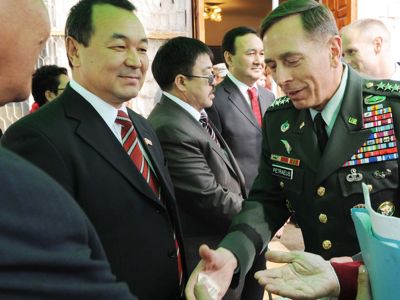
On 11 March 2010, General Petraeus paid a visit to Kyrgyz leaders. Here, he is presenting a medal to Bolotkon Kumarov, the Governor of Chuy Province. Standing on his left is Parliament Vice-President Kubanychbek Isabekov.
Events in a remote, landlocked and agrarian nation of slightly over five million people have become the center of world attention.
A week of violence which first erupted in Kyrgyzstan’s second largest city, Osh, in the south of the country, has resulted in the deaths of at least 120 civilians and in over 1,700 being injured.
More than 100,000 ethnic Uzbeks have fled Osh and the nearby city of Jalal-Abad (Jalalabad) and three-quarters of those have reportedly crossed the border into Uzbekistan.
A report of June 14 estimated that 50,000 were stranded on the Kyrgyz side of the border without food, water and other necessities. [1]
Witnesses describe attacks by gangs of ethnic Kyrgyz against Uzbeks with reports of government armed forces siding with the assailants.
The following day the United Nations High Commissioner for Refugees (UNHCR) estimated that 275,000 people in total had fled the violence-torn area.
On June 14 the deputy head of the International Committee of the Red Cross in Osh, Severine Chappaz, was quoted as warning: "We are extremely concerned about the nature of the violence that is taking place and are getting reports of severe brutality, with an intent to kill and harm. The authorities are completely overwhelmed, as are the emergency services.
"The armed and security forces must do everything they can to protect the vulnerable and ensure that hospitals, ambulances, medical staff and other emergency services are not attacked." [2]
The government of neighboring Uzbekistan had registered 45,000 refugees by June 14, with an estimated 55,000 more on the way. United Nations representatives said that over 100,000 people had fled Kyrgyzstan, mainly ethnic Uzbeks to Uzbekistan, by June 15.
According to a news account of the preceding day, "Kyrgyz mobs burned Uzbek villages and slaughtered residents on Sunday, sending more than 75,000 Uzbeks fleeing across the border into Uzbekistan. Ethnic Uzbeks in a besieged neighbourhood of the Kyrgyz city of Osh said gangs, aided by the military, were carrying out genocide, burning residents out of their homes and shooting them as they fled." [3]
Accounts of hundreds of corpses in the streets and a hundred bodies buried in one unmarked grave have also surfaced.
The government of acting (unelected) president Roza Otunbayeva (the nation’s first ambassador to the United States in the early 1990s) called up all reservists under 50 years of age and issued shoot-to-kill orders in the affected areas.
On June 13 Russia deployed a reinforced battalion of as many as 650 airborne troops to the Kant Air Base in Kyrgyzstan where Russian air force units have been stationed since 2003. (Russia had also sent 150 paratroopers to the base after April’s overthrow of Otunbayeva’s predecessor Kurmanbek Bakiyev.)
On June 15 two chartered planes repatriated 195 Chinese nationals from Kyrgyzstan, flying them into the adjoining Xinjiang Uygur Autonomous Region. By the following day almost 1,000 Chinese had been rescued.
India, Pakistan, Turkey and Russia also evacuated citizens from the nation.
Both the Collective Security Treaty Organization consisting of Russia, Kyrgyzstan and five other former Soviet republics and the Shanghai Cooperation Organization of China, Russia and all Central Asian nations except for Turkmenistan have addressed the Kyrgyz crisis.
This month’s bloody rampages were an aftershock of those following the overthrow of President Bakiyev in early April [4], following which at least 80 people were killed and over 1,500 injured. At that time Russian President Dmitry Medvedev warned that "Kyrgyzstan is on the threshold of a civil war." [5]
The current violence in Kyrgyzstan, which may prove to be terminal for the 19-year-old Central Asian state, is a continuation and inevitable culmination of that of April. The latter in turn occurred five years after the overthrow of the government of President Askar Akayev by a coalition of opposition forces led by Bakiyev, Otunbayeva and Felix Kulov, a coup that was widely celebrated in the West at the time as the high point of an inexorable wave of what were characterized as "color" and "rainbow" revolutions in the former Soviet Union and beyond.
Two months after the 2005 putsch in Kyrgyzstan, U.S. President George W. Bush was in the Georgian capital of Tbilisi where he crowed: "In recent months, the world has marvelled at the hopeful changes taking place from Baghdad to Beirut to Bishkek [the Kyrgyz capital]. But before there was a purple revolution in Iraq, or an orange revolution in Ukraine, a cedar revolution in Lebanon, there was a rose revolution in Georgia." [6]
Bush’s statement, his transparent endorsement of the "color revolution" model of extending U.S. domination over former Soviet states and Middle Eastern nations, has been echoed by former U.S. national security advisor and self-ordained geostrategic chess master Zbigniew Brzezinski who was quoted by a Kyrgyz news source as saying, "I believe revolutions in Georgia, Ukraine and Kyrgyzstan were a sincere and snap expression of the political will.” [7]
The ringleaders of the 2005 violent, unconstitutional takeover in Kyrgyzstan divided up top government posts, with Bakiyev becoming president, Kulov prime minister and Otunbayeva acting foreign minister.
Regarding the "hopeful changes" that Bush and Brzezinski acclaimed, it is worth recalling that the only two elected presidents in the young nation’s history are wanted men forced into exile. The "shock therapy" privatization of the nation’s economy in the 1990s, as disruptive as it was abrupt, laid the groundwork for subsequent destabilization, but that buildings are flammable is no defense for an arsonist.
The Pentagon opened the Manas Air Base (also named the Ganci Air Base by the U.S.) near the Kyrgyz capital in December of 2001, two months after the invasion of Afghanistan to support military operations in that nation.
The base, since last summer called the Transit Center at Manas, has seen hundreds of thousands of U.S. and North Atlantic Treaty Organization combat troops pass through in the interim.
Washington’s civilian hit man for the expanding war in South Asia, which is the largest and most deadly war in the world currently with hundreds of thousands of troops involved and millions of civilians displaced on both sides of the Afghanistan-Pakistan border, is Richard Holbrooke, appointed Special Representative for Afghanistan and Pakistan after the new administration was installed in Washington in January of last year.
This February he visited Kyrgyzstan and the three other former Soviet Central Asian republics it borders: Kazakhstan, Tajikistan and Uzbekistan. Shortly after returning to Washington, "Holbrooke said that the United States would soon renew an agreement to use the Manas airbase, where he said 35,000 US troops were transiting each month on their way in and out of Afghanistan." [8]
Afterward Major John Redfield of U.S. Central Command (CENTCOM) said that during the next month, this March, 50,000 American troops had passed through the Kyrgyz base to and from Afghanistan, and the new commander of U.S. operations at Manas with the 376th Air Expeditionary Wing, Colonel Dwight Sones, recently disclosed that "55,000 servicemen were airlifted to Afghanistan via Manas in May." [9]
That is, 20,000 more troops a month over a three-month period and at a rate of almost two-thirds of a million annually.
In February of 2009 Kyrgyzstan’s parliament voted 78-1 to close the U.S. air base at Manas and President Kurmanbek Bakiyev signed a decree to do so.
The U.S. was given "180 days to withdraw some 1,200 personnel, aircraft and other equipment." [10] The following month Kyrgyz deputies also voted to expel military personnel from Australia, Denmark, Italy, Spain, South Korea, the Netherlands, Norway, New Zealand, Poland, Turkey and France, all nations providing troops for NATO’s International Assistance Security Force (ISAF) in Afghanistan.
Popular internal opposition to the presence of U.S. and NATO forces in the country had been mounting as the Afghan war dragged on interminably and especially after the killing of a Kyrgyz civilian, Alexander Ivanov, by an American soldier in December of 2006 and the dumping of 80 tons of fuel into the atmosphere by U.S. military planes the year before. Many Kyrgyz also fear that the use of the air base at Manas for an attack against Iran could pull their nation into a second and far more catastrophic armed conflict.
The situation was made worse in August of 2008 when "A major depot with weapons and ammunition" was "found in a private house in Bishkek rented by U.S. nationals in an operation by Kyrgyz police....According to law enforcement officers, six heavy machine guns, 26 Kalashnikov assault-rifles, almost 3,000 cartridges for them, two Winchester rifles, four machine gun barrels, two grenade launches, four sniper guns, six Beretta pistols, 10,000 cartridges for a nine-millimetre pistol, 478 12-millimetre cartridges, 1,000 tracer cartridges and 123 empty magazines were found there.
"Police said the house belonged to a Kyrgyz national, who had rented it to US nationals.
"They also said there were several staffers of the U.S. Embassy to Kyrgyzstan having diplomatic immunity, as well as ten U.S. military in the house during the search." [11]
The U.S. claimed it had government permission to store the above-described arsenal in a private residence.
Last year Russia negotiated an extension of its military presence at the Kant Air Base for 49 years and offered the Kyrgyz government a $2 billion loan.
In June of 2009 the outgoing U.S. commander at Manas, Colonel Christopher Bence, "said the facility had started to wind down operations" and "has started to shut down and will close by mid-August." [12] He added "that over the past year alone 189,000 troops from 20 countries had moved to and out of Afghanistan via the Manas base" [13] and that "we have started shipping equipment and supplies to other locations and those shipments should be finished by August 18." [14] (Recall that 55,000 Western troops passed through the base last month alone.)
However, earlier in the month President Barack Obama sent a personal appeal to his Kyrgyz counterpart urging him to reverse the decision to expel U.S. military personnel, some 1,300 permanently assigned to the base, and "Kyrgyzstan showed more flexibility on the matter after receiving the letter...." [15]
On July 2 President Bakiyev signed an agreement to extend U.S. military presence at Manas after Washington offered $180 million a year for the use of the base, thereafter referred to as a transit center. "Rent for the land is $60 million as compared to $17.4 million Kyrgyzstan received for hosting the airbase." [16] In early August U.S. Defense Secretary Robert Gates sent a letter to President Bakiyev commending him for overriding the near-unanimous decision by his country’s parliament, including his own party’s deputies, to close down Pentagon operations, instead simply renaming the Manas Air Base while activity there was scheduled to increase.
A Russian report on the transition, a change more formal than substantive, said that "Many experts on Central Asian politics speculated that Bishkek was simply angling for more money and was not intending to close the base." [17]
It is in part a struggle over the $180 million in U.S. funds as well as the $2 billion in Russian aid pledged in February of last year that precipitated April’s phase two of the so-called Tulip Revolution.
Complementing the new arrangement with the Pentagon, last December Kyrgyzstan authorized the establishment of a NATO representative office in its capital. A spokesman for the nation’s parliament said at the time, "Until recently, the NATO representative office was located in the city of Astana, Kazakhstan." Kyrgyz Defense Minister Bakyt Kalyev stated: "NATO recently started to pay special attention to Central Asia in light of the deteriorating situation in Afghanistan.
"The relocation of NATO’s official to the territory of Kyrgyzstan will proceed as part of the Partnership for Peace Program. One of the key reasons behind the transfer of the office from Astana to Bishkek is the fact that the territory of the republic houses the International Transit Center." [18]
Richard Holbrooke met with the Kyrgyz president this February to solidify plans for the Manas base.
This March it was announced that the Pentagon is to set up a "counter-terrorism" special forces training base in Kyrgyzstan.
- General David Petraeus in traditional Kyrgyz costume.
General David Petraeus, chief of U.S. Central Command, visited Kyrgyzstan and met with its president in March. "The visit [came] a day after US diplomats confirmed Washington would provide US$5.5 million to the Kyrgyz government toward the construction of a counter-terrorism training center in southern Kyrgyzstan." [19]
The day after this April’s uprising began a Pentagon spokesman said of the operations at Manas that "Our support to Afghanistan continues and has not been seriously affected, and we are hopeful that we will be able to resume full operations soon." [20]
A week later the government of then interim prime minister Roza Otunbayeva extended the lease for the Manas base another year. The next month a record number of Western troops passed through Kyrgyzstan in support of the war in Afghanistan.
On June 10 Robert Simmons, NATO’s Special Representative for the Caucasus and Central Asia, arrived in the Kyrgyz capital to further military cooperation with the new regime. "Simmons visits Kyrgyzstan each time the existence of the Transit Center at Manas, called Manas Air Base until 2009, is threatened. The high-ranking diplomat’s first visit to Bishkek took place in May 2005.
"Then, Washington was concerned about the base’s future after the March 2005 Tulip Revolution in Kyrgyzstan that overthrew President Askar Akayev. Simmons paid another visit to the republic in February 2009, or two weeks before President Kurmanbek Bakiyev announced his intention to close the base. This time, Simmons met with Roza Otunbayeva, head of the Kyrgyz interim government, and acting Finance Minister Temir Sariyev, who is responsible for budget income." [21]
In addition, "Kyrgyz media say Washington has paid $15 million in first-quarter lease payments ahead of schedule and promises to transfer the second tranche to the cash-strapped Kyrgyz budget soon." [22]
On June 8 EurasiaNet, "operated by the Central Eurasia Project of the Open Society Institute," [23] ran a feature entitled "Pentagon Looks to Plant New Facilities in Central Asia," which included these excerpts:
"The Pentagon is preparing to embark on a mini-building boom in Central Asia. A recently posted sources-sought survey indicates the US military wants to be involved in strategic construction projects in all five Central Asian states, including Turkmenistan and Uzbekistan.
"According to the notice posted on the Federal Business Opportunities (FBO) website in mid-May, the US Army Corps of Engineers wants to hear from respondents interested in participating in ’large-scale ground-up design-build construction projects in the following Central South Asian States (CASA): Kazakhstan; Kyrgyzstan; Tajikistan; Turkmenistan; and Uzbekistan.’
“’We anticipate two different projects in Kyrgyzstan. Both are estimated to be in the $5 million to $10 million dollar range.’” [24]
On June 14 Pentagon spokesman Colonel David Lapan told CNN that "the refueling and troop transport operations at the U.S. transit base in Manas, Kyrgyzstan, continue ’unabated’ by ethnic riots in the southern part of the country....Refueling operations had been halted while the United States negotiated new fuel contracts with the interim government...but late last week refueling started again." [25]
An analysis recently appeared on the website of the German international radio broadcaster Deutsche Welle which provided insightful background information regarding the current crisis in Kyrgyzstan:
"Bakiyev’s installation as president in 2005 with US backing may have provided Washington with a friendly government with whom to do business with but it also gave the US a significant foothold in a country that some strategists believe is paramount to its plans for regional dominance."
"The inclusion of Kyrgyzstan and three other central Asian states in NATO’s Partnership for Peace program in 1994 was seen as a major step toward increasing US military presence in the region which eventually led to the US base at Manas, outside Bishkek in the north, being established."
"While Manas remains a key hub for US operations in Afghanistan, it is also used as a NATO base - a situation which angers and concerns Russia which fears the eastern enlargement of its former Cold War opponent, putting Kyrgyzstan at the center of a power struggle for regional influence....Russia is also concerned about the possibility of being encircled by NATO member states should the alliance go ahead with its provocative eastern enlargement."
"The Chinese see increasing US influence as not only a threat to its plans for Eurasia, which along with promoting its emerging market policy also includes energy security and supply, but also a threat to the People’s Republic itself....Beijing [is] more concerned that the porous nature of the border is allowing US intelligence agencies to run covert destabilizing operations into the strategically vital and politically fragile [Xinjiang] province. Beijing believes the flow of people across the border gives US operations a perfect cover." [26]
Small and seemingly insignificant Kyrgyzstan is the country most vital to U.S. and NATO for the reinforcement and escalation of the war in Afghanistan, even more than Pakistan where NATO supply convoys are routinely attacked and destroyed.
The transit center in the country is the only base the Pentagon has in Central Asia after it was evicted from the Karshi-Khanabad Air Base in Uzbekistan five years ago.
Kyrgyzstan is Washington’s military outpost in a region where the interests of several major nations - Russia, China, India, Pakistan and Iran among them - converge. U.S. stratagems in the nation, whether attempts at the maintenance of a permanent military presence or rotating governments through the use of standard "regime change" maneuvers, will have consequences far more serious than what the status of the diminutive and impoverished Central Asian nation may otherwise indicate.
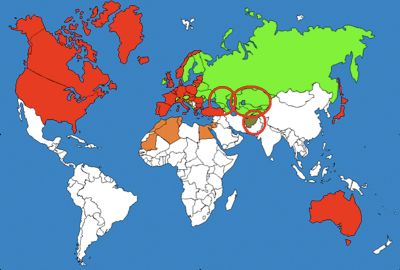
US Penetration and Encirclement of Eurasia.
In order to address properly, without any ideological prejudice, but with intellectual honesty, the question about drug production in Afghanistan and the related international problems, it is necessary and useful to define (even if in broad terms) the geopolitical framework and to further clarify certain concepts, usually assumed to be understood and widely shared.
The geopolitical framework
Considering today’s main global actors, namely the U.S., Russia, China and India, their geographic location in the two distinct areas of America and Eurasia and, above all, their relations in terms of power and world geo-strategy, Afghanistan constitutes, together with the Caucasus and the Central Asian Republics, a large area (fig. 1), whose destabilization offers an advantage to the U.S., i.e. to the only geopolitical player external to the Eurasian context. In particular, the destabilization of this large region affords the U.S. at least three geopolitical and geo-strategic opportunities: a) its progressive penetration in the Eurasian landmass; b) the containment of Russia; c) the creation of a vulnus in the Eurasian landmass.
U.S. penetration in Eurasia — U.S. encirclement of Eurasia
As stated by Henry Kissinger, the bi-oceanic nation of the U.S. is an island outside of the Eurasian Continent. From the geopolitical point of view, this particular location has determined the main vectors of U.S. expansion throughout the Planet. The first was the control of the entire Western hemisphere (North and South America), the second one has been the race for hegemony over the Euroafroasian landmass, that is to say the Eastern hemisphere.
With regard to the process of U.S. penetration into the Eurasian landmass, starting from the European peninsula, it is worth remembering that it began, in the course of WWI, with Washington’s interference in the internal quarrels between the European Nations and the Empires. The penetration continued during WWII. In April 1945, the so-called “Liberators” occupied the Western part of Europe up to East Berlin. Starting from this date, Washington and the Pentagon have regarded Europe, i.e. the Western side of Eurasia, like a U.S. bridgehead linking it to the Eurasian landmass. The U.S. imposed a similar role to the other occupied nation, Japan, representing the Eastern insular arc of Eurasia. From an Eurasian point of view, the North American “pincer” was the true outcome of WWII.
With the creation of certain military “tools” like NATO (North Atlantic Treaty Organization) (1949), the security treaty among Australia, New Zealand, United States (ANZUS, 1951), the Baghdad Pact, that afterwards evolved into CENTO Pact (Central Treaty Organisation, 1959), the Manila Pact – SEATO (South East Asia Treaty Organization, 1954), the military encirclement of the whole Eurasian landmass was accomplished in less than one decade.
The third step of the U.S. long march towards the heart of Eurasia, starting from its Western side, was carried out in 1956, during the Suez crisis, with the progressive removal of France and, under certain aspects, also of Great Britain as geopolitical actors in the Mediterranean Sea. On account of the “special relationship” between Tel-Aviv and Washington, the U.S. became an important player in the Near Eastern region in a time lapse shorter than 10 years. Following its new role in the Near and Middle East, the U.S. was able either to consolidate its hegemonic leadership within the Western system or to consider the Mediterranean Sea as the starting point of the long road that would eventually enable U.S. troops to reach the Central Asian region. U.S. infiltration into the vast Eurasian zone occurred also in other geopolitical sectors, particularly the South-Eastern one (Korea, 1950-1953; Vietnam, 1960-1975).
In accordance with its strategy aimed at dominating the Eastern hemisphere, Washington worked also at the diplomatic level, focusing its attention on Beijing. With the creation of the axis Washington – Beijing, conceived in tandem by Kissinger and Nixon (1971-1972), the U.S. contributed towards exacerbating the fracture inside the so-called socialist field, constituted by China and URSS and, thus, to block any potential “welding” between the two “lungs” of Eurasia, China and Russia.
During the seventies, two main geopolitical axes faced each other within the Eurasian landmass: the Washington-Islamabad-Beijing axis and the Moscow-New Delhi one.
1979, the year of destabilization and its legacy for today’s Afghanistan
Among the many events affecting international relations whick took place in 1979, two are of pivotal importance for their role in upsetting the geopolitical equation, based at the time on the equilibrium between the United States and the URSS.
We are speaking of the Islamic revolution in Iran and of the Russian military involvement in Afghanistan.
Following the takeover of Iran by the Ayatollah Khomeyni, one of the essential pillars of the western geopolitical architecture, with the U.S. as the leader, was destroyed.
The Pahlavi monarchy could easily be used as a pawn in the fight between the U.S. and the URSS, and when it disappeared both Washington and the Pentagon were forced to envision a new role for the U.S. on the world scene. A new Iran, now autonomous and out of control, introduced a variation in the regional geopolitical chessboard, possibly able to induce a profound crisis within the “stable” bipolar system. Moreover, the new Iran, established as a regional power against the US and Israel, possessed such characteristics (especially its geographic extent and centrality, and its political-religious homogeneity) as to compete for the hegemony over at least part of the Middle-East, in open contrast to similar interests on the part of Ankara and Tel-Aviv, faithful allies of Washington, Islamabad, Baghdad and Riyadh. For such reasons, Washington strategists, in accordance with their bicentennial “geopolitics of chaos”, persuaded Saddam Hussein to start a war against Iran. The destabilization of the whole area allowed Washington and Western countries enough time to plan a long-term strategy and in the meantime to wear down the Soviet bear.
In an interview released to French weekly Le Nouvel Observateur [1], Zbigniew Brzezinski, President Jimmy Carter’s national security adviser, revealed that the CIA had secretly operated in Afghanistan to undermine the regime in Kabul since July 1979, that is to say, five months before the Soviet invasion. Indeed, it was on July 3, 1979, that President Carter signed the first directive to provide secret aid to the opponents of the pro-Soviet regime in Kabul. That very day the Polish-born U.S. strategist wrote a note to President Carter in which he explained that this aid was going to induce a Soviet military intervention. And this is precisely what happened the following month of December. In the same interview, Brzezinski recalls that, when the Soviets invaded Afghanistan, he wrote another note to President Carter in which he expressed his opinion that at that point the USA had the opportunity of giving to the USSR its Vietnam War.
In Brezinski’s opinion, this intervention was unsustainable for Moscow and in time would have led to the collapse of the Soviet Empire. In fact, the drawn out Soviet war in support of the communist regime in Kabul further contributed to the weakening of the Soviet Union, already engaged in a severe internal crisis, encompassing both political- bureaucratic and socio-economic aspects. As we now well know, the Soviet withdrawal from the Afghan theatre left behind an exhausted country, whose political situation, economy and geo-strategic assets were extremely weak. Indeed, after less than 10 years from the Teheran revolution, the entire region had been completely destabilized exclusively to the advantage of the western system. The parallel and unrestrained decline of the Soviet Union, accelerated by the Afghan adventure, and, afterwards in the nineties, by the dismemberment of the Yugoslav Federation (a sort of buffer state between the Western and Soviet blocks) changed the balance of power to favour U.S. expansionism in the Eurasian region.
After the bipolar system, a new geopolitical era began, that of the “unipolar moment”, in which the USA was the “hyperpuissance” (according to the definition of the French minister Hubert Védrine).
However, the new unipolar system was going to be short lived and indeed it ended at the beginning of the XXI century, when Russia re-emerged as a strategic challenger in global affairs and, at the same time, China and India, the two Asian giants, emerged as economic and strategic powers. On the global level, we have to consider also the growing weight of some countries of Indigenous Latin America, such as Brazil, Venezuela. The very important relations of these countries with China, Russia and Iran seem to acquire a strategic value and prefigure a new multipolar system, whose two main pillars could be constituted by Eurasia and Indigenous Latin America.
Afghanistan - due to its geographical characteristics, to its location in respect of the Soviet State (whose neighbouring nations Turkmenistan, Uzbekistan and Tajikistan were, at that time, Soviet Republics), and to the wide variety of ethnic groups forming its population, different either in culture or in religion - represented for Washington an important portion of the so-called “arc of crisis”, namely that geographical region linking the southern boundaries of the USSR and the Arabian Sea. The Afghanistan trap for the URSS was therefore chosen for evident geopolitical and geo-strategic reasons.
From the geopolitical point of view, Afghanistan is clearly representative of a crisis zone, being from time immemorial a stage for the conflicts among Great Powers.
The area is now “ruled” by the governmental entity established by U.S. forces and named Islamic Republic of Afghanistan, but traditionally the Pashtun tribes have dominated over the other ethnic groups (Tajiks, Hazaras, Uzbeks, Turkmens, Balochs). Its history was intertwined with broader events involving the interaction and the prolonged fighting among the three neighbouring great geopolitical entities: the Moghul Empire, the Uzbek Khanate and the Persian Empire. In the 18th and 19th centuries, when the country was under the rule of the Kingdom of Afghanistan, the area became strategic in the rivalry and conflict between the British Empire and the Russian Empire for supremacy in Central Asia, termed "The Great Game". The Russian land empire, in its efforts to secure access to the Indian Ocean, to India and to China, collided with the interests of the British maritime empire, that, for its part, sought to expand into the Eurasian landmass, using India as a staging post, towards the East, to Burma, China, Tibet and the basin of the Yangtze river, and towards the West, to present-day Pakistan, Afghanistan and Iran, as far as the Caucasus, the Black Sea, to Mesopotamia and the Persian Gulf. Towards the end of the 20th century, in the framework of the bipolar system, Afghanistan became the battlefield where, once again, a maritime Power, the USA, confronted a land Power, the URSS.
The actors that confronted each other on this battlefield were basically: URSS troops, Afghan tribes and the so-called mujahideen, the latter were supported by US, Pakistan and Saudi Arabia.
After the withdrawal of the Soviet troops from the Afghan chessboard, the Taliban movement took on an increasingly important role in the region, on the basis of at least three main factors: a) ambiguous relations with some components of the Pakistani secret services; b) ambiguous relations with the U.S. (a sort of “legacy” stemming from the previous contacts between the U.S. and some components of the “mujahideen” movement which occurred during the Soviet - Afghan war); c) wahabism as an ideological-religious platform directly instrumental for the interests of Saudi Arabia in its projection towards certain zones as Bosnia, the Middle East area and the Caucasus (namely Chechnya and Dagestan).
The three elements mentioned above allowed the Taliban movement, on the one hand, to insert and root itself in the Afghan zone, gaining increasing importance at the military (with the creation and consolidation of the so-called sanctuaries) and economic (namely control of the drug traffic) levels, while impeding it, on the other hand, from becoming an autonomous organization. Actually, because of its infiltration by the U.S., Pakistan and Saudi Arabia, the Taliban movement has to be considered as local organization directed by external players. Such considerations enable us to better understand and explain the choice made by Obama and Karzai to open a dialogue with the Talibans, and even to include some of them in local governments. Moreover, the apparent contradictory behaviour of the U.S. (and Karzai) in Afghanistan, could be explained in light of the theory and praxis according to which, entrusting the enemy with institutional responsibilities aims to weaken it, and follows the classic rule of U.S. geopolitical praxis to maintain in a state of crisis a region considered strategic.
As we well know now, the drug production in Afghanistan has gone up more or less 40 times since the country’s occupation by NATO.
If we examine the measures adopted so far by U.S. forces aimed at containing and overcoming the drug trafficking issue in the broader context of U.S. geopolitical policies, we can observe that U.S. and NATO forces are apparently “wasting” their time: drug production and distribution in the southern part of the country are still going on. As we well know, a large-scale drug production is impossible in this area, because of the ongoing fighting. Hence, U.S. and NATO forces are focusing their strategic interest in the northern part of the country. Here, they have built roads and bridges linking Afghanistan to Tajikistan (the road to Russia via Uzbekistan), Kyrgyzstan and Azerbaijan (see A. Barentsev, Afghan Heroine flow channelled to Russia, FONDSK). This modus operandi unveils the real intentions of the Pentagon and Washington: opening a road towards Russia, starting from Afghanistan and the Central Asian republics. In fact, NATO and other western forces are not waging a genuine fight against drug production and trafficking.
In this context, the reported US/NATO fight against drug production and trafficking in Afghanistan seems to belong to the realm of Western rhetoric rather than being a concrete fact (Fig. 2).
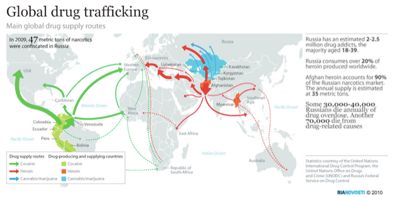
Afghanistan and Central Asian area (to be compared with previous figure)
Similarly, the fight against the Taliban movement seems to be clearly subordinated to (and thus dependent on) the general strategy of the U.S. in the Eurasian landmass. Nowadays, this strategy consists in the setting up of military garrisons by the U.S. and its Western allies along the strip that, starting from Morocco, crosses the Mediterranean Sea and arrives as far as the Central Asian republics. The principal goals of these garrisons are:
a) the separation of Europe from North Africa;
b) the control of north Africa and the Near East (particularly the zone constituted by Turkey, Syria and Iran – using the Camp Bondsteel base, located in Kosovo);
b) the containment of Russia, and, under certain aspects, of China too;
c) an attempt at cutting the Eurasian landmass in two parts;
d) the enlargement of the “arc of crisis” in the Central Asian area [Brzezinski defines this area the “Balkans of Eurasia” (the definition of President Carter’s former adviser rings more like a strategic plan than an objective description of the area)].
Creating a geopolitical chasm in Central Asia, i.e. a vulnus in the Eurasia landmass, could lead to hostility and enmity among the main players in Asia, Russia, India and China (fig. 3). The only beneficiary of this game would thus be the United States.
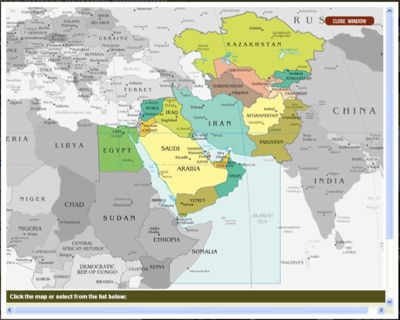
- The huge arc of crisis.
In addition to the attempt “to knife” Eurasia along the illustrated path (from the Mediterranean Sea up to the Central Asia), we observe that the U.S. can rely on (since 2008) AFRICOM and, of course, the related cooperative security locations in Africa: a useful military “device” which is also pointed in the direction of the Middle East and part of Central Asia (fig. 4).
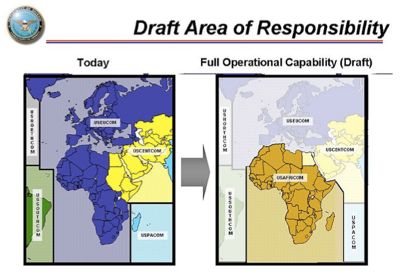
4 February 2007 Draft Map of the United States Africa Command (USAFRICOM) showing its creation from parts of USEUCOM, USCENTCOM and USPACOM. An updated definitive map from the Unified Command Plan 2008, signed by the President on December 17, 2008 can be found at http://www.defenselink.mil/specials/unifiedcommand).
In order to understand the importance of the Central Asian zone for the strategy of the U.S. in terms of extending its hegemony over the Eurasian landmass, it is enough to glance at the following picture (fig. 5), illustrating the U.S. Commanders’ areas of responsibilities. The picture is representative of what we can call – paraphrasing the expression “the white man’s burden” formulated by the bard of British imperialism, Rudyard Kipling, 1899 – the "US’ burden".
- The US’ burden.
General remarks on "accepted and shared“ concepts
With a view to reaching a broader understanding of the complex dynamics presently at work on a global level, it is useful to criticize a number of general concepts which we consider to be widely accepted and shared. As we know, in the framework of a geopolitical analysis, the correct use of terms and concepts is at least as important as those related to the description of the reality through maps and diagrams. For instance, the so-called “globalization” is only a euphemistic expression for the economic expansionism of the U.S. and its capitalistic western allies (see Jacques Sapir, Le nouveau XXI siécle, Paris, 2008, p. 63-64). Even the rhetorical call for the defense of supposed “human rights”, or similar democratic values, put out by some think-thanks, governments or simple civilian activists, highlights the colonialist bias of the U.S. on the mass media and culture, without any consideration for other ways of life, like those expressed by non-western civilisations, i.e. more than three quarters of the world population. Among these concepts, we have to consider the most important one from the geopolitical (and international relations) point of view, that is the so-called International Community. The expression “International Community” does not mean anything in geopolitical terms. Actually, the International Community is not a real entity; its related concept sounds, simultaneously, like an aspiration of some utopian activists and a specific falsification of history.
In the real world as we know it - made up of states, nations, people, international organisations [generally based on (hegemonic) “alliances”] and, of course the relations among these entities - speaking in generic terms of an International Community actually means to mis-describe the real powers currently acting at global and local scales.
Considering now the focus of the International Forum on drug production in Afghanistan (Moscow, June 9-10 2010), aimed at finding “shared solutions” for the Afghan drug question in the context of the “International Community” (I.C.), as analysts, we honestly have to underline that instead of I.C. it is more pragmatic to speak of the real players involved (and that could be involved) in the Afghan zone.
The real players in the Afghan theatre
For analytical reasons is useful to aggregate the players involved in the Afghan theatre in the following three categories: external players; local players; players who could potentially become involved in the Afghan context. Afterwards we can easily define some conditions in order to delineate the characters of those partners who would be in a position to stabilize - effectively - the entire geopolitical area.
 External players: US and NATO-ISAF (except Turkey) forces are to be considered external players because they are totally foreign to the specific geopolitical area, even if conceived in a broad sense;
Local players: among the local players we can enumerate the bordering countries (Iran, Turkmenistan, Uzbekistan, Tajikistan, China, Pakistan), the tribes, the insurgent forces, the Taliban and the “governmental” entity led by Karzai.
Regarding the players belonging to the third category as defined above, we can include the Collective Security Treaty Organisation (CSTO), the Shanghai Cooperation Organisation (SCO), i.e. the main Eurasian organisations with a large experience in managing questions related to the border control and drug trafficking of Central Asian area, and the Eurasian Economic Community (EURASEC). Moreover we have to mention also ONU, in particularly the United Nations Office on Drugs and Crime (UNODOC).
Potential partners capable of overcoming the drug question in Afghanistan have to present at least the following characteristics: a) the knowledge of the local dynamics related to the ethnic, cultural, religious and economic aspects; b) the acknowledgement by the local population as part of the same cultural context (obviously in a broad sense); c) the will to coordinate collectively actions without any prejudice or mental reserve within a Eurasian program.
The partners presenting the features synthetically described above are those included in the second and third categories. As a matter of fact, U.S. and NATO – ISAF forces are perceived by the local population as what they really are: occupying forces. Moreover, considering NATO’s role as a hegemonic alliance led by Washington and acting within the framework of the U.S. global strategy, its presence in Afghanistan should be considered a serious obstacle to the stabilization of the entire area. The Taliban and even the governmental entity, do not appear, due to the ambiguous relations that they seem to have with the occupying U.S. forces, to be hopeful partners in a collaborative effort to triumph over the drug question in Afghanistan.
The real players with the ability to stabilize the area are - without any doubt - the Afghanistan bordering countries and the Eurasian organizations. Among the bordering countries, a special role could be played by Iran. Teheran is the only country that has demonstrated it can assure the security of Afghan-Iranian border, specially for drug trafficking. Also Moscow and Beijing assume an important function in the stabilization of the area and in the fight against drug trafficking, because Russia and China, it is worth to reiterating, are the main powers of the Eurasian organizations mentioned above. A strategic axis between the two “lungs” of Eurasia, balanced by the Central Asian republics and India, could constitute the lasting solution for the stabilization of the area and hence the drug question. Only in the framework of a shared Eurasian plan aimed at stabilizing the area – conceived and implemented by Eurasian players –, would it be possible to hold a dialogue with local tribes and with those insurgent movements which are clearly not directed by external players.
Conclusions
The stabilization of the Afghan area is an essential requirement for any plan aimed to tackle the drug production and trafficking problem.
However, because of the pivotal role of Afghanistan in the Middle East and in the Central Asian regions, the strategy to stabilize the area has to be conceived in the context of the integration of the Eurasian landmass. Candidates particularly interested to halt the drug production and traffic are the Afghanistan bordering countries.
U.S. and NATO forces, because of their clear geopolitical praxis aimed at hegemonizing the Eurasian landmass, are not credible candidates.
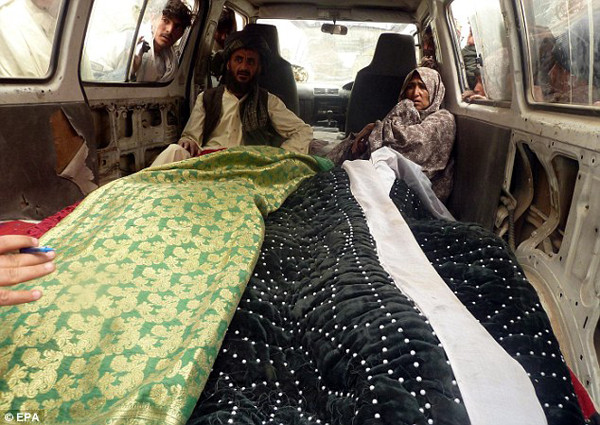



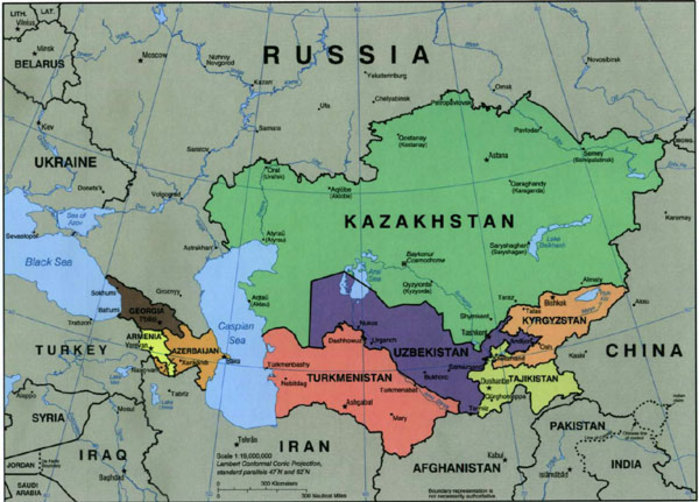
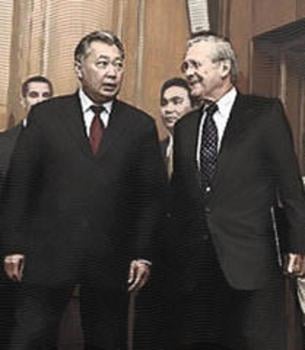
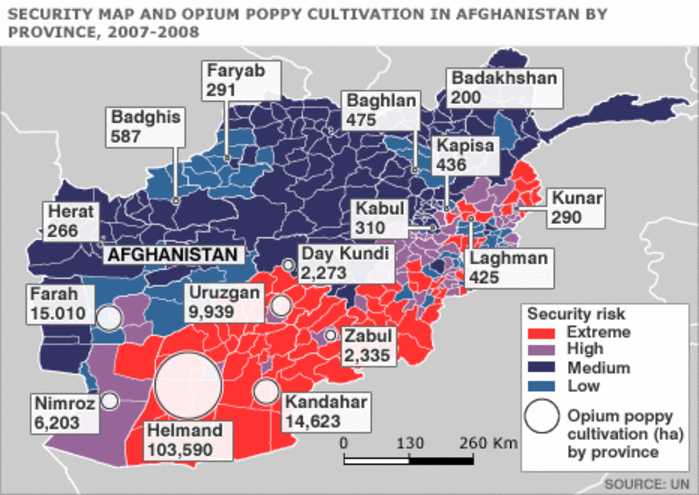

 Posts
Posts


![[Most Recent Quotes from www.kitco.com]](http://www.kitconet.com/charts/metals/gold/t24_au_en_eukg_2.gif)