Showing posts with label cuba. Show all posts

Sunday, 3 October 2010

ecuador coup attempt: cia fingerprints, corruption

.
http://www.waynemadsenreport.com/articles/20101001_1

October 1, 2010

Obama administration fingerprints on Ecuador coup attempt

by courtesy of Wayne Madsen

Using the standard CIA playbook on toppling democratically-elected governments in Latin America, the Obama administration, which was not happy with Ecuadorian President Rafael Correa's moves to increase state control over oil companies in the nation and his decision to oust the United States military from its airbase at Manta, appears to have suffered a major defeat in the failed coup attempt in Ecuador by police officers and Air Force personnel who were backed by rightist elements in the National Assembly and business community. Correa was re-elected with an overwhelming majority last year after he gave the U.S. military its walking papers from the Manta airbase. The Pentagon and CIA have been working to topple Correa ever since by pumping money into opposition political parties and other groups through NGOs funded by the U.S. National Endowment for Democracy.

In a statement from Correa after his rescue from the Police Hospital in Quito by a military special operations team, the president warned of a larger conspiracy launched against him by his political opposition, saying the "attempt at destabilization is the result of a strategy that has been brewing for quite some time. A barrage of messages and misinformation have been given to the National Police, which today has been realized through violent actions from a conspiracy attempt."

Correa's predecessor, the pro-U.S. Lucio Gutierrez, who is wedded to foreign oil company interests in the country, was accused by the government of covertly supporting the police and Air Force mutineers.

Although Secretary of State Hillary Clinton issued a weak statement saying the United States backed Correa, it came one day after Clinton heaped praise on former Secretary of State Henry Kissinger, the person who helped to craft the September 11, 1973 coup in Chile and the assassination of its progressive president Salvador Allende. In fact, Clinton and Obama had given military and political support to the right-wing junta that ousted democratically-elected progressive President Manuel Zelaya in Honduras in June 2009 and has fought against allowing the ousted democratically-elected president of Haiti, Jean-Bertrand Aristide, to return to his country from exile in South Africa after the CIA-engineered coup against him in 2004.

Clinton's tepid response to the attempted coup against Correa was in marked contrast to the strong denunciations of the attempted coup and messages of support for Correa that came from Venezuela, Brazil, Argentina, Peru, Mexico, Bolivia, Cuba, and Spain.

And the fact that Correa, like Venezuelan President Hugo Chavez, who was briefly ousted in an April 2002 coup organized by the CIA, was held as a virtual hostage at the Police Hospital in Quito for the greater part of a day provided a grim reminder of an old CIA tactic in staging coups in Latin America. Chavez was briefly held hostage on a Venezuelan island in the Caribbean while a U.S.-registered plane stood by to fly him into exile. In an emergency Latin American summit meeting in Argentina, Chavez saw the U.S. behind the events in Ecuador. He said, "The Yankee extreme right is trying right now, through arms and violence, to retake control of the continent." Chavez's own experience with a CIA backed coup and the June 2009 coup, supported by the Pentagon, CIA, and Mossad against his ally Zelaya in Honduras, makes him an expert on CIA and Mossad tactics in the region. Informed sources have told WMR that Correa and Chavez are currently comparing notes on the coups launched against them.

Ecuadorian intelligence will be looking closely at the wereabouts of key CIA personnel stationed at the CIA station at the US embassy in Quito and a smaller CIA station within the US Agency for International Development (USAID) mission in Guayaquil. In the 2002 coup attempt against Chavez, the US embassy's top CIA and DIA officers were discovered to be helping to direct the coup from Venezuelan military installations.

Clinton's State Department has been casting Ecuador in a bad light throughout the past two years, calling the country "difficult to do business in," the only real priority that the Obama administration cares about due to its total subservience to Wall Street and the fat cat bankers. The State Department's "Investment Climate Statement" for Ecuador states: "Ecuador can be a difficult place in which to do business. . . There are restrictions or limitations on private investment in many sectors that apply equally to domestic and foreign investors . . . A 2006 hydrocarbons law imposed new conditions in the petroleum sector that have been problematic for many companies, complicated by a 2007 decree that imposed additional restrictions. A 2008 mining mandate stalled mining activity, and a new Mining Law is expected in early 2009. Negotiations for a free trade agreement between the United State and Ecuador, which would have included investment provisions, stopped in April 2006. The current Government of Ecuador has not expressed interest in restarting negotiations." Correa's financial policies, as well as his foreign policy that saw him order out the American base at Manta and establish close ties with Venezuela, Iran, and other countries inimical to American and Israeli hegemony, placed a huge CIA and Mossad target on Correa's back. In June, Ecuador sponsored a resolution at the Organization of American State (OAS) summit in Lima condemning Israel's attack on the Turkish aid flotilla transporting humanitarian aid to Gaza. Ten nations voted with Ecuador in support of the resolution.

The uprising among Ecuadorian Air Force ranks, with Air Force personnel taking over and shutting down Quito's international airport, will have Ecuadorian counter-intellligence personnel looking closely at the possible role of Israeli technicians and trainers who support the Air Force's 26 Israeli-made Kfir combat planes. Israel also reportedly sold Python-3 air-to-air missiles to the Ecuadorian Air Force in 1997.

Mossad also has its hooks into the Ecuadorian National Police, where the main coup plotters received support. Mossad is chiefly tasked with spying on Ecuador's large Ecuadorian-Arab community. The activities of the Mossad station at the Israeli embassy in Quito before and during the coup attempt will also draw the attention of counter-intelligence officers. Last year, Tel Aviv-based On Track Innovations received a contract to provide an electronic biometric-based electronic identification card system to Ecuador's Central Registry Office.


http://www.voltairenet.org/article167150.html

Quito’s Police: CIA breeding ground

Jean Guy Allard

The uprising by putschist elements of the Ecuadoran police against President Rafael Correa confirms an alarming report about the infiltration of the Ecuadoran police by U.S. intelligence services released in 2008, which indicated that many members of the police corps developed a “dependency” on the U.S. Embassy.

2 October 2010
Havana (Cuba)

Translated by Machetera
Source: Jean Guy Allard / Granma Internacional (Cuba)
through Voltaire network
JPEG - 100.8 kb
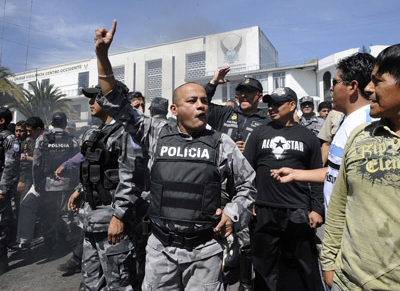
Rebellious elements within Ecuadorian police seize Quito International Airport, 30 September 2010.

“I applied and was accepted at the Escuela superior de policía de Quito, and studied there from September 1992 to August 1995.”
Guy Philippe, speaking to Peter Hallward about his background prior to leading an armed insurgency that contributed to the removal of Haiti’s elected president, Jean Bertrand Aristide.


The report made clear that the Ecuadoran Police “maintain informal economic dependence on the United States, to pay for informants, training, equipment and operations.”

The systematic use of corruption techniques by the CIA in order to acquire the “goodwill” of police officers was described and denounced on many occasions by the ex-CIA agent Philip Agee who, before leaving the agency’s ranks, was assigned to the U.S. Embassy in Quito.

In his official report, distributed at the end of October 2008, the Ecuadoran Defense Minister Javier Ponce revealed how U.S. diplomats dedicated themselves to the corruption of the police as well as officers from the armed forces.

In confirmation, the leadership of the Ecuadoran police then announced that it would sanction any of its agents who collaborated with the United States, while the U.S. Embassy claimed “transparency” in its support of Ecuador.

“We work with the Ecuadoran government, with the military, with the Police, on objectives that are very important for security,” said the U.S. Ambassador in Quito, Heather Hodges.

However, the diplomat told journalists that she would not comment “on intelligence matters.”

For her part, the public affairs officer, Marta Youth, categorically refused to comment on the Ecuadoran government’s denunciations, which included complaints about CIA participation in an operation with Colombia that led to a military attack by the Colombian military against FARC guerrillas on Ecuadoran territory on March 1st of that year.

The head of Army intelligence, Mario Pazmiño, had been removed for concealing information related to the attack on the FARC.

In recent months, U.S. officials have appeared in Ecuador under the pretext of extending relations between Ecuador and the United States. Arturo Valenzuela, the U.S. Assistant Secretary of State for Western Hemisphere Affairs, repeatedly visited President Correa, leading up to a visit from Secretary of State Hillary Clinton.

Valenzuela was accompanied by Todd Stern, “Climate Change Envoy,” also known for his CIA ties.

Wednesday, 31 March 2010

soros & co back wikileaks / kosher mob & oval office

.
updated april 1 2010

by courtesy of Wayne Madsen

CIA, Mossad and Soros behind Wikileaks

related text: pentagon adds wikileaks to list of enemies

March 25-26, 2010

Suspicions abound that Wikileaks is part of U.S. cyber-warfare operations

WMR has learned from Asian intelligence sources that there is a strong belief in some Asian countries, particularly China and Thailand, that the website Wikileaks, which purports to publish classified and sensitive documents while guaranteeing anonymity to the providers, is linked to U.S. cyber-warfare and computer espionage operations, as well as to Mossad's own cyber-warfare activities.

Wikileaks claims to have decrypted video footage of a U.S. Predator air strike on civilians in Afghanistan and that covert U.S. State Department agents followed Wikileaks's editor from Iceland to Norway in a surveillance operation conducted jointly by the United States and Iceland. Iceland's financially-strapped government recently announced a policy of becoming a haven for websites that fear political oppression and censorship in their home countries. However, in the case of Wikileaks, countries like China and Thailand are suspicious of the websites' actual "ownership."

Wikileaks says it intends to show its video at an April 5 press conference at the National Press Club in Washington, DC but that its presenters may be detained or arrested before that time. WMR's sources believe the Wikileaks "militancy" in the face of supposed surveillance appears fake.

Our Asian intelligence sources report the following: "Wikileaks is running a disinformation campaign, crying persecution by U.S. intelligence- when it is U.S. intelligence itself. Its [Wikileaks'] activities in Iceland are totally suspect." Wikileaks claims it is the victim of a new COINTELPRO [Counter Intelligence Program] operation directed by the Pentagon and various U.S. intelligence agencies. WMR's sources believe that it is Wikileaks that is part and parcel of a cyber-COINTELPRO campaign, such as that proposed by President Obama's "information czar," Dr. Cass Sunstein.

In January 2007, John Young, who runs cryptome.org, a site that publishes a wealth of sensitive and classified information, left Wikileaks, claiming the operation was a CIA front. Young also published some 150 email messages sent by Wikileaks activists on cryptome. They include a disparaging comment about this editor by Wikileaks co-founder Dr. Julian Assange of Australia. Assange lists as one of his professions "hacker." His German co-founder of Wikileaks uses a pseudonym, "Daniel Schmitt."

Wikileaks claims it is "a multi-jurisdictional organization to protect internal dissidents, whistleblowers, journalists and bloggers who face legal or other threats related to publishing" [whose] primary interest is in exposing oppressive regimes in Asia, the former Soviet bloc, Sub-Saharan Africa and the Middle East, but we are of assistance to people of all nations who wish to reveal unethical behavior in their governments and corporations. We aim for maximum political impact. We have received over 1.2 million documents so far from dissident communities and anonymous sources."

In China, Wikileaks is suspected of having Mossad connections. It is pointed out that its first "leak" was from an Al Shabbab "insider" in Somalia. Al Shabbab is the Muslim insurgent group that the neocons have linked to "Al Qaeda."

Asian intelligence sources also point out that Assange's "PhD" is from Moffett University, an on-line diploma mill and that while he is said to hail from Nairobi, Kenya, he actually in from Australia where his exploits have included computer hacking and software piracy.

WMR has confirmed Young's contention that Wikileaks is a CIA front operation. Wikileaks is intimately involved in a $20 million CIA operation that U.S.-based Chinese dissidents that hack into computers in China. Some of the Chinese hackers route special hacking program through Chinese computers that then target U.S. government and military computer systems. After this hacking is accomplished, the U.S. government announces through friendly media outlets that U.S. computers have been subjected to a Chinese cyber-attack. The "threat" increases an already-bloated cyber-defense and offense budget and plays into the fears of the American public and businesses that heavily rely on information technology.

It is also pointed out that on Wikileaks advisory board is Ben Laurie, a one-time programmer and Internet security expert for Google, which recently signed a cooperative agreement with the U.S. National Security Agency (NSA) and has been charged by China with being part of a U.S. cyber-espionage campaign against China. Other Wikileaks advisory members are leading Chinese dissidents, including Wan Dan, who won the 1998 National Endowment for Democracy (NED) Democracy Award; Wang Youcai, founder of the Chinese Democracy Party; Xiao Qiang, the director of the China Internet Project at the University of California at Berkeley, member of the advisory board of the International Campaign for Tibet, and commentator on the George Soros-affiliated Radio Free Asia; and Tibetan exile and activist Tashi Namgyal Khamsitsang.

Our sources in Asia believe that Wikileaks ran afoul of their CIA paymasters after it was discovered that some of Wikileaks's "take" was being diverted to Mossad instead of to their benefactors at Langley. After a CIA cur-off in funding, "Daniel Schmitt" took over and moved the Wikileaks operation to Belgium and Sweden with hopes of making a more secure base in Iceland.

There are strong suspicions that Wikileaks is yet another Soros-funded "false flag" operation on the left side of the political spectrum. WMR has learned that after former Senator Norm Coleman (R-MN) decided to oppose Soros's choice of UN Secretary General Kofi Annan's deputy Mark Malloch Brown as President of the World Bank, succedding the disgraced Paul Wolfowitz, Soros put the Wikileaks operation into high gear. "Daniel Schmitt" hacked into Coleman's supporters list, stealing credit card info, addresses, and publishing the "take" on Wikileaks. Democrat Al Franken, who was strongly backed by Soros, defeated Coleman in a legally-contested and very close election.

It is also believed by informed sources that Soros is behind the operation to move Wikileaks to Iceland. By becoming a power in Iceland, Soros can prevent Icelanders from paying back the British and Dutch investors in Icelandic online Ponzi scheme banking and continue his all-out war against British Prime Minister Gordon Brown, who has, in turn, targeted Soros for betting against pound sterling.

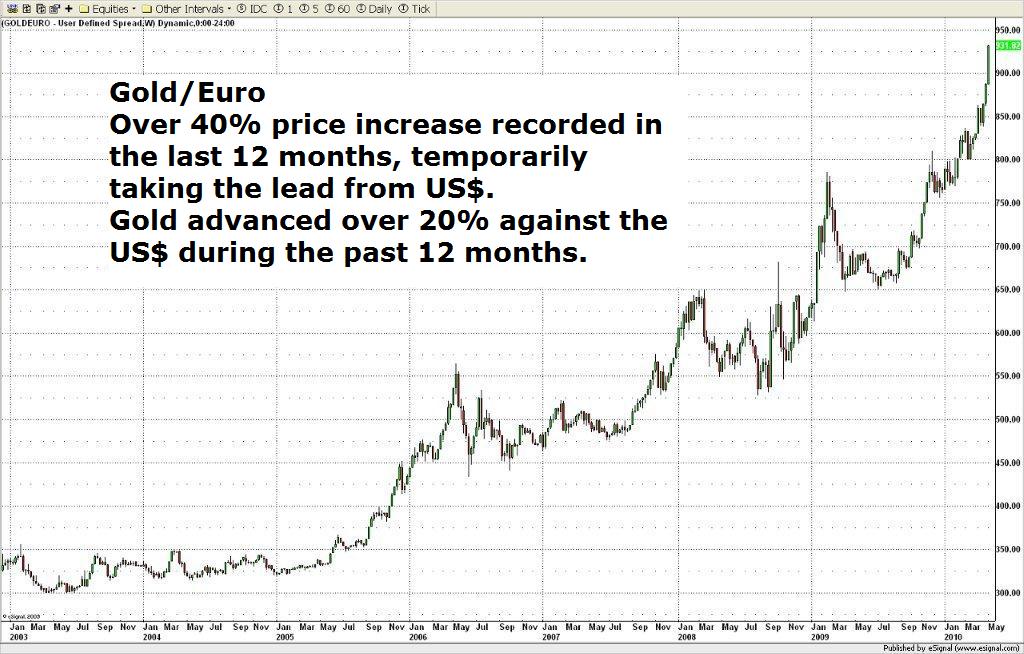
Iceland is classic prey for Soros. The Icelandic krona has been decimated as a currency and has no where to go but up in value, especially if the British pound and the euro depreciate. Soros is currently talking down the euro, planning its fall and shorting it, just like he did versus the pound in London in the 1980s. After the UK's and Europe's currencies are devalued, Soros will buy every euro note in sight, thus making trillions.

Soros and his Wikileaks friends have in Iceland a practically unregulated banking system desperate for an influx of capital -- money that will come from the exiled Russian tycoons in Israel, London and the United States. Israeli investors like Bank Leumi, and awash in siphoned-off Bernard Madoff cash, will do their bit for this smash-and-grab operation by Soros's Quantum-linked hedge funds.

With Wikileaks firmly ensconced in Iceland, the "brave" and much-heralded information leakers will run an international blackmail operation against Soros's foes and launch computer break-ins against Soros's business rivals and non-Quantum banks. Wikileaks will be used as the info-hitmen against President Obama's and Rahm Emanuel's enemies in the 2012 re-election campaign.

From Iceland, Soros will be well-positioned to gain control over the massive mineral resources under the melting ice sheet of Greenland. Under the ice are the only major rare-earth deposits outside of China and with such minerals at his disposal, Soros can control the world's electronics industries. This past week's volcanic activity in Iceland could, however, disrupt or destroy Soros's plans to establish and control a North American-European gateway in Iceland.

The following are some of the emails Young revealed in his exposure of Wikileaks's CIA connections (as well as to the Russian "phishing" Mafia, an operation run by Russian-Israeli Jews using Israel as a base) [Note: in the second email, "JYA" is a reference to John Young Associates]:

To: John Young
From: Wikileaks
Subject: martha stuart pgp
Date: Sun, 7 Jan 2007 12:20:25 -0500

-----BEGIN PGP MESSAGE-----
Version: None

J. We are going to fuck them all. Chinese mostly, but not entirely a feint. Invention
abounds. Lies, twists and distorts everywhere needed for protection.
Hackers monitor
chinese and other intel as they burrow into their targets, when they pull, so do we.
Inxhaustible supply of material. Near 100,000 documents/emails a day. We're going to crack the world open and let it flower into something new
. If fleecing the CIA will assist us, then fleece we will. We have pullbacks from NED, CFR, Freedomhouse and other CIA teats. We have all of pre 2005 afghanistan. Almost all of india fed. Half
a dozen foreign ministries.
Dozens of political parties and consulates, worldbank,
apec, UN sections, trade groups, tibet and fulan dafa associations and... russian
phishing mafia who pull data everywhere
. We're drowing. We don't even know a tenth
of what we have or who it belongs to. We stopped storing it at 1Tb.

-------------------------------------------
From: Julian Assange
Date: Mon, 8 Jan 2007 13:40:14 +0000
To: funtimesahead[a t]lists.riseup.net
Subject: [WL] cryptome disclosure

[This is a restricted internal development mailinglist for w-i-k-i-l-e-a-k-s-.-o-r-g.
Please do not mention that word directly in these discussions
; refer instead to 'WL'.
This list is housed at riseup.net, an activist collective in Seattle with an established lawyer
and plenty of backbone.]

No idea what JYA was saying!

It's clear to me however, that he was not trying to protect people's
identities with his xxxxx'ing, but rather trying to increase the
sexiness of the document. Perhaps he feels WL is a threat to the
central status mechanism in his life? I think he just likes the
controversy.

He may have done us a great favor. There's a lot of movement in that
document. It's a little anarchist, but I think it generally reads
well and sounds like people doing something they care about.

Btw, I suggest we be careful with Wayne Madsen too. He seems to be
another case of someone who was fantastic a few years ago, but
recently has started to see conspiracies everywhere. Both cases
possibly age related.

I am not spending any more thought on it. Next week is going to be
busy.
The weeks earlier stories will be already done and that'll set
the agenda for the rest of the week, not jya's attention seeker.

I'm willing to handle calls for .au, although my background may make
S a better bet.

--------------------------

One of WMR's sources had the following thoughts about Assange's comments about this editor:

Careful: Madsen is up to no good concerning secrets concerning WikiLeaks.
Another Case of Someone: The writer has spent time in psychiatric institution.
Was Fantastic: Formerly On Our Side, Now becoming an Enemy.
Conspiracies Everywhere: the George Soros conspiracy in which WikiLeaks is a cog.
Both Cases: Here it is again, he's been in an institution.
Age Related: In 2007, the editor was 52 years old but with possible early senility setting in.


March 26-28, 2010

Wikileaks and Iceland media law are stalking horses for Soros

Following up on WMR's March 25, 2010 report on Wikileaks's ties to U.S. intelligence, Mossad, and George Soros, WMR has received additional information that points to the Icelandic media law that would turn the economically-battered country into an information safe haven for websites like Wikileaks as being a contrivance of George Soros's Open Society Institute (OSI).

WMR has learned that OSI's Mark Thompson spoke at the May 2009 First Council of Europe Conference of Ministers responsible for Media and New Communications Services. Present at the conference was Katrin Jakobsdóttir, Iceland's Minister of Culture, Education, and Science and members of the Icelandic parliament, the Althing. It was after this conference that the Icelandic Modern Media Initiative was introduced with much fanfare from Wikileaks and its co-founder Julian Assange. Thompson has a background that includes propagandizing for the western incursion into the Balkans, including directing the Media Analysis Unit for the UN mission in Yugoslavia, UNPROFOR; the Organization for Security and Cooperation in Europe, and Soros's OSI.

Wikileaks claims it is the first website dedicated to revealing sensitive and classified information. This is false. In fact, Cryptome, founded by New York City architect John Young, was the first and Wikileaks is a mere poor facsimile. John Young once proudly proclaimed to this editor that he would likely become America's "first political prisoner" from the Internet. Young's Cryptome has gone far beyond Wikileaks by publishing a list of British MI-6 agents, Microsoft's manual on how it conducts surveillance for U.S. law enforcement, photos of Guantanamo and a list of the detainees imprisoned there, and even overhead photos of Dick Cheney's home in McLean, Virginia while it was under construction.

And Wikileaks appears to have climbed on to the previous work of others. In 2008, Wikileaks claimed to have obtained, through "hacking," the credit card records of the Norm Coleman Senate campaign in Minnesota. In fact, WMR has been informed that the credit card files, along with the campaign's backup material, was stored by the webmaster in an unprotected folder. It was this file that was downloaded. The "hack" was heralded by MinnesotaIndependent.com, a Soros-funded operation. The illegal operation was never acted upon by law enforcement. In addition, the website PoliticsInMinnesota.com reported on the leak of the files several weeks before the Coleman data appeared on Wikileaks.

It is Young's Cryptome that has been harassed by the U.S. government and Internet Service Providers. Meanwhile, Wikileaks has come up with a fanciful tale of its activists being tailed in Iceland by shadowy Icelandic and American gumshoes and fears that they will be "taken out" before they can air a video at the National Press Club in Washington, DC on April 5 showing a U.S. missile attack on Afghan civilians. There is also a specious claim that the military's encryption codes were somehow broken to obtain the video. If that is true, the real story is that the United States suffered a major compromise of its cryptographic keys, something that has only rarely occurred in the past.

When John Young pulled out of the Wikileaks operation in 2007, suspecting it was a CIA front, there were also early allegations that Wikileaks was funded by Soros. Soros fronts for the CIA by running the operations of Radio Free Europe, Radio Liberty, and Radio Free Asia. In fact, one of Wikileaks's advisory board members, Chinese dissident Xiao Qiang, is a commentator for Radio Free Asia.

Soros has been heavily involved in Iceland since 1998 and it is Soros who helped found the small Democracy Movement. The website Reykjavik Grapevine took the Democracy Movement to task last October 22 when it wrote, "A speculative column appearing on Vísir.is points out that billionaire George Soros has enough money to buy Iceland . . . Foreign investment - or foreign exploitation - of Iceland has been on the minds of a lot of Icelanders lately, especially as more companies from abroad express an interest in Iceland's natural resources . . . And look at this, Obama's OMB director Peter Orszag (the name is Jewish from Hungarian-Romanian Transylvania like fellow vampire Soros) and his connection to Iceland: "In 1998, after serving in the Clinton administration, Orszag co-founded an economic consulting group company with his brother and Joseph Stiglitz called Sebago Associates, where he served as president through 2007. The firm's clients have included the World Bank, the Nordic Council of Ministers, and most notably, the Central Bank of Iceland. The once prosperous economy of Iceland has been devastated by the current economic crisis, which its citizens say was carried out by a gang of financial criminals who followed disastrous policies and advice - provided by Peter Orszag and Company."

Soros appears to have been partly behind the collapse of the Icelandic economy and now his minions in Reykjavik and his contrivance, Wikileaks, wants to transform Iceland into an information technology safe harbor from he and his NGO network can engage in massive propaganda campaigns and destabilization efforts around the world without the fear of legal ramifications.

WMR's sources report that the Soros Private Equity group (since renamed TowerBrook Capital Partners) invested $10 million in TradeDoubler, a Swedish online provider and platform, in cooperation with the Icelandic venture firm Arctic Ventures. TradeDoubler handles online financial payments and transactions but mainly online advertising, and is big in online betting throughout Europe. The downfall of Iceland's banks was enabled by online banking and investment. Ragnar Thorisson, an Icelander, worked at VBS Securities before founding Arctic Ventures (where he invested in E-Trade Nordic). He then invested in Argnor, a wireless service provider. Ordinary members of the TradeDoubler Board of Directors include Niclas Gabrán and Ramez Sousou of Soros Private Equity group, now TowerBrook Capital Partners. Thorisson reportedly sold his shares in TradeDoubler.

It is also noteworthy that TowerBrook is heavily invested in healthcare services and pharmaceuticals and stands to reap huge profits from President Obama's health care program.

Although Soros claims he is for freedom of information, going as far as promoting Iceland as a freedom of information paradise, criticism of Soros's operations don't appear to be covered by the former Hungarian Nazi collaborator's largess as seen in the following RT program when this editor criticized Soros's operations. Iceland's Soros-prompted media reform bill also contains a provision for an Icelandic Freedom of Expression Award, a typical Soros construct. Soros's NGO network provides for a number of awards that are used to pad the resumes of a number of dubious bad actors.

http://www.waynemadsenreport.com/articles/20100328_1

March 29, 2010

Soros's game plan for Iceland and its "freedom of information" zone was hatched years ago

More details have emerged from WMR's sources about the Wikileaks claim that it is subject to intense surveillance by U.S. and Icelandic authorities.

Wikileaks, a website that claims to publish explosive sensitive documents from government agencies around the world, claims to have been the subject of surveillance because it plans to release a video of a missile attack by American forces of Afghan villagers. The site also claims to have broken top secret U.S. military encryption codes to obtain the video, which it plans to release at a press conference at the National Press Club in Washington, DC on April 5.

Wikileaks has been party to a proposed media bill in the Icelandic legislature that would establish a "freedom of information" zone in Iceland benefiting journalists, human rights campaigners, and whistleblowers.

WMR's sources claim the entire Wikileaks episode in Iceland and its claims are a fraud inspired by George Soros, a frontman for the CIA and the Rothschild banking family in Britain.

Iceland appears to be getting wise to the Wikileaks caper. According to IceNews, Iceland's Ministry of Justice has distanced itself from Wikileaks's alleagtions of Icelandic surveillance and Fridrik Smari Bjorgvinsson, chief of the Reykjavik police, said the only link to the Wikileaks charges was the arrest of 17 year-old in Kopavogur on March 22 for breaking into a business. Wikileaks claims the individual was questioned about how the U.S. military video was obtained. However, according to the Icelandic government, Wikileaks is creating a fantasy issue over the arrest of a young person for breaking and entering in a country where such crimes are rare.

John Young, who runs the bona fide sensitive document exposure website, Cryptome.org, left the Wikileaks board in 2007, charging that it was a CIA front. In a leaked January 8, 2007, e-mail, Wikileaks's co-editor wrote that WMR's editor "see[s] conspiracies everywhere" and that the condition was "possibly age related." This editor was 52 years old as of the date of the e-mail.

WMR has learned from knowledgeable sources that Wikileaks's claims that it protects the identity of whistleblowers and leakers are rife with problems. Wikileaks uses the program "TOR" for file downloads. WMR has been informed by one source that TOR, the German word for "gate," "gives away email accounts, user names, and passwords on a user's computer, meaning the CIA can trace any whistleblower dumb enough to believe Wikileaks's hype and everyone who is downloading." From an unrestricted information zone in Iceland, Wikileaks would be free to collect such sensitive user information to pass on to Langley and Soros's operatives -- working under non-governmental organization (NGO) cover, around the world.

Last year, Wikileaks leaked its own confidential donor list on its website. Wikileaks released a statement that the list was leaked "possibly to test the project's principles of complete impartiality when dealing with whistleblowers." One was a convicted hacker who had broken into Worldcom's intranet and obtained Social Security Numbers, bank account information, and direct deposit details for over 80,000 WorldCom employees.

Soros has long preyed on Iceland's economy. WMR's sources reveal that during the winter of 2007-2008, Soros hedge funds were shorting the Icelandic krona. There are reports that the U.S. Justice Department is now investigating Soros's SAC Capital for shorting the euro and the British pound.

The collapse of the Icelandic economy, aided and abetted by Soros and Rorthschild financial interests in Britain and the Netherlands, set the stage for Soros to make the approach to financially-broke Iceland to become a global information "safe harbor."

Wikileaks critics also point out that the website has produced information that had previously been available elsewhere, including such "exposés" as U.S. detainee abuse, use of chemical weapons in Iraq and Afghanistan, and U.S. military propaganda operations. The recent revelation of a 2008 U.S. Army Counterintelligence Center report citing Wikileaks as a threat to national security is a red herring. The document proposes to identify those who leak to Wikileaks to "damage and potentially destroy" the Wikileaks "center of gravity." According to WMR's sources, Wikileaks's use of TOR has already exposed the leakers. At the least, the U.S. Army's fears about the Wikileaks site is an extreme over-reaction. At the most, the Army was attempting to boost the website's bona fides as part of a cyber-psychological warfare campaign.

http://www.waynemadsenreport.com/articles/20100401

April 1-4, 2010

How Wikileaks and Soros conspired to bring down Swiss bank

WMR's financial intelligence sources report that the unauthorized disclosure of a compact disk to Wikileaks that contained financial details of the clients of the secretive and usually highly-secure Zurich-based independent money management Julius Baer Group was designed to destroy the firm's standing with its customers and make it ripe for a hostile takeover by interests associated with multi-billionaire vulture capitalist George Soros, including Goldman Sachs. Julius Baer was founded in the 19th century.

In December 2007, the former chief of Baer's Cayman Islands unit, Rudolf Elmer, leaked information about surveillance of him and his family to Wikileaks. In June 2005, the Swiss newspaper "Cash" and the Wall Street Journal reported on the receipt of a CD containing clients’ transactions, including every deposit made, from Baer's Cayman unit that dealt with anonymous trusts. The CD data covered the time frame 1997 to 2002. Elmer had been suspected of the leak and was fired by Baer in 2003. In January 2008, Wikileaks began publishing details of Baer's clients -- who were accused of tax evasion and money laundering. The clients resided in the United States, Hong Kong, Germany, Switzerland, Greece, Spain, and Peru. Elmer was jailed briefly in 2005 by Swiss authorities for violation of Swiss financial privacy laws. Elmer eventually turned over Baer documents to Manhattan District Attorney Robert Morgenthau, the US Internal Revenue Service, and the Senate Senate subcommittee on investigations headed by Senator Carl Levin (D-MI).

For Europeans and others who had no financial or other connections to the United States, the fact that they were placed under an investigation by the United States represented a huge jurisdictional leap by the United States in applying U.S. laws where they had no force. In April 2007, some Baer documents were also leaked to the German tax authorities.

For example, the Hong Kong resident on the leaked Baer documents is Lord Kadoorie, who died in 1993. The Kadoorie family, originally Iraqi Jews from Baghdad, migrated to Hogn Kong via Mumbai. The Kadoories, however, were not involved in tax evasion' since using offshore accounts is completely legal in Hong Kong.

Elmer worked for Baer for 16 years, first bas a senior auditor and then from 1994 to 2003 as the chief of the bank's unit in the Cayman Islands. Elmer is represented by former Senate Foreign Relations Committee investigator Jack Blum, now with the Lobel Novins Lamont law firm in Washington, DC. After being fired by Baer in 2003, Elmer went to work for Noble Investments of Zurich, a hedge fund consultancy. Elmer began leaking information about Noble, as well, including its use of a Bermuda shell corporation to avoid Swiss taxes.

Blum helped investigate bribery violations of the Foreign Corrupt Practices Act in the 1970s by Lockheed Corporation. The Lockheed bribery scandal helped bring down Japanese Prime Minister Kakuei Tanaka, who was later convicted and imprisoned in Japan for accepting bribes from Lockheed. However, WMR has learned that Blum and the Senate committee was very selective in who they investigated for laundering money from foreign bribes. While Tanaka was singled out, Chilean dictator General Augusto Pinochet, who overthrew and assassinated democratically-elected Chilean President Salvador Allende with the help of Henry Kissinger and the CIA, was allowed to launder his ill-gotten gains through Riggs Bank in Washington, DC. WMR has learned that Tanaka despised both Richard Nixon and Kissinger and he was thus targeted selectively by the Nixon Justice and Treasury Departments.

On December 4, 2008, Alex Widmer, 52, the CEO of Julius Baer and a widower with three children, was found dead from an apparent suicide. Widmer had expanded Baer's presence in Moscow and Indonesia and he previously served as the chief of private banking for Credit Suisse. WMR has learned that Widmer was assassinated after he discovered the links between the bank's leaks of client information to the media and Wikileaks and Israeli intelligence and the Soros network. Only the New York Times reported that Widmer's death was from suicide and an autopsy report was never released but bank employees were told that Widmer died from an "unexpected illness."

After Julius Baer Group was rocked by the leaks by Elmer through Wikileaks, Baer became the target of a takeover bid by Goldman Sachs. As hedge funds began withdrawing from Baer, the firm's share values dropped by 60 percent making it vulnerable to a hostile takeover. The hedge fund withdrawals lasted for ten months during which time Goldman Sachs was behind the attack on Lehman Brothers and Soros was shorting the Icelandic krona.

There is also another interesting wrinkle to the Baer story. The leaks of Baer's client data began in 2002. Wikileaks was not founded until 2006. In the interim, there were other operatives involved in leaking the firm's data to the media. The suspicions are that they worked for Soros's Quantum, which is a front for Rothschild interests, as well as for Goldman Sachs. WMR has learned that suspicions about the pre-Wikileaks leakers is focused on Mossad agents. The Julius Baer operations in the Cayman Islands would have involved the financial holdings of Latin Americans involved in drug money laundering. The involvement of Mossad in exposing the Cayman accounts likely had repercussions for Israelis who were also involved in cocaine smuggling in Latin America. It is pointed out that in March 2007, as Baer information was continuing to leak, Tsuriel Raphael, Israel's ambassador to El Salvador, was found in the garden of his home drunk, naked, and tied up with a rubber ball in his mouth and a sex toy inserted in his anus. Raphael was recalled to Israel. A few months earlier, in January, the body of David Dahan, the chief of Israel's Defense Ministry Mission to Europe, was found floating in the Seine near Rouen, France. Police ruled out foul play and said the death was a suicide.

Post-9/11 anti-terrorist financing legislation permitted Goldman Sachs's and Soros's operatives within the Treasury Department to target any bank where it was even suggested that people associated with Osama bin Laden may have had accounts. However, for Soros, Goldman Sachs, and the Mossad, the attack on Julius Baer represented some "score settling" over Swiss financial holdings from victims of the Holocaust.

To summarize succinctly what occurred with Baer and Wikileaks, WMR received the following real-world explanation: "The Bush administration investigators find few accounts actually linked to terrorism, but a lot of accounts of rich Arabs, who get pissed at being misidentified and who then complain to Bush. So then, the neocons go after middle-tier billionaires and millionaires for 'tax evasion' and 'corruption' - which are NOT part of the USA Patriot Act, but are still a good source of easy money, since the victims don't have room to complain. When the robbed do complain, they are threatened with exposure to the media, and when the media hesitates to publish, there's a standoff. The banks have to protect their clients since the "prosecution" targets, in some cases, are intelligence agents. The Soros hedge funds and Goldman dump shares in the Euro banks, but to no avail. They hire stooges like Rudolf Elmer, a disgruntled manager fired from the Caribbean division of Julius Baer. All he's got is tax evasion, not even proof of drug money, because he's not stupid enough to cross the cartel. Elmer then moves to Mauritius. So without any handles on Baer and other Swiss banks, the U.S. government leaks customer lists (confiscated from scared employees by the Treasury and CIA agents) to Wikileaks, conveniently created by the Soros-Goldman Sachs-Mossad construct for blackmail purposes."

---------------------------------------------------------------------------------------------------------------

Israel-US

http://www.waynemadsenreport.com/articles/20100323

March 23, 2010

Israel's secret network into the Obama Oval Office.

As Israel's hard right-wing Prime Minister Binyamin Netanyahu visits the Oval Office today, there is speculation that he and President Barack Obama will square off over Israeli settlements in east Jerusalem after weeks of acrimony between the two countries after Israel announced plans to build an additional 1600 Jewish units in Arab neighborhoods in the disputed city.

Apparently, Netanyahu is still flexing his political muscles by requiring Secretary of State Hillary Clinton to meet him on March 22 at the Mayflower Hotel in Washington (the same hotel that served as the tryst rendezvous for former New York Governor Eliot Spitzer who was "honeytrapped" by an escort agency run by a suspected Mossad-linked owner) rather than at her office at the State Department. Netanyahu's impolitic moves follows his handing Vice President Joe Biden a broken plaque, with shards of glass flying, at a recent event in Jerusalem. Netanyahu's brother-in-law, Hargai Ben-Artzi, recently used the typical and well-worn canard of "anti-Semitic" to describe Obama.

WMR has learned from a source close to Netanyahu that the Israeli Prime Minister's chief adviser, Ron Dermer, serves as his personal conduit to the Oval Office, particularly to Obama's chief of staff, Rahm Emanuel. Dermer is a leading Israeli hawk who also co-authored "The Case for Democracy: The Power of Freedom to Overcome Tyranny and Terror" with Israeli expansionist and former Soviet refusenik Natan Sharansky.

Dermer is a classic dual U.S.-Israeli citizen. Although he claims to have given up his U.S. passport when he agreed to work for Netanyahu in Jerusalem, Ron Dermer's brother is the former three-term mayor of Miami Beach, David Dermer. Ron Dermer has enough clout in Washington to get put right through the the president's chief aides, including Emanuel and David Axelrod.

The father of the Dermer brothers, Jay Dermer, also served as a two-term mayor of Miami Beach. Jay Dermer died in 1984 at the age of 54, one year following the death in Miami Beach of Meyer Lansky. Jay Dermer fought to protect Florida's paramutuel gambling interests against the introduction of casinos into the state. Lansky tried to flee to Israel in 1970 to avoid prosecution in the United States. Although Israel ruled that Lansky was a threat to "public safety," he was given Israeli travel documents. After Switzerland, Brazil, Argentina, Paraguay, Bolivia, Peru and Panama rejected Lansky's offer of $1 million for asylum, he was arrested in 1972 in Miami. Most of the criminal charges against Lansky were dropped by the Nixon administration and Lansky was judged too ill to stand trial for other charges. Lansky remained in Miami Beach until his death.

The Miami Beach connection to the Oval Office is noteworthy since the city has continued to serve as a major base in the United States for the Jewish Mafia, which started with Lansky and continues with the number of Russian-Israeli Jewish gangsters in the city, many of them wanted by Russia.

Although Chicago native Lee "Rosy" Rosenberg, seen as a close friend of Obama and who served on the finance committee for the Obama presidential campaign, has taken over as the new president of the American Israel Public Affairs Committee (AIPAC), the Israeli media has reported that he is adept at bringing in big money for Israeli causes from individuals not normally known for their public support for Israel. Rosenberg's music and real estate industry businesses, in addition to his close links to Emanuel and Axelrod, have some observers wondering whether the individuals not for their public support for Israel may be those connected to dodgy business enterprises, particularly those in Las Vegas.

As the media writes about the "gulf" between Obama and Netanyahu, the presence of Israeli insiders in the Oval Office puts into doubt any suggestion that Israel and the United States are drifting apart on any policies.

---------------------------------------------------------------------------------------------------------------

Cuba

http://www.waynemadsenreport.com/articles/20100324_2

March 24-25, 2010

Castro's secret archives: US Special Ops prepares to snatch five decades of damaging material

WMR has learned from knowledgeable sources in the Pentagon that the U.S. Special Operations Command has recently been tasked to come up with a covert operation designed to snatch the secret archives complied over five decades by former Cuban President Fidel Castro.

Our sources report that among Castro's archives are documents proving the collaboration of top U.S. Mafia figures, including Mafia financial boss Meyer Lansky, with the CIA in the assassination of President John F. Kennedy in Dallas in 1963. Castro apparently kept track of many of those involved in the assassination of Kennedy because they were also actively involved in anti-Castro plots associated with right-wing Cuban exiles that were organized out of Miami, New Orleans, Houston, and Dallas, cities where the Mafia was extremely active.

WMR has learned that Castro's extensive archives have been secured in a well-protected facility on the Isle of Youth (formerly the Isle of Pines) off the southwest coast of Cuba.

In addition to documents that point to the mob's and CIA's involvement in the Kennedy assassination, including the roles played by the Canadian Bronfman family and their wealthy attorney, the CIA-connected Louis Bloomfield of Montreal, the Castro archives reportedly contain a wealth of information about Cuban support for Angola's government and liberation movements in Africa and Latin America. The archives also have details about the role of the CIA in the Angolan civil war and the coups that toppled Chilean President Salvador Allende and other leaders, as well as Henry Kissinger's infamous Operation Condor that "disappeared" thousands of leftist, student, and labor leaders in Latin America.

The plans by the U.S. Special Operations Command to surreptitiously land on the Isle of Youth and secure the Castro archives may have something to do with the recent arrest of a U.S. Agency for International Development (USAID) contractor as he was boarding a plane in Havana. Alan Phillip Gross of Potomac, Maryland was arrested on December 5 last year and charged with espionage. Gross entered Cuba on a tourist visa but began working on projects designed to provide Internet technology services for Cuban Jewish communities. Gross worked for Development Alternatives, Inc. (DAI) of Bethesda, Maryland, a State Department contractor that specializes in bringing high-technology services to "civil society organizations." Gross is reportedly a satellite technology expert.

Gross reportedly made a number of trips to Cuba before his arrest. Throwing doubt on claims that Gross was in Cuba to help provide Internet access to the Cuban Jewish community, several prominent members of Cuba's Jewish community said they never met Gross. In addition, Cuba's small Jewish community was already receiving computer and Internet assistance from ORT, a non-governmental organization.

Gross's mission in Cuba has been clouded in mystery. Cuba said Gross was illegally distributing satellite communications equipment, which would be important for in-country support in a mission to secretly insert a U.S. military team in Cuba to spirit away Castro's archives.

Due to Gross's visibility with Jewish groups in the United States, his arrest has affected on-going talks between Washington and Havana designed to improve relations between the two nations.

DAI's website states the company started operations in 1970 and by 1980 was active in Sudan, the then-Zaire, Tanzania, and Indonesia. In a move that mirrors that of Barack Obama and his mother Ann Dunham, DAI extended its development operations from Indonesia to Pakistan and by 1982 the firm was fully active in that nation at a time the U.S. was using Pakistan as a base to support the Afghan mujaheddin against the Soviet Union in Afghanistan. DAI is also active in Jordan, Palestine, Mexico, and South Africa.

The arrest of Gross in December came as former President Fidel Castro began to reassert control over the government, particularly through the appointment as Vice President of the Council of State of Ramiro Valdes Menendez, a Castro loyalist and former Interior Minister who understands the need to protect the Island of Youth archives from being snatched by the United States or other non-state players.

In April 2003, a Cuban man hijacked an Antonov-24 from the Isle of Youth and, after a brief landing at Havana's Jose Marti International Airport where some women and children passengers were released, was allowed to fly to Key West. The hijacker, who threatened to blow up the plane with two hand grenades, was eventually granted asylum in the United States after the ritualistic debriefing by FBI and CIA personnel.

Wayne Madsen

Investigative journalist, author and syndicated columnist. His columns have appeared in a wide number of newspapers and journals. Madsen is a regular contributor on Russia Today. He has written The Handbook of Personal Data Protection (London: Macmillan, 1992); Genocide and Covert Operations in Africa 1993-1999 (Edwin Mellen Press, 1999); Jaded Tasks: Big Oil, Black Ops & Brass Plates and Overthrow a Fascist Regime on $15 a Day and co-authored America’s Nightmare: The Presidency of George Bush II (Dandelion, 2003).

Thursday, 25 February 2010

geopolitics: shift of the balance of power (6 texts)

Balance of Power Shift Coming Says Wolfensohn, Former World Bank President

In the next 40 years, a global power shift will see today's leading economic countries drop from having 80% of the world's income to 35%, says John Wolfensohn, former World Bank president. By 2030, two-thirds of people in the world's middle class will be Chinese.

January 2010

STANFORD GRADUATE SCHOOL OF BUSINESS

James Wolfensohn is all about balance. The former World Bank president introduced himself to a student audience Jan. 11 by talking about how he is grateful at this point in his life to devote time and money to a "balance between business and nonbusiness activities." And in the speech before an overflow crowd, he urged students to "enrich your life as you enrich your business."

"That aspect of duality is the thing that has made my life meaningful" he said.

But the balance of power in the world is what Wolfensohn spent the majority of his hour-long appearance on. A huge power shift will occur in the next 40 years that will reduce the influence of the wealthiest countries, he said. As population and GDP grows in countries such as China and India, they will assume a larger role in relationship to the United States and Europe. The developed countries will drop from having 80% of the world's income to 35%. "There will be a monumental shift of economic power. It's not just a moderation trend, but a fundamental change in the world balance," he said.

By 2030, two-thirds of people in the world's middle class will be Chinese, Wolfensohn said. "These are not trivial changes -- they are tectonic changes in the way the planet works. In my generation we didn't have to think about it. We knew we were a rich country."

But today's students will have to confront a new world in which Africa is no longer an isolated continent but the fastest-growing market for cell phones.

Looking around the auditorium, Wolfensohn noted that many more students from China and India travel to the United States to study, rather than the other way around. In 2007 just 11,200 Americans studied in China. That year more than 110,000 Chinese were studying in the United States.

"It's a tragedy in terms of the potential of young people that they're still being guided to look at European countries," he said.

Wolfensohn was making a repeat appearance at the Stanford Graduate School of Business as a speaker in the Global Management Program's Global Speaker Series. In 2004, while still at the helm of the World Bank, he spoke about how developed countries were delivering on the promise they made to aid developing ones.

He stepped down in 2005 from a decade-long career heading the agency that is in charge of redistributing the world's wealth from the rich to the poor. He now heads an investment banking firm in New York. At 76, he is still advising organizations and governments on economic policy and helps developing countries through his foundation.

Asked about whether humanitarian aid to Africa was a help or a hindrance, Wolfensohn said aid organizations need to be selective. "There are some extremely corrupt countries," he said, adding that the best countries should be rewarded. "I say to the others: it's not acceptable to steal."

He also predicted a shakeup in how the leadership of the World Bank and the International Monetary Fund would be appointed. Traditionally, the president of the former was from the United States and the latter from Europe. The bank may be "internationalized" in the future.

The World Bank's stated goal is to reduce poverty. As an international financial institution, it provides loans to developing countries for capital programs. It was created out of World War II with France as the first recipient of world aid. In the late 1960s the emphasis shifted to loans for developing countries.

Wolfensohn is a native of Sydney, Australia, and a naturalized U.S. citizen. In addition to his firm, Wolfensohn & Co., he is an honorary trustee of the Brookings Institution. He was appointed to head the World Bank in 1995 by President Bill Clinton and served two terms.

Joyce Routson

---------------------------------------------------------------------------------------------------------------

http://news.bbc.co.uk/1/hi/world/americas/8531266.stm

2010/02/24

New US-free Americas bloc agreed

Latin American and Caribbean nations have agreed to set up a new regional body without the US and Canada.

The new bloc would be an alternative to the Organisation of American States (OAS), the main forum for regional affairs in the past 50 years.

Mexico has been hosting a regional summit in the beach resort of Cancun.

The OAS has been dogged by rifts between some members and the US over economic policy and trade, and criticised for promoting US interests.

'Regional integration'

The proposed new grouping was one of the main issues on the agenda of the two-day summit, which ended on Tuesday.

It "must as a priority push for regional integration... and promote the regional agenda in global meetings", Mexican President Felipe Calderon told the summit, which includes leaders and representatives from 32 countries.

Cuban President Raul Castro was quick to applaud Mr Calderon's announcement as a historic move toward "the constitution of a purely Latin American and Caribbean regional organisation".

Cuba was suspended from the OAS in 1962 because of its socialist political system. In 2009, the OAS voted to lift Cuba's suspension but the country has declined to rejoin.

Venezuelan President Hugo Chavez earlier expressed his support for the proposal, citing it as a move away from US "colonising" of the region.

A US State Department official, Arturo Valenzuela, said he did not see the new body as a problem.

"This should not be an effort that would replace the OAS, " he said.

The terms of the new bloc and whether it would replace the Rio Group of Latin American countries has not been clarified.

"It's very important that we don't try to replace the OAS," said Chile's President-elect Sebastian Pinera. "The OAS is a permanent organisation that has its own functions."

On Monday, Bolivian President Evo Morales proposed that it begin operating in July 2011 with a summit hosted by Venezuela.

Falklands row

The Cancun summit has also unanimously backed Argentina's claim over the British-owned Falklands.

Argentina is angered that a UK firm has begun drilling for oil off the Falkland Islands, which lie about 450km (280 miles) off the Argentine coast.

Argentina and Britain went to war over the South Atlantic islands, which Argentina calls the Malvinas, in 1982, after Buenos Aires invaded them.

The leaders at Cancun also discussed whether to recognise Porfirio Lobo as the legitimate president of Honduras after he was elected president under interim authorities following a 28 June coup that ousted Manuel Zelaya.

A long-term plan to help Haiti recover from the devastating January earthquake was also on the agenda.

---------------------------------------------------------------------------------------------------------------

updates from The Times:

US refuses to endorse British sovereignty in Falklands oil dispute


Brazil attacks UN over Falklands stand-off

http://www.timesonline.co.uk/tol/news/uk/article7036764.ece

Latin America backs Argentina as Britain begins Falklands oil quest

February 23, 2010

Argentina cemented a Latin American front over the Falklands yesterday as a British oil rig began drilling in the disputed seas around the islands.

Regional leaders at the Rio Group summit in Mexico were expected to sign up for a resolution backing Argentina in its escalating row with Britain after Brazil and Chile pledged their support.

Venezuela’s vociferous President, Hugo Chávez, set the tone of the summit, offering military support. Characterising Britain as an imperialist relic, Mr Chávez demanded the return of "Las Malvinas", as they are known to Argentinians.

“The English are still threatening Argentina. Things have changed. We are no longer in 1982,” he warned. “If conflict breaks out, be sure Argentina will not be alone like it was back then.”

British control of the archipelago was “anti-historic and irrational”, the former paratrooper continued, asking “why the English speak of democracy but still have a Queen”.

Unlike 1982, when some Latin American nations, notably President Pinochet’s Chile, backed Britain’s campaign to repel Argentina’s brief invasion of the islands, the continent now enjoys strong ties between ideologically aligned governments and could mount a powerful resistance to British oil operations.

Mr Chávez was joined by President Ortega of Nicaragua, who predicted that the Rio Group would throw its weight behind Argentina’s claim. “We will back a resolution demanding that England return Las Malvinas to its rightful owner, that it return the islands to Argentina,” he said.

Brazil, the biggest regional power and traditionally Argentina’s main rival, was similarly supportive. “Las Malvinas must be reintegrated into Argentine sovereignty,” Marco Aurelio García, foreign policy adviser to President Lula da Silva, said, adding: “Unlike in the past, today there is a consensus in Latin America behind Argentina’s claims.”

Almost three decades on from the confict, the defeat of Argentina still stings the national consciousness as an historic injury which must be redressed. President Fernández de Kirchner of Argentina has made the issue a central plank of her presidency, whipping up long-simmering resentments that have only been compounded by the prospect of a black gold bonanza in the isolated, windswept archipelago.

The British Geological Survey estimates that up to 60 billion barrels of oil could be beneath Falklands waters, although Desire Petroleum, the company carrying out the drilling, says that the commericially viable reserves are much smaller.

Desire said that test drilling at the Liz 14/19-A exploration site off the Falklands began at 1415 GMT yesterday. “Drilling operations are expected to take approximately 30 days and a further announcement will be made once drilling is completed.

Tensions between the former adversaries rose last week to their highest level since the war, as Argentina attempted to block ships supplying what it says are “illegal” British activities and Britain hit back with a warning that the islands were much better defended than on the eve of the Argentine invasion in 1982.

---------------------------------------------------------------------------------------------------------------

http://www.nytimes.com/2010/02/24/world/europe/24nato.html

February 24, 2010

Gates Calls European Mood a Danger to Peace

WASHINGTON — Defense Secretary Robert M. Gates, who has long called European contributions to NATO inadequate, said Tuesday that public and political opposition to the military had grown so great in Europe that it was directly affecting operations in Afghanistan and impeding the alliance’s broader security goals.

“The demilitarization of Europe — where large swaths of the general public and political class are averse to military force and the risks that go with it — has gone from a blessing in the 20th century to an impediment to achieving real security and lasting peace in the 21st,” he told NATO officers and officials in a speech at the National Defense University, the Defense Department-financed graduate school for military officers and diplomats.

A perception of European weakness, he warned, could provide a “temptation to miscalculation and aggression” by hostile powers.

The meeting was a prelude to the alliance’s review this year of its basic mission plan for the first time since 1999. “Right now,” Mr. Gates said, “the alliance faces very serious, long-term, systemic problems.”

Mr. Gates’s blunt comments came just three days after the coalition government of the Netherlands collapsed in a dispute over keeping Dutch troops in Afghanistan. It now appears almost certain that most of the 2,000 Dutch troops there will be withdrawn this year. And polls show that the Afghanistan war has grown increasingly unpopular in nearly every European country.

The defense secretary, putting a sharper point on his past criticisms, outlined how NATO shortfalls were exacting a material toll in Afghanistan. The alliance’s failure to finance needed helicopters and cargo aircraft, for example, was “directly impacting operations,” he said.

Mr. Gates said that NATO also needed more aerial refueling tankers and intelligence-gathering equipment “for immediate use on the battlefield.”

Yet alliance members, he noted, were far from reaching their spending commitments, with only 5 of 28 having reached the established target: 2 percent of gross domestic product for defense. By comparison, the United States spends more than 4 percent of its G.D.P. on its military.

Dana Allin, a senior fellow with the International Institute of Strategic Studies in London, called Mr. Gates’s remarks “very striking.”

“Whether this is a conscious statement to sound a real sharp warning, there’s no question that the frustration among the American military establishment is palpable regarding coalition operations in Afghanistan,” he said.

Mr. Gates did soften his message a bit, noting that, not counting United States forces, NATO troops in Afghanistan were to increase to 50,000 this year, from 30,000 last year.

“By any measure,” he said, “that is an extraordinary feat.”

More sobering, he said, was that just two months into the year, NATO was facing shortfalls of hundreds of millions of euros — “a natural consequence of having underinvested in collective defense for over a decade.”

NATO’s problems — greatly magnified by the expansion of its mandate beyond European borders, following 9/11 — called for “serious, far-reaching and immediate reforms,” Mr. Gates said.

Indeed, the secretary general of NATO, Anders Fogh Rasmussen, last month turned to an unlikely source — Russia — to request helicopters for use in Afghanistan, arguing that this would help reduce the terrorism threat and drug trade on a border of the former Soviet Union.

Mr. Rasmussen, speaking at the same meeting as Mr. Gates, said that NATO’s members needed to better coordinate their weapons purchases. The European Union and NATO should collaborate on developing capabilities like heavy-lift helicopters, he said, and avoid “spending double money.”

---------------------------------------------------------------------------------------------------------------

http://www.timesonline.co.uk/tol/news/world/afghanistan/article7035719.ece

Dutch confirm Afghan troop pullout sparking fears of domino effect

February 22, 2010

Nato was left in fear of further troop withdrawals from Afghanistan yesterday after the Dutch Prime Minister conceded that he could not prevent his forces being pulled out this year after the collapse of the Government in The Hague.

Jan Peter Balkenende lost the argument over extending the deployment at a 16-hour Cabinet session, in the first big reversal for the recently appointed Nato leader, Anders Fogh Rasmussen, who had publicly requested a continued Dutch commitment.

“Our task as the lead nation [in Uruzgan province] ends in August,” Mr Balkenende said. After a three-month draw-down, the Dutch will be completely out of Afghanistan by the end of the year.

There are concerns that other countries where public opinion is turning against the Afghan campaign could follow, notably Canada, which has had the biggest proportional casualty rate and is committed to withdrawing its 2,800 troops by the end of next year. Another concern is the continued presence of 1,000 Australian troops. The Canberra Government has repeatedly refused to take over the lead role in Uruzgan if Holland leaves, demanding that a big Nato power provide the main share of troop numbers.

Just as important is the impression that European countries are struggling to find their share of the 10,000 extra troops requested by US General Stanley McChrystal to join 30,000 extra US troops in Afghanistan, with France ruling out more forces and a fierce debate in Germany.

The Times understands that the Dutch forces in Uruzgan will be replaced by US troops, diverting them from the surge operation against the Taleban.

Asadullah Hamdam, governor of Uruzgan, said that peace and reconstruction efforts would suffer, telling the BBC that the Dutch played a key role in building roads, training Afghan police and providing security for civilians. “If they withdraw and leave these projects incomplete, they will leave a big vacuum,” he said.

A British security source said: “This is a big setback because the Dutch are very highly rated. It is also a psychological blow, because as soon as one country leaves it starts making the public in other countries worried.”

Although the Dutch endured some sniping from bigger Nato powers about their perceived lack of aggression after they deployed to Uruzgan in 2006, their “population centric” strategy was a precursor of “The McChrystal Doctrine” adopted by British and American forces.

Mr Balkenende faces a general election in May after his main coalition partners, PvdA, the Labour party, walked out rather than break a promise to withdraw the 1,950 Dutch troops this year. Wouter Bos, the Labour leader, said: “A plan was agreed to when our soldiers went to Afghanistan. Our partners in the government did not want to stick to that plan, and on the basis of their refusal we have decided to resign.”

Mr Balkenende’s Christian Democrats and Labour are forecast to lose seats in the 150-member parliament. The two big gainers are forecast to be the ultra-liberals D66 and the right-wing Party of Freedom of the anti-Islamist MP Geert Wilders. Both oppose the Afghan mission.

A recent poll put support for keeping Dutch troops in Uruzgan at 35 per cent compared with 58 per cent for withdrawal, after 21 Dutch deaths.

The Dutch mission in Afghanistan was due to end in 2008, but the Government extended it until August 2010 — a decision made while the head of Nato was Jaap de Hoop Scheffer, a former Dutch defence minister.

In October Mr Rasmussen said: “I would regret a Dutch withdrawal. We are at a critical juncture, where there should be no doubt about our firm commitment. Any doubts will simply play into the hands of those who want us to fail.” This month he issued a letter to The Hague requesting that Dutch troops stay for another year in a reduced training role, a gesture that may have been designed to be helpful by ending their frontline role, but which ended up dividing the Cabinet

---------------------------------------------------------------------------------------------------------------

http://www.mcclatchydc.com/2010/02/21/87061/war-game-shows-how-attacking-iran.html

Feb. 21, 2010

War game shows how attacking Iran could backfire

Warren P. Strobel

McClatchy Newspapers

February 21, 2010

WASHINGTON — Here's a war game involving Iran, Israel and the U.S. that shows how unintended consequences can spin out of control:

With diplomacy failing and precious intelligence just received about two new secret Iranian nuclear facilities, Israel launches a pre-emptive strike against Tehran's nuclear complex. The strike is successful, wiping out six of Iran's key sites and setting back its suspected quest for a bomb by years.

But what happens next isn't pretty.

The U.S. president and his National Security Council try to keep the crisis from escalating. That sours U.S.-Israeli relations, already stressed by the fact that Israel didn't inform Washington in advance of the strike. The White House tries to open a channel for talks with Iran, but is rejected.

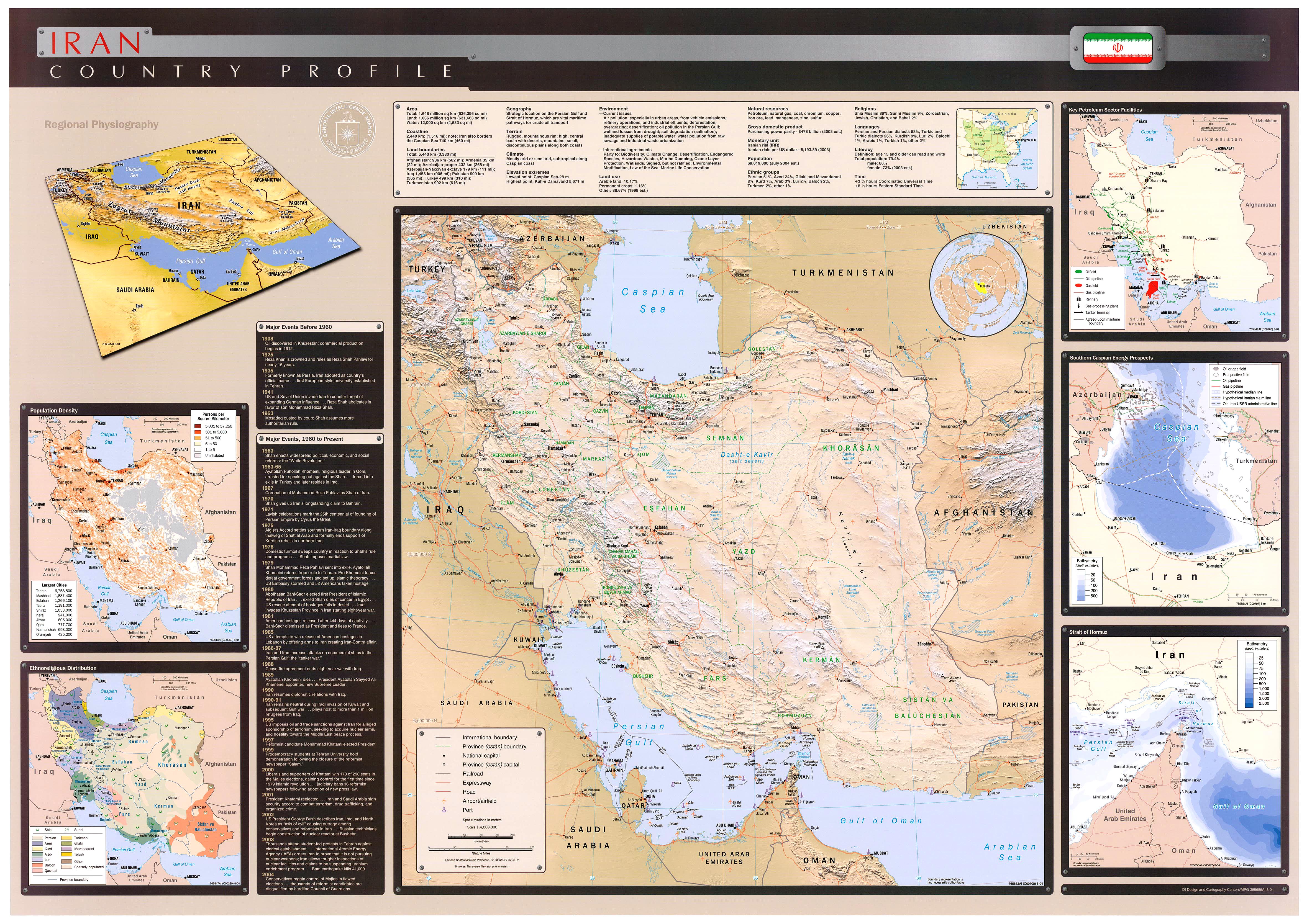
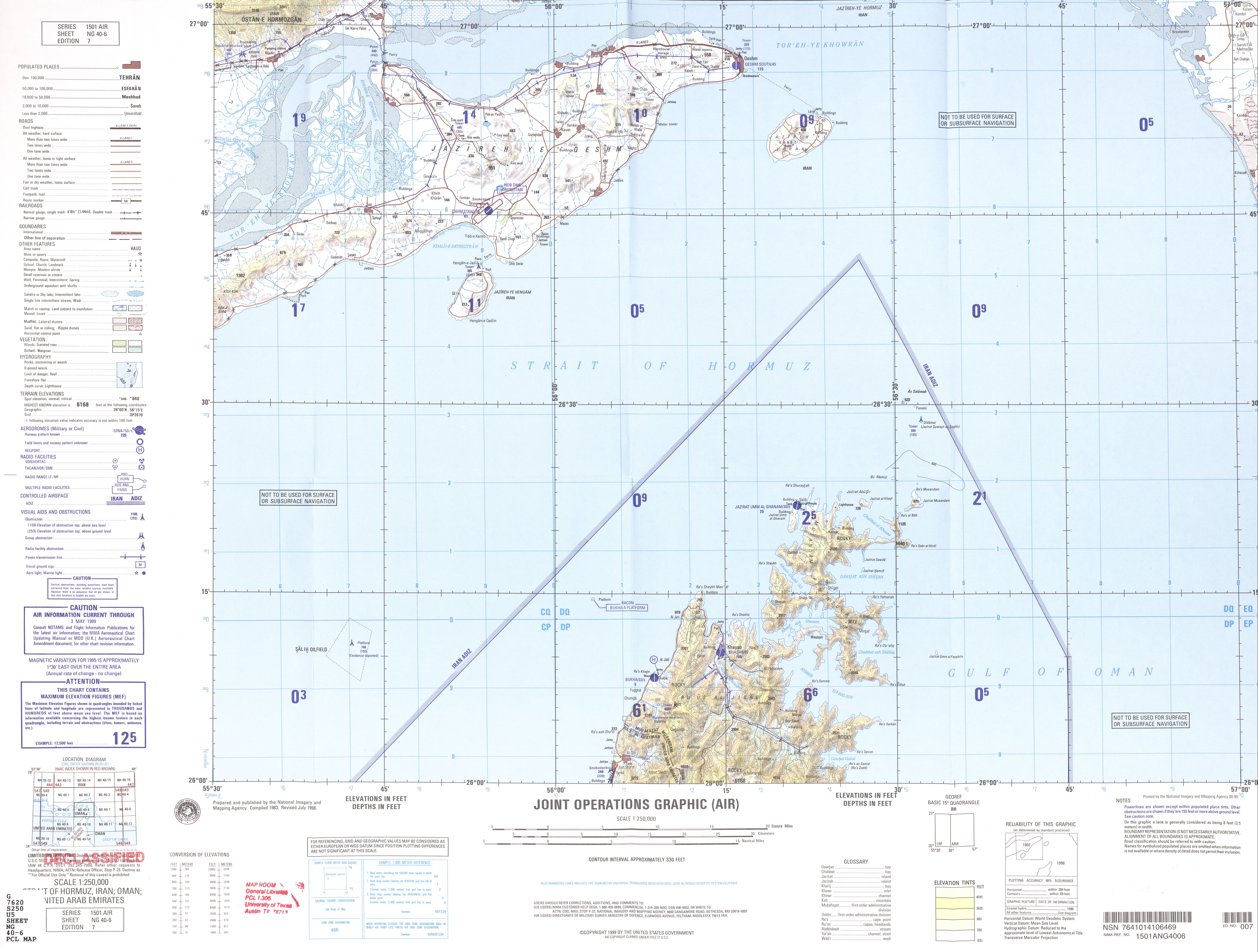
Instead, Iran attacks Israel, both directly and through its proxies in Lebanon and the Gaza Strip. It misinterprets U.S. actions as weakness and mines the Straits of Hormuz, the world's chief oil artery. That sparks a clash and a massive U.S. military reinforcement in the Persian Gulf.

This recent war game conducted at the Saban Center for Middle East Policy, part of the Washington-based Brookings Institution, a center-left think tank, appears to dampen hopes for a simple solution to Iran's real-world nuclear challenge.

The lesson is "once you start this, it's really hard to stop it," said Kenneth Pollack, a former White House and CIA official who oversaw the simulation.

Pollack and others who participated in the day-long exercise late last year are quick to point out that war games are imperfect mirrors of reality. How Iran's notoriously opaque and fractious leadership would react in a real crisis is particularly hard to divine.

But the outcome underscores what diplomats, military officers and analysts have long said: even a "successful" airstrike on Iran's nuclear facilities — setting the program back by two to four years — could come at a tremendous, unpredictable cost.

"It's ... an option that has to be looked at very, very, very carefully," a senior European diplomat said Friday. "Because we know what the results could be, and they could be disastrous." He requested anonymity to speak more frankly on the sensitive issue.

Tensions over Iran's nuclear program rose again this week after the U.N.'s nuclear watchdog reported that the country could be secretly developing a nuclear warhead to be placed atop a ballistic missile. Additionally, Iran has begun enriching uranium closer to the purity level needed for use in a nuclear weapon.

Israel, which sees Iran as a direct threat, has refused to rule out military force, although officials there say they are counting for now on diplomatic pressure. There have even been hints from Sunni Arab states, particularly Saudi Arabia, that they would look the other way in the event of a strike on Shiite Iran, a historic adversary.

Yet one of the Brookings war game's major conclusions is that Israel could pay dearly for an attack on Iran.

By the end of the simulation, eight days after the fictitious Israeli strike, Israel's prime minister, under heavy domestic pressure, is forced to launch a 48-hour air blitz in southern Lebanon to halt rocket attacks from Hezbollah, the militant group sponsored by Iran. Israeli officials know the blitz is unlikely to achieve its objectives, and prepare a larger, costlier operation in Lebanon, including ground forces.

Israel's relations with the United States, its most important ally, are damaged. To avoid damaging them further, Israel bows to intense U.S. pressure and absorbs occasional missile strikes from Iran without retaliating.

Some members of the "Israeli" team nonetheless felt that setting back Iran's nuclear program "was worth it, even given what was a pretty robust response," said one participant. He asked that his name not be used, because under the game's ground rules, participants are supposed to remain anonymous.

Jonathan Peled, an Israeli embassy spokesman, declined comment on the war game or its outcome.

"All we can say is that Iran constitutes a threat not only to Israel but to the region, to the US and to the world at large, and therefore should be addressed without delay by the international community, first and foremost through effective sanctions," he said.

The Brookings war game was one of three simulations regarding Iran's nuclear program conducted in December. The other two, at Harvard University and Tel Aviv University, reportedly found that neither sanctions nor threats dissuaded Tehran from its suspected nuclear weapons ambitions.

In the Brookings game, three teams of experts, including former senior U.S. officials, played the Israeli, Iranian and American leadership. They assembled in separate rooms at the think tank's Washington headquarters. Israeli and U.S. "officials" communicated with each other, but not with the Iranians.

One of the simulation's major findings was how aggressively the Iranians responded to the attack — more aggressively, some participants felt, than they would in real life — and how Washington and Tehran, lacking direct communication, misunderstood each other.

Iran did not retaliate directly against the United States or U.S. troops in Iraq or Afghanistan. But it struck back at Israel, then attacked Dharan in eastern Saudi Arabia, then began mining the Straits of Hormuz.

"There would be almost no incentive for Iran not to respond" with force, said another participant, a member of the Iranian team. "It was interesting to see how useful it was for Tehran to push the limits."

Without knowing it, Iran's last two actions crossed U.S. "red lines," prompting an American military response.

"No one came out on top — (but) arguably the Iranians," the Iran team member said.

The Tehran regime was also able to crush its domestic political opposition.