Showing posts with label spain. Show all posts

Sunday, 3 October 2010

ecuador coup attempt: cia fingerprints, corruption

.
http://www.waynemadsenreport.com/articles/20101001_1

October 1, 2010

Obama administration fingerprints on Ecuador coup attempt

by courtesy of Wayne Madsen

Using the standard CIA playbook on toppling democratically-elected governments in Latin America, the Obama administration, which was not happy with Ecuadorian President Rafael Correa's moves to increase state control over oil companies in the nation and his decision to oust the United States military from its airbase at Manta, appears to have suffered a major defeat in the failed coup attempt in Ecuador by police officers and Air Force personnel who were backed by rightist elements in the National Assembly and business community. Correa was re-elected with an overwhelming majority last year after he gave the U.S. military its walking papers from the Manta airbase. The Pentagon and CIA have been working to topple Correa ever since by pumping money into opposition political parties and other groups through NGOs funded by the U.S. National Endowment for Democracy.

In a statement from Correa after his rescue from the Police Hospital in Quito by a military special operations team, the president warned of a larger conspiracy launched against him by his political opposition, saying the "attempt at destabilization is the result of a strategy that has been brewing for quite some time. A barrage of messages and misinformation have been given to the National Police, which today has been realized through violent actions from a conspiracy attempt."

Correa's predecessor, the pro-U.S. Lucio Gutierrez, who is wedded to foreign oil company interests in the country, was accused by the government of covertly supporting the police and Air Force mutineers.

Although Secretary of State Hillary Clinton issued a weak statement saying the United States backed Correa, it came one day after Clinton heaped praise on former Secretary of State Henry Kissinger, the person who helped to craft the September 11, 1973 coup in Chile and the assassination of its progressive president Salvador Allende. In fact, Clinton and Obama had given military and political support to the right-wing junta that ousted democratically-elected progressive President Manuel Zelaya in Honduras in June 2009 and has fought against allowing the ousted democratically-elected president of Haiti, Jean-Bertrand Aristide, to return to his country from exile in South Africa after the CIA-engineered coup against him in 2004.

Clinton's tepid response to the attempted coup against Correa was in marked contrast to the strong denunciations of the attempted coup and messages of support for Correa that came from Venezuela, Brazil, Argentina, Peru, Mexico, Bolivia, Cuba, and Spain.

And the fact that Correa, like Venezuelan President Hugo Chavez, who was briefly ousted in an April 2002 coup organized by the CIA, was held as a virtual hostage at the Police Hospital in Quito for the greater part of a day provided a grim reminder of an old CIA tactic in staging coups in Latin America. Chavez was briefly held hostage on a Venezuelan island in the Caribbean while a U.S.-registered plane stood by to fly him into exile. In an emergency Latin American summit meeting in Argentina, Chavez saw the U.S. behind the events in Ecuador. He said, "The Yankee extreme right is trying right now, through arms and violence, to retake control of the continent." Chavez's own experience with a CIA backed coup and the June 2009 coup, supported by the Pentagon, CIA, and Mossad against his ally Zelaya in Honduras, makes him an expert on CIA and Mossad tactics in the region. Informed sources have told WMR that Correa and Chavez are currently comparing notes on the coups launched against them.

Ecuadorian intelligence will be looking closely at the wereabouts of key CIA personnel stationed at the CIA station at the US embassy in Quito and a smaller CIA station within the US Agency for International Development (USAID) mission in Guayaquil. In the 2002 coup attempt against Chavez, the US embassy's top CIA and DIA officers were discovered to be helping to direct the coup from Venezuelan military installations.

Clinton's State Department has been casting Ecuador in a bad light throughout the past two years, calling the country "difficult to do business in," the only real priority that the Obama administration cares about due to its total subservience to Wall Street and the fat cat bankers. The State Department's "Investment Climate Statement" for Ecuador states: "Ecuador can be a difficult place in which to do business. . . There are restrictions or limitations on private investment in many sectors that apply equally to domestic and foreign investors . . . A 2006 hydrocarbons law imposed new conditions in the petroleum sector that have been problematic for many companies, complicated by a 2007 decree that imposed additional restrictions. A 2008 mining mandate stalled mining activity, and a new Mining Law is expected in early 2009. Negotiations for a free trade agreement between the United State and Ecuador, which would have included investment provisions, stopped in April 2006. The current Government of Ecuador has not expressed interest in restarting negotiations." Correa's financial policies, as well as his foreign policy that saw him order out the American base at Manta and establish close ties with Venezuela, Iran, and other countries inimical to American and Israeli hegemony, placed a huge CIA and Mossad target on Correa's back. In June, Ecuador sponsored a resolution at the Organization of American State (OAS) summit in Lima condemning Israel's attack on the Turkish aid flotilla transporting humanitarian aid to Gaza. Ten nations voted with Ecuador in support of the resolution.

The uprising among Ecuadorian Air Force ranks, with Air Force personnel taking over and shutting down Quito's international airport, will have Ecuadorian counter-intellligence personnel looking closely at the possible role of Israeli technicians and trainers who support the Air Force's 26 Israeli-made Kfir combat planes. Israel also reportedly sold Python-3 air-to-air missiles to the Ecuadorian Air Force in 1997.

Mossad also has its hooks into the Ecuadorian National Police, where the main coup plotters received support. Mossad is chiefly tasked with spying on Ecuador's large Ecuadorian-Arab community. The activities of the Mossad station at the Israeli embassy in Quito before and during the coup attempt will also draw the attention of counter-intelligence officers. Last year, Tel Aviv-based On Track Innovations received a contract to provide an electronic biometric-based electronic identification card system to Ecuador's Central Registry Office.


http://www.voltairenet.org/article167150.html

Quito’s Police: CIA breeding ground

Jean Guy Allard

The uprising by putschist elements of the Ecuadoran police against President Rafael Correa confirms an alarming report about the infiltration of the Ecuadoran police by U.S. intelligence services released in 2008, which indicated that many members of the police corps developed a “dependency” on the U.S. Embassy.

2 October 2010
Havana (Cuba)

Translated by Machetera
Source: Jean Guy Allard / Granma Internacional (Cuba)
through Voltaire network
JPEG - 100.8 kb
Rebellious elements within Ecuadorian police seize Quito International Airport, 30 September 2010.

“I applied and was accepted at the Escuela superior de policía de Quito, and studied there from September 1992 to August 1995.”
Guy Philippe, speaking to Peter Hallward about his background prior to leading an armed insurgency that contributed to the removal of Haiti’s elected president, Jean Bertrand Aristide.


The report made clear that the Ecuadoran Police “maintain informal economic dependence on the United States, to pay for informants, training, equipment and operations.”

The systematic use of corruption techniques by the CIA in order to acquire the “goodwill” of police officers was described and denounced on many occasions by the ex-CIA agent Philip Agee who, before leaving the agency’s ranks, was assigned to the U.S. Embassy in Quito.

In his official report, distributed at the end of October 2008, the Ecuadoran Defense Minister Javier Ponce revealed how U.S. diplomats dedicated themselves to the corruption of the police as well as officers from the armed forces.

In confirmation, the leadership of the Ecuadoran police then announced that it would sanction any of its agents who collaborated with the United States, while the U.S. Embassy claimed “transparency” in its support of Ecuador.

“We work with the Ecuadoran government, with the military, with the Police, on objectives that are very important for security,” said the U.S. Ambassador in Quito, Heather Hodges.

However, the diplomat told journalists that she would not comment “on intelligence matters.”

For her part, the public affairs officer, Marta Youth, categorically refused to comment on the Ecuadoran government’s denunciations, which included complaints about CIA participation in an operation with Colombia that led to a military attack by the Colombian military against FARC guerrillas on Ecuadoran territory on March 1st of that year.

The head of Army intelligence, Mario Pazmiño, had been removed for concealing information related to the attack on the FARC.

In recent months, U.S. officials have appeared in Ecuador under the pretext of extending relations between Ecuador and the United States. Arturo Valenzuela, the U.S. Assistant Secretary of State for Western Hemisphere Affairs, repeatedly visited President Correa, leading up to a visit from Secretary of State Hillary Clinton.

Valenzuela was accompanied by Todd Stern, “Climate Change Envoy,” also known for his CIA ties.

Tuesday, 28 September 2010

biz updates: shut down the fed / world depression...

.
http://blogs.telegraph.co.uk/finance/ambroseevans-pritchard/100007777/shut-down-the-fed-part-ii/

Shut Down the Fed (Part II)

see part I

Ambrose Evans-Pritchard
September 27th, 2010

I apologise to readers around the world for having defended the emergency stimulus policies of the US Federal Reserve, and for arguing like an imbecile naif that the Fed would not succumb to drug addiction, political abuse, and mad intoxicated debauchery, once it began taking its first shots of quantitative easing.

My pathetic assumption was that Ben Bernanke would deploy further QE only to stave off DEFLATION, not to create INFLATION. If the Federal Open Market Committee cannot see the difference, God help America.

We now learn from last week’s minutes that the Fed is willing “to provide additional accommodation if needed to … return inflation, over time, to levels consistent with its mandate.”

NO, NO, NO, this cannot possibly be true.

Ben Bernanke has not only refused to abandon his idee fixe of an “inflation target”, a key cause of the global central banking catastrophe of the last twenty years (because it can and did allow asset booms to run amok, and let credit levels reach dangerous extremes).

Worse still, he seems determined to print trillions of emergency stimulus without commensurate emergency justification to test his Princeton theories, which by the way are as old as the hills. Keynes ridiculed the “tyranny of the general price level” in the early 1930s, and quite rightly so. Bernanke is reviving a doctrine that was already shown to be bunk eighty years ago.

Inflation targeting: is Bernanke the new Von Havenstein, head of the Weimar Reichsbank?

Inflation targeting: is Bernanke the new Von Havenstein, head of the Weimar Reichsbank?

So all those hillsmen in Idaho, with their Colt 45s and boxes of krugerrands, who sent furious emails to the Telegraph accusing me of defending a hyperinflating establishment cabal were right all along. The Fed is indeed out of control.

The sophisticates at banking conferences in London, Frankfurt, and New York who aplogized for this primitive monetary creationsim – as I did – are the ones who lost the plot.

My apologies. Mercy, for I have sinned against sound money, and therefore against sound politics.

I stick to my view that Friedmanite QE ‘a l’outrance‘ is legitimate to prevent a collapse of the M3 broad money supply, and to prevent outright deflation in economies with total debt levels near or above 300pc of GDP. Not in any circumstances, but where necessary, and where conducted properly by purchasing bonds outside the banking system (not the same as Bernanke “creditism”).

The dangers of tipping into a debt compound trap – as described by Irving Fisher in Debt-Deflation Theory of Great Depresssions in 1933 – outweigh the risk of an expanded money stock catching fire and setting off an inflation surge later. Debt deflation is a toxic process that can and does destroy societies as well as economies. You do not trifle with it.

But deliberately creating inflation “consistent” with the Fed’s mandate – implicitly to erode debt – is another matter. Nor can this be justified at this particular juncture. M3 has been leveling out. M2 has begun to rise briskly. The velocity of money has picked up. The M1 monetary mulitplier has jumped.

We have a very odd world. The IMF has doubled its global growth forecast to 4.5pc this year, and authorities everywhere have ruled out a serious risk of a double dip recession.

Yet at the same time the Bank of Japan has embarked on unsterilised currency intervention, which amounts to stimulus, and both the Fed and the Bank of England are signalling fresh QE.

You can’t have it both ways. If the US is not in deep trouble, the Fed should not be thinking of extra QE. It should step back and let the economy heal itself, if necessary enduring several years of poor growth to purge excess leverage.

Yes, U6 unemployment is 16.7pc. But as dissenters at the Minneapolis Fed remind us, you cannot solve a structural unemployment crisis with loose money.

Fed is trying to conjure away the hangover from the last binge (which Greenspan/Bernanke caused, let us not forget), as if to vindicate its prior claim that you can always clean up painlessly after asset bubbles.

Are the Chinese right? Are the Americans and the British now so decadent that they will refuse to take their punishment, opting to default on their debts by stealth?

Sooner or later we may learn what the Fed’s hawkish bloc of Fisher, Lacker, Plosser, Hoenig, Warsh, and Kocherlakota really think about this latest lurch into monetary la la land, with all that it implies for moral hazard and debt contracts.

If I have written harsh words about these heroic resisters, I apologise for that too.

-----------------------------------------------------------------------------------------------------------------------

http://www.telegraph.co.uk/finance/comment/ambroseevans_pritchard/8026324/Gold-is-the-final-refuge-against-universal-currency-debasement.html

Gold is the final refuge against universal currency debasement

States accounting for two-thirds of the global economy are either holding down their exchange rates by direct intervention or steering currencies lower in an attempt to shift problems on to somebody else, each with their own plausible justification. Nothing like this has been seen since the 1930s.

Ambrose Evans-Pritchard
26 Sep 2010

“We live in an amazing world. Everybody has big budget deficits and big easy money but somehow the world as a whole cannot fully employ itself,” said former Fed chair Paul Volcker in Chris Whalen’s new book Inflated: How Money and Debt Built the American Dream.

“It is a serious question. We are no longer talking about a single country having a big depression but the entire world.”

The US and Britain are debasing coinage to alleviate the pain of debt-busts, and to revive their export industries: China is debasing to off-load its manufacturing overcapacity on to the rest of the world, though it has a trade surplus with the US of $20bn (£12.6bn) a month.

Premier Wen Jiabao confesses that China’s ability to maintain social order depends on a suppressed currency. A 20pc revaluation would be unbearable. “I can’t imagine how many Chinese factories will go bankrupt, how many Chinese workers will lose their jobs,” he said.

Plead he might, but tempers in Washington are rising. Congress will vote next week on the Currency Reform for Fair Trade Act, intended to make it much harder for the Commerce Department to avoid imposing “remedial tariffs” on Chinese goods deemed to be receiving “benefit” from an unduly weak currency.

Japan has intervened to stop the strong yen tipping the country into a deflation death spiral, though it too has a trade surplus. There is suspicion in Tokyo that Beijing’s record purchase of Japanese debt in June, July, and August was not entirely friendly, intended to secure yuan-yen advantage and perhaps to damage Japan’s industry at a time of escalating strategic tensions in the Pacific region.

Brazil dived into the markets on Friday to weaken the real. The Swiss have been doing it for months, accumulating reserves equal to 40pc of GDP in a forlorn attempt to stem capital flight from Euroland. Like the Chinese and Japanese, they too are battling to stop the rest of the world taking away their structural surplus.

The exception is Germany, which protects its surplus ($179bn, or 5.2pc of GDP) by means of an undervalued exchange rate within EMU. The global game of pass the unemployment parcel has to end somewhere. It ends in Greece, Portugal, Spain, Ireland, parts of Eastern Europe, and will end in France and Italy too, at least until their democracies object.

It is no mystery why so many states around the world are trying to steal a march on others by debasement, or to stop debasers stealing a march on them. The three pillars of global demand at the height of the credit bubble in 2007 were – by deficits – the US ($793bn), Spain ($126bn), UK ($87bn). These have shrunk to $431bn, $75bn, and $33bn respectively as we sinners tighten our belts in the aftermath of debt bubbles.. The Brazils and Indias of the world are replacing some of this half trillion lost juice, but not all.

East Asia’s surplus states seem structurally incapable of compensating for austerity in the West, whether because of the Confucian saving ethic, or the habits of mercantilist practice, or in China’s case by the lack of a welfare net. Their export models rely on the willingness of Anglo-PIGS to bankrupt themselves.

So we have an early 1930s world where surplus states are hoarding money, instead of recycling it. A solution of sorts in the Great Depression was for each deficit country to devalue, breaking out of the trap (then enforced by the Gold Standard). This turned the deflation tables on the surplus powers – France and the US from 1929-1931 – forcing them to reflate as well (the US in 1933) or collapse (France in 1936). Contrary to myth, beggar-thy-neighbour policy was the global cure.

A variant of this may now occur. If China continues to hold down its currency, the country will import excess US liquidity, overheat, and lose wage competitiveness. This is the default cure if all else fails, and I believe it is well under way.

The latest Fed minutes are remarkable. They add a new doctrine, that a fresh monetary blitz – or QE2 – will be used to stop inflation falling much below 1.5pc. Surely the Fed has not become so reckless that it really aims to use emergency measures to create inflation, rather preventing deflation? This must be a cover-story. Ben Bernanke’s real purpose – as he aired in his November 2002 speech on deflation – is to weaken the dollar.

If so, he has succeeded. The Swiss franc smashed through parity last week as investors digested the message. But the swissie is an over-rated refuge. The franc cannot go much further without destabilizing Switzerland itself.

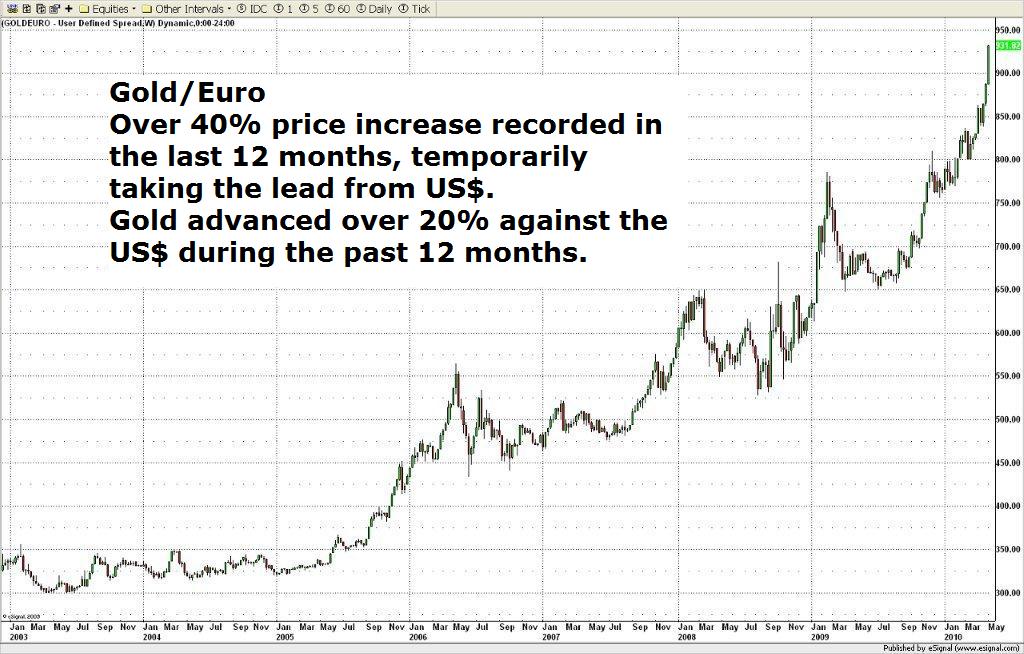
Gold has no such limits. It hit $1300 an ounce last week, still well shy of the $2,200-2,400 range reached in the late Medieval era of the 14th and 15th Centuries.

This is not to say that gold has any particular "intrinsic value"’. It is subject to supply and demand like everything else. It crashed after the gold discoveries of Spain’s Conquistadores in the New World, and slid further after finds in Australia and South Africa. It ultimately lost 90pc of its value – hitting rock-bottom a decade ago when central banks succumbed to fiat hubris and began to sell their bullion. Gold hit a millennium-low on the day that Gordon Brown auctioned the first tranche of Britain’s gold. It has risen five-fold since then.

We have a new world order where China and India are buying gold on every dip, where the West faces an ageing crisis, and where the sovereign states of the US, Japan, and most of Western Europe have public debt trajectories near or beyond the point of no return.

The managers of all four reserve currencies are playing fast and loose: the Fed is clipping the dollar; the Bank of England is clipping sterling; the European Central Bank is buying the bonds of EMU debtors to stave off insolvency, something it vowed never to do just months ago; and the Bank of Japan has just carried out two trillion yen of “unsterilized” intervention.

Of course, gold can go higher.

-----------------------------------------------------------------------------------------------------------------------

http://www.telegraph.co.uk/finance/economics/7980291/EU-austerity-policies-risk-civil-war-in-Greece-warns-top-German-economist-Dr-Sinn.html

EU austerity policies risk civil war in Greece, warns top German economist Dr Sinn

Greece’s austerity measures cannot prevent default and will lead to a breakdown of the political order if continued for long, a leading German economist has warned.

Ambrose Evans-Pritchard in Cernobbio, Italy
03 Sep 2010

“This tragedy does not have a solution,” said Hans-Werner Sinn, head of the prestigious IFO Institute in Munich.

“The policy of forced 'internal devaluation', deflation, and depression could risk driving Greece to the edge of a civil war. It is impossible to cut wages and prices by 30pc without major riots,” he said, speaking at the elite European House Ambrosetti forum at Lake Como.

“Greece would have been bankrupt without the rescue measures. All the alternatives are terrible but the least terrible is for the country to get out of the eurozone, even if this kills the Greek banks,” he said.

Dr Sinn said Greece is an entirely different case from Spain and Portugal, which still have manageable public debts and can bring their public finances back into line with higher taxes.

“Greece would have defaulted in the period between April 28 and May 7, had the money not been promised by the European Union,” he said, describing the failure of the EU’s bail-out strategy to include a haircut for the banks as an invitation to moral hazard.

“There should be a quasi-insolvency procedure for countries. Creditors have to accept a haircut before any money flows for rescue plans, otherwise we’ll never have debt discipline in the eurozone,” he said.

Greek society has so far held together well, despite a wave of strikes and street violence in the early months of the crisis. However, unemployment is rising fast and political fatigue with such austerity policies typically sets in the second year.

Under the rescue deal, the eurozone pledged €80bn of new loans at 5pc interest and the International Monetary Fund offered a further €30bn.

The joint bail-out was hoped to safeguard Greece against the pressure from global capital markets for two and half years, but the relief rally proved short. Spreads on longer-term Greek government debt have surged back to crisis levels of about 800 basis points, implying a high risk of default.

“We are in the second Greek crisis right now, today,” said Dr Sinn.

Greece is undergoing what amounts to an IMF austerity package but without the IMF cure of debt restructuring or devaluation that usual for a country with a spiralling public debt and a chronic loss of competitiveness.

The IMF says Greece’s debt will rise to 150pc by 2013-2014 even if Athens complies fully, a strategy viewed as self-defeating by several ex-IMF officials. There is a strong suspicion that the real objective is to bail-out North European banks with heavy exposure to Southern Europe, rather help Greece.

Dr Sinn said the Germany is now was super-competitive after clawing back 18pc in competitiveness during its long slump. “We’re in a new phase of history. The toggle switch has turned and we are going to see a mirror image of the last 15 years. This time it is Germany that will have an internal boom,” he said.

Germans will not recyle their savings in the Club Med region. They will invest at home.


http://www.telegraph.co.uk/finance/comment/ambroseevans_pritchard/7909432/The-Death-of-Paper-Money.html

The Death of Paper Money

As they prepare for holiday reading in Tuscany, City bankers are buying up rare copies of an obscure book on the mechanics of Weimar inflation published in 1974.

Ambrose Evans-Pritchard Published
25 Jul 2010

Ebay is offering a well-thumbed volume of "Dying of Money: Lessons of the Great German and American Inflations" at a starting bid of $699 (shipping free.. thanks a lot).

The crucial passage comes in Chapter 17 entitled "Velocity". Each big inflation -- whether the early 1920s in Germany, or the Korean and Vietnam wars in the US -- starts with a passive expansion of the quantity money. This sits inert for a surprisingly long time. Asset prices may go up, but latent price inflation is disguised. The effect is much like lighter fuel on a camp fire before the match is struck.

People’s willingness to hold money can change suddenly for a "psychological and spontaneous reason" , causing a spike in the velocity of money. It can occur at lightning speed, over a few weeks. The shift invariably catches economists by surprise. They wait too long to drain the excess money.

"Velocity took an almost right-angle turn upward in the summer of 1922," said Mr O Parsson. Reichsbank officials were baffled. They could not fathom why the German people had started to behave differently almost two years after the bank had already boosted the money supply. He contends that public patience snapped abruptly once people lost trust and began to "smell a government rat".

Some might smile at the Bank of England "surprise" at the recent the jump in Brtiish inflation. Across the Atlantic, Fed critics say the rise in the US monetary base from $871bn to $2,024bn in just two years is an incendiary pyre that will ignite as soon as US money velocity returns to normal.

Morgan Stanley expects bond carnage as this catches up with the Fed, predicting that yields on US Treasuries will rocket to 5.5pc. This has not happened so far. 10-year yields have fallen below 3pc, and M2 velocity has remained at historic lows of 1.72.

As a signed-up member of the deflation camp, I think the Bank and the Fed are right to keep their nerve and delay the withdrawal of stimulus -- though that case is easier to make in the US where core inflation has dropped to the lowest since the mid 1960s. But fact that O Parsson’s book is suddenly in demand in elite banking circles is itself a sign of the sort of behavioral change that can become self-fulfilling.

As it happens, another book from the 1970s entitled "When Money Dies: the Nightmare of The Weimar Hyper-Inflation" has just been reprinted. Written by former Tory MEP Adam Fergusson -- endorsed by Warren Buffett as a must-read -- it is a vivid account drawn from the diaries of those who lived through the turmoil in Germany, Austria, and Hungary as the empires were broken up.

Near civil war between town and country was a pervasive feature of this break-down in social order. Large mobs of half-starved and vindictive townsmen descended on villages to seize food from farmers accused of hoarding. The diary of one young woman described the scene at her cousin’s farm.

"In the cart I saw three slaughtered pigs. The cowshed was drenched in blood. One cow had been slaughtered where it stood and the meat torn from its bones. The monsters had slit the udder of the finest milch cow, so that she had to be put out of her misery immediately. In the granary, a rag soaked with petrol was still smouldering to show what these beasts had intended," she wrote.

Grand pianos became a currency or sorts as pauperized members of the civil service elites traded the symbols of their old status for a sack of potatoes and a side of bacon. There is a harrowing moment when each middle-class families first starts to undertand that its gilt-edged securities and War Loan will never recover. Irreversible ruin lies ahead. Elderly couples gassed themselves in their apartments.

Foreigners with dollars, pounds, Swiss francs, or Czech crowns lived in opulence. They were hated. "Times made us cynical. Everybody saw an enemy in everybody else," said Erna von Pustau, daughter of a Hamburg fish merchant.

Great numbers of people failed to see it coming. "My relations and friends were stupid. They didn’t understand what inflation meant. Our solicitors were no better. My mother’s bank manager gave her appalling advice," said one well-connected woman.

"You used to see the appearance of their flats gradually changing. One remembered where there used to be a picture or a carpet, or a secretaire. Eventually their rooms would be almost empty. Some of them begged -- not in the streets -- but by making casual visits. One knew too well what they had come for."

Corruption became rampant. People were stripped of their coat and shoes at knife-point on the street. The winners were those who -- by luck or design -- had borrowed heavily from banks to buy hard assets, or industrial conglomerates that had issued debentures. There was a great transfer of wealth from saver to debtor, though the Reichstag later passed a law linking old contracts to the gold price. Creditors clawed back something.

A conspiracy theory took root that the inflation was a Jewish plot to ruin Germany. The currency became known as "Judefetzen" (Jew- confetti), hinting at the chain of events that would lead to Kristallnacht a decade later.

While the Weimar tale is a timeless study of social disintegration, it cannot shed much light on events today. The final trigger for the 1923 collapse was the French occupation of the Ruhr, which ripped a great chunk out of German industry and set off mass resistance.

Lloyd George suspected that the French were trying to precipitate the disintegration of Germany by sponsoring a break-away Rhineland state (as indeed they were). For a brief moment rebels set up a separatist government in Dusseldorf. With poetic justice, the crisis recoiled against Paris and destroyed the franc.

The Carthaginian peace of Versailles had by then poisoned everything. It was a patriotic duty not to pay taxes that would be sequestered for reparation payments to the enemy. Influenced by the Bolsheviks, Germany had become a Communist cauldron. Spartakists tried to take Berlin. Worker `soviets' proliferated. Dockers and shipworkers occupied police stations and set up barricades in Hamburg. Communist Red Centuries fought deadly street battles with right-wing militia.

Nostalgics plotted the restoration of Bavaria’s Wittelsbach monarchy and the old currency, the gold-backed thaler. The Bremen Senate issued its own notes tied to gold. Others issued currencies linked to the price of rye.

This is not a picture of America, or Britain, or Europe in 2010. But we should be careful of embracing the opposite and overly-reassuring assumption that this is a mild replay of Japan’s Lost Decade, that is to say a slow and largely benign slide into deflation as debt deleveraging exerts its discipline.

Japan was the world’s biggest external creditor when the Nikkei bubble burst twenty years ago. It had a private savings rate of 15pc of GDP. The Japanese people have gradually cut this rate to 2pc, cushioning the effects of the long slump. The Anglo-Saxons have no such cushion.

There is a clear temptation for the West to extricate itself from the errors of the Greenspan asset bubble, the Brown credit bubble, and the EMU sovereign bubble by stealth default through inflation. But that is a danger for later years. First we have the deflation shock of lives. Then -- and only then -- will central banks go to far and risk losing control over their printing experiment as velocity takes off. One problem at a time please.


http://blogs.telegraph.co.uk/finance/ambroseevans-pritchard/100007444/it-pays-to-riot-in-europe/

It pays to riot in Europe

Ambrose Evans-Pritchard
August 25th, 2010

Ireland must now pay more than Greece to borrow.

Dublin has played by the book. It has taken pre-emptive steps to please the markets and the EU. It has done an IMF job without the IMF. Indeed, is has gone further than the IMF would have dared to go.

It has imposed draconian austerity measures. The solidarity of the country has been remarkable. There have no riots, and no terrorist threats.

Protesters attack riot police in Athens over harsh austerity measures

Protesters attack riot police in Athens over harsh austerity measures

Yet as of today it is paying 5.48pc to borrow for ten years, or near 8pc in real terms once deflation is factored in. This is crippling and puts the country on an unsustainable debt trajectory if it lasts for long.

Yet Greece is able to borrow from the EU at 5pc and from the IMF at a staggered rate far below that (still too high for the policy to work, but that is another matter). These were the terms of the €110bn joint bail-out.

To add insult to injury Ireland is having SUBSIDIZE Greece to meet its share of the rescue fund.

I am sure you can all see the absurdity of this. It has moral hazard written all over it, and shows what happens once a dysfunctional system twists itself into ever greater knots rather confronting the core issue.

Yes, I know that the Irish and Greek maturities are different but the fact is that Greece has extracted better terms by letting matters get further out of hand.

George Papandreou’s PASOK has benefitted from dilly-dallying on the first set of austerity measures, and – not to be too diplomatic about it – by insulting the Germans with demands for war reparations. Hotheads also set fire to downtown Athens and Thessaloniki, improving the effect.

If I were Irish – (and I suppose in a sense I am: Sir John Parnell was my great, great, great grandfather) – I would be a little annoyed.

-----------------------------------------------------------------------------------------------------------------------

http://blogs.telegraph.co.uk/finance/ambroseevans-pritchard/100007519/china%E2%80%99s-young-officers-and-the-1930s-syndrome/

China’s young officers and the 1930s syndrome

Ambrose Evans-Pritchard
September 7th, 2010

I try to remain optimistic that the US and China will work out a more or less amicable way to run the world for the next half century, a “Chimerica” of interwoven superpowers.

But it was slightly disturbing to hear the warnings of a distinguished China-watcher at a closed-door session of the annual Ambrosetti conference on Lake Como.

(This gathering of the global policy elites at Villa D’Este is a hardship assignment for Telegraph hacks. It fell to me again this year, but somebody has to do it.)

“China’s military spending is growing so fast that it has overtaken strategy,” said Professor Huang Jing from the Lee Kwan Yew School of Public Policy in Singapore. (He kindly let me quote his remarks.)

“The young officers are taking control of strategy and it is like young officers in Japan in the 1930s. They are thinking what they can do, not what they should do. This is very dangerous.

“They are on a collision course with a US-dominated system”.

Harvard Professor Niall Ferguson rattled me even further with a talk warning that the Chimerica marriage of the last generation is “on the rocks”.

“China gets 10pc growth: the US gets 10pc unemployment. That doesn’t seem the basis for a happy marriage,” said Prof Fergusson, – who used to sit next to me at the Telegraph as a young leader writer almost 20 years ago, before he went on to become one of the 100 most influential people on the planet (Time magazine).

China’s trade surplus is surging back to near record levels, yet the yuan has barely moved against the dollar since the fixed peg ended in June. It has actually fallen against a trade-weighted basket of currencies.

This is not an accident. The exchange rate is controlled. The yuan must rise – ceteribus paribus – unless the central bank prevents it doing so by purchasing foreign assets.

Prof Ferguson said naval rivalry is passé – cyberwarfare is the issue of the future, and he advises the West to be a little more careful about its reliance on Chinese-manufactured microchips.

Be that as it may, the current flash-point is a very old fashioned showdown between gunboats in the Yellow Sea and the South China Sea (the latter now a “core interest” of China along with Tibet and Taiwan), also claimed in part by a ring of other nations who are not pleased.

related post: china: territorial waters / leading energy demand

In late July, the chairman of US chiefs of staff, Admiral Mike Mullen, said he had moved from being “curious” about what the Chinese were doing, “to being concerned about what they’re doing. They seem to be taking a much more aggressive approach.”

“I see a fairly significant investment in high-end equipment – satellites, ships … anti-ship missiles, obviously high-end aircraft and all those kinds of things. They are shifting from a focus on their ground forces to focus on their navy, and their air force.”

Last week this little spat escalated to the point where a Chinese submarine erected a Chinese flag on the seabed of the South China Sea, 4,000 meters below the surface.

China has a perfect right to develop a blue-water navy and to make its presence felt in the region. The question in such matters is judging the purpose and precise circumstances, and I must confess that Prof Huang’s comments were slightly disturbing, always bearing in mind that he has a Singapore (Chinese diaspora) perspective.

Let it be said in China’s defence that it occupies no overseas military bases, and has no modern history of projecting imperial power.

On balance, I remain hopeful that country with a one-child policy, an aging crunch from Hell, and a chronic dearth of young people, will show an enormous reluctance to support military adventurism. Losing an only child is especially cruel.

Let us hope that the Communist hierachy in Beijing can rein in those young officers. But as Dr Huang said, they can no longer control much of anything, least of all the 17m-strong base of the Communist Party.

“The empire has lost control of its officials, which is how Chinese empires have always fallen in history.”

This needs watching, I fear.


http://www.telegraph.co.uk/finance/comment/ambroseevans_pritchard/7442926/Is-Chinas-Politburo-spoiling-for-a-showdown-with-America.html

Is China's Politburo spoiling for a showdown with America?

The long-simmering clash between the world's two great powers is coming to a head, with dangerous implications for the international system.

Ambrose Evans-Pritchard
14 Mar 2010

U.S. President Obama shakes hands with Chinese ambassador to the U.S. Zhou as U.S. ambassador to China Huntsman looks on during a tour of the Great Wall of China in Badaling
US President Barack Obama shakes hands with Chinese ambassador to America Zhou Wenzhong on the Great Wall of China Photo: Reuters

China has succumbed to hubris. It has mistaken the soft diplomacy of Barack Obama for weakness, mistaken the US credit crisis for decline, and mistaken its own mercantilist bubble for ascendancy. There are echoes of Anglo-German spats before the First World War, when Wilhelmine Berlin so badly misjudged the strategic balance of power and over-played its hand.

Within a month the US Treasury must rule whether China is a "currency manipulator", triggering sanctions under US law. This has been finessed before, but we are in a new world now with America's U6 unemployment at 16.8pc.

"It's going to be really hard for them yet again to fudge on the obvious fact that China is manipulating. Without a credible threat, we're not going to get anywhere," said Paul Krugman, this year's Nobel economist.

China's premier Wen Jiabao is defiant.

"I don’t think the yuan is undervalued. We oppose countries pointing fingers at each other and even forcing a country to appreciate its currency," he said yesterday. Once again he demanded that the US takes "concrete steps to reassure investors" over the safety of US assets.

"Some say China has got more arrogant and tough. Some put forward the theory of China's so-called 'triumphalism'. My conscience is untainted despite slanders from outside," he said

Days earlier the State Council accused America of serial villainy. "In the US, civil and political rights of citizens are severely restricted and violated by the government. Workers' rights are seriously violated," it said.

"The US, with its strong military power, has pursued hegemony in the world, trampling upon the sovereignty of other countries and trespassing their human rights," it said.

"At a time when the world is suffering a serious human rights disaster caused by the US subprime crisis-induced global financial crisis, the US government revels in accusing other countries." And so forth.

Is the Politiburo smoking weed?

I let others discuss the rights and wrongs of this, itself a response to the US report card on China. Clearly, Beijing is in denial about is own part in the global imbalances behind the credit crisis, specifically by running structural trade surpluses, and driving down long rates through dollar and euro bond purchases. No doubt the West has made a hash of things, but the Chinese view of events is twisted to the point of delusional.

What interests me is Beijing's willingness to up the ante. It has vowed sanctions against any US firm that takes part in a $6.4bn weapons contract for Taiwan, a threat to ban Boeing from China and a new level of escalation in the Taiwan dispute.

In Copenhagen, Wen Jiabao sent an underling to negotiate with Mr Obama in what was intended to be - and taken to be - a humiliation. The US President put his foot down, saying: "I don't want to mess around with this anymore." That sums up White House feelings towards China today.

We have talked ourselves into believing that China is already a hyper-power. It may become one: it is not one yet. China is ringed by states - Japan, Korea, Vietnam, India - that are American allies when push comes to shove. It faces a prickly Russia on its 4,000km border, where Chinese migrants are itching for Lebensraum across the Amur. Emerging Asia, Brazil, Egypt and Europe are all irked by China's yuan-rigged export dumping.

Michael Pettis from Beijing University argues that China's reserves of $2.4 trillion - arguably $3 trillion - are a sign of weakness, not strength. Only twice before in modern history has a country amassed such a stash equal to 5pc-6pc of global GDP: the US in the 1920s, and Japan in the 1980s. Each time preceeded depression.

The reserves cannot be used internally to support China's economy. They are dead weight, beyond any level needed for macro-credibility. Indeed, they are the ultimate indictment of China's dysfunctional strategy, which is to buy $30bn to $40bn of foreign bonds every month to hold down the yuan, refusing to let the economy adjust to trade realities. The result is over-investment in plant, flooding the world with goods at wafer-thin export margins. China's over-capacity in steel is now greater than Europe's output.

This is catching up with China, in any case. Professor Victor Shuh from Northerwestern University warns that the 8,000 financing vehicles used by China's local governments to stretch credit limits have built up debts and commitments of $3.5 trillion, mostly linked to infrastructure. He says the banks may require a bail-out nearing half a trillion dollars.

As America's creditor - owner of some $1.4 trillion of US Treasuries, agency bonds, and US instruments - China can exert leverage. But this is not what it seems. If the Politburo deploys its illusiory power, Washington can pull the plug on China's export economy instantly by shutting markets. Who holds whom to ransom?

Any attempt to retaliate by triggering a US bond crisis would rebound against China, and could be stopped - in extremis - by capital controls. Roosevelt changed the rules in 1933. Such things happen. The China-US relationship is no doubt symbiotic, but a clash would not be "mutual assured destruction", as often claimed. Washington would win.

Contrary to myth, the slide to protectionism after the 1930 Smoot-Hawley Tariff Act did not cause the Depression. Trade contracted more slowly in the 1930s than this time. The Smoot-Hawley lesson is that tariffs have asymmetrical effects. They devastate surplus countries: then America. Deficit Britain did well by retreating into Imperial Preference.

Barack Obama has never exalted free trade. This orthodoxy is, in any case, under threat in the West. His top economic adviser Larry Summers let drop in Davos that free-trade arguments no longer hold when dealing with "mercantilist" powers. Adam Smith recognized this too, despite efforts by free-trade ultras to appropriate him for their cause.

China's trasformation has been remarkable since Deng Xiaoping unleashed capitalism, but as ex-diplomat George Walden writes in China: a Wolf in the World? you cannot feel at ease with a regime that still covers up Mao's murderous nihilism. He reminds us too that China has never forgiven the humilations inflicted by the West when the two civilizations collided in the 19th Century, and intends to exact revenge. Handle with care.

-----------------------------------------------------------------------------------------------------------------------

http://blogs.wsj.com/deals/2010/08/20/wall-street-drug-use-employees-giving-up-cocaine-for-pot-and-pills/

August 20, 2010
Kyle Stock

Wall Street Drug Use: Employees Giving Up Cocaine for Pot and Pills

The credit crisis appears to have sobered up Wall Street in more ways than one.

A review of drug-test data compiled by drug testing firm Sterling Infosystems Inc., shows that cocaine is losing its favor among investment professionals. What drug is their choice? Marijuana.

Last year, cocaine showed up in 7% of the positive tests at Wall Street firms, down from 16% in 2007, according to Sterling, a New York-based firm that screens about 5,900 employees a year for some 270 finance shops.

Meanwhile, the prevalence of marijuana in failed tests jumped from 64% to 80% between 2007 and 2009.

“I think the incidence of hard drug use is lower today than it was 10 or 15 years ago,” says Adam Zoia, CEO of executive recruiting firm Glocap Search LLC. “The banks, in particular, are pretty persnickity on background checks.”

In all, finance seems to be a relatively clean profession. Only 2% of the industry failed drug tests last year, compared with 3.6% of the working world at-large, according to Sterling. Retail workers, in comparison, were red-flagged 4.1% of the time.

The highest levels of abuse seem to be at real estate investment trust companies, a sector that, incidentally, does more random testing than others.

But the test results generally capture drug use among new hires, candidates who knew that they would likely be tested. Random drug testing is rare, according to a spokesman for a bulge-bracket bank who asked to remain unnamed.

Among existing employees, psychologists and counselors said that drug abuse has not slackened. Some even said it is peaking, exacerbated by the credit crisis and the volatile and tenuous recovery that has ensued.

Seabrook House, a 24-bed luxury rehab facility in Pennsylvania, has been crammed with Wall Street refugees in recent months, according to Clinical Director William Heran. They are paying $24,000 for a three-month program to get clean.

Mr. Heran has been around long enough to discern a forex trader from an M&A banker. He says the rage these days is a Pez dispenser with the head of a red devil. Inside? Pills of Oxycodone or Percocet.

“We’re in crisis mode,” he says. “Many of these drugs are so accessible to the average person, let alone the person who is well-spoken and professional.”

Indeed, amphetamines seem to be gaining cache, showing up in 10% of Sterling’s positive tests this year, compared with 3% in 2007.

Across the U.S., cocaine and marijuana use has been static since 2002 at least, according to federal Health Department data. But New York is a hot-bed for illicit drugs and Manhattanites are particularly heavy users.

In a 2001 survey, 9.6% of Manhattan residents said they had used marijuana in the previous year, compared with 6% of people across the country; 5% of the island’s residents had done cocaine in the previous month, compared with 2.3% U.S.-wide.

Turning Point For Leaders, a Connecticut-based intervention and rehab company, is also seeing a steady stream of clients from Wall Street. Robert Curry, who founded the business, says that the industry is still a hot bed of abuse.

“Investment bankers — gunslingers, as we call them — are highly prone to addiction,” he explained. “And there’s a lot of denial among employers. The attitude is: ‘If they can’t fix themselves, then they’re going to have to live with it. We’re not going to put any time and effort into it.’”

Many counselors says that finance workers feel entitled to illicit drugs, given their paychecks and stress of their jobs. They are also allegedly very good at masking their addictions, the counselors say.

Heavy users, however, are seldom fooling their employers, says Brad Lamm, president of New York-based Intervention Specialists. Lamm has also seen a surge in substance abuse on Wall Street – in his words “a lot of crack and coke.”

“The titans of Wall Street normalize crazy behavior all the time,” he says. “If somebody’s delivering and showing up and doing the work, they almost have to catch on fire for someone to sound the alarm.”

The upside is that none of Mr. Lamm’s clients has been fired for abuse. In fact, he typically contacts the employer before an intervention with a sort of mantra that he uses to get through to both the user and the boss: “Dead guys don’t bonus.”

Kyle Stock writes for FINS, Dow Jones’ finance career site.

Friday, 2 July 2010

gs vs fcic/bis risky call/debt as drug/euro mutiny/decrescita/terror profit soc gen

.
http://www.bloomberg.com/news/2010-07-01/goldman-sachs-pressed-by-u-s-financial-crisis-panel-for-derivatives-data.html

Goldman Sachs Pressed for Derivatives Data


Goldman Sachs Group Inc. refused a request from the Financial Crisis Inquiry Commission to reveal how much it makes trading derivatives, saying the bank doesn’t separate the figure from other businesses.

“Some other firms have provided us with that data when we’ve asked for it and Goldman Sachs hasn’t,” Commissioner Brooksley Born said today in Washington on the second day of a hearing investigating the role of derivatives in the 2008 credit crisis, which sparked the worst recession since the 1930s. “It makes one wonder why Goldman has the incentive or impetus to not release this information.”

Banks including JPMorgan Chase & Co., the biggest derivatives dealer, have provided estimates to investors. The top five U.S. commercial banks, including Goldman Sachs, generated an estimated $28 billion in revenue from privately negotiated derivatives in 2009, according to company reports collected by the Federal Reserve and people familiar with banks’ income sources.

Goldman Sachs, the most profitable Wall Street firm in history, is being questioned about credit-default swap trades with American International Group Inc., the insurer bailed out by the U.S. government after AIG was unable to meet collateral demands from trading partners on the contracts. The swaps, used by Goldman Sachs and other banks to hedge against declines in the value of mortgage-linked debt, caused losses at AIG as housing prices collapsed.

‘It’s Integrated’

Goldman Sachs Chief Financial Officer David Viniar testified today that the firm has no way of separating out its derivatives data from trading in cash securities.

“We don’t have a separate derivatives business,” Viniar told the panel. “It’s integrated into the rest of our business.”

Commissioner Byron Georgiou said he doubted Goldman Sachs was unable to provide the information.

“When you tell us that you don’t know how much you make in your derivatives business, nobody here really believes it,” Georgiou told Viniar. “Nobody here believes that you don’t know how much money you’re making on the various aspects of your business, it doesn’t make any sense.”

$49.1 Trillion

Goldman Sachs held a gross amount of $49.1 trillion of derivatives contracts as of March 31, according to an Office of the Comptroller of the Currency report last month. The bank reported total trading revenue of $7.65 billion during the first quarter. That follows total trading revenue of $23.2 billion in 2009, according to a filing with the Federal Reserve.

“It’s kind of dangerous, don’t you think, to claim to the FCIC that you don’t know the profitability of a major line of business,” said Craig Pirrong, a finance professor at the University of Houston. “How can you rationally allocate capital, for instance, if you don’t know the return to that capital?”

Under a March 2008 amendment to derivatives accounting standards, companies are exempt from breaking out gains or losses on derivatives used as part of a trading book that also includes cash securities, if other information on the trading activities is provided, according to the Financial Accounting Standards Board’s Statement No. 161.

Goldman Sachs is “definitely capable of providing the data that was asked for, but I can understand their fear of doing so,” said Brian Yelvington, head of fixed-income strategy at broker-dealer Knight Libertas LLC in Greenwich, Connecticut, and a former credit swaps trader.

Derivatives Revenue

“There is a potential for such a number to vastly overstate the amount of profit or loss captured by a particular business because much of that business may be symbiotic with another,” Yelvington said. “They may have made money on the derivatives leg of a trade, for example, and lost it on the cash leg.”

JPMorgan said in February 2009 that about 8 percent of its total revenue from 2006 to 2008 came from derivatives in its investment-banking unit, according to a presentation made to investors.

That breakdown and revenue figures from regulatory filings imply that half of JPMorgan’s $31.2 billion in trading revenue those years came from derivatives, according to Alexander Yavorsky, a senior analyst at Moody’s Investors Service in New York.

‘Highly Imprecise’

“Reporting a revenue number, just the profit on derivatives without looking at cash positions associated with hedging those, is going to be a highly imprecise exercise,” Yavorsky said in an interview today.

Goldman Sachs was subpoenaed by the commission last month after the New York-based firm sent more than a billion pages of documents to the panel, a shipment so sizable that panel members called it an attempt to hinder their probe.

“We did not ask them to pull up a dump truck to our offices and dump a bunch of rubbish,” Chairman Phil Angelides, who previously served as California’s treasurer, said June 7. “This has been a very deliberate effort over time to run out the clock.”

The commission, which will report its findings to Congress and President Barack Obama by December, said June 29 that the bank had been more responsive to information requests since being subpoenaed. Separately, Goldman Sachs faces a U.S. Securities and Exchange Commission fraud suit over sales of a mortgage-linked security. The bank has said the SEC suit is unfounded.

Born’s Warning

Born had warned in 1998, as chairman of the Commodity Futures Trading Commission, that the unregulated over-the- counter derivatives market posed a danger to the global financial system. She moved to address changes in how swaps based on interest rates, commodities or currencies were traded and was stopped by then-Federal Reserve Chairman Alan Greenspan, SEC Chairman Arthur Levitt and Treasury Secretary Robert Rubin, who all argued the market could regulate itself.

Born said last year that the banks that caused the crisis were trying to stop the congressional overhaul of the market.

“Special interests in the financial-services industry are beginning to advocate a return to business as usual,” Born said in May 2009 as she accepted a Profile in Courage award from the John F. Kennedy Library Foundation.

To contact the reporters on this story: Matthew Leising in New York at mleising@bloomberg.net; Shannon D. Harrington in New York at sharrington6@bloomberg.net

---------------------------------------------------------------------------------------------------------------

http://www.telegraph.co.uk/finance/comment/ambroseevans_pritchard/7859800/BIS-plays-with-fire-demands-double-barrelled-monetary-and-fiscal-tightening.html

BIS plays with fire, demands double-barrelled monetary and fiscal tightening

The Bank for International Settlements has warned authorities across the developed world that they cannot rely on ultra-low interest rates to cushion the blow of austerity measures.

Ambrose Evans-Pritchard
28 Jun 2010

Both fiscal and monetary policy may have to be tightened at the same time and ­before recovery is entrenched, a chilling possibility for asset markets. "Macroeconomic support has its limits," said the bank's annual report.

The Swiss-based "bank for central bankers" said ultra-low rates and massive fiscal stimulus saved the world from an economic meltdown during the credit crisis, but the balance of advantage has since shifted.

"Such powerful measures have strong side-effects, and their dangers are becoming apparent. The time has come to ask how they can be phased out," it said.

"There are limits to how long monetary policy can remain expansionary. Keeping interest rates near zero for too long, with abundant liquidity, leads to distortions and creates risks for financial stability. We cannot wait for the resumption of strong growth to begin the process of policy correction."

The clarion call for higher rates and an end to quantitative easing is controversial and pits the BIS against the International Monetary Fund in an epochal policy battle. If wrong, the BIS strategy risks pushing the global economy into depression.

Dominique Strauss-Kahn, the IMF chief, warned against zealous self-flagellation at the G20 summit. "It could be a catastrophe if all the countries were tightening, it could totally destroy the recovery."

Gabriel Stein, of Lombard Street Research, said the BIS is playing with fire. "Fiscal and monetary tightening were tried in tandem in the early 1930s and it didn't work then. The BIS ought to know better," he said.

The bank said the US and Europe made the fatal error of holding rates too low after the dotcom bust, fearing a slide towards deflation. The effect was to fuel asset bubbles and depress credit yields, pressuring lenders to chase risk. "Our recent experience with exactly these consequences a mere five years ago should make us extremely wary this time around," it said.

The BIS warned that central banks are luring banks into a fresh trap by shoring up lenders with cheap access to short-term funding, which is then used to buy long-dated bonds at higher yield – the so-called sovereign "carry trade". Some have already been caught out badly in Greek debt.

"Financial institutions may underestimate the risk associated with this maturity exposure. They might face difficulty rolling over their short-term debt. An unexpected tightening of monetary policy might cause serious repercussions," it said.

The parallel with post dotcom errors is likely to rile critics. Housing markets and banks were robust at the time, whereas the damage now is deeply structural in the US, Britain and Europe. Yet the BIS has clearly concluded that it is better for indebted economies to take their punishment early rather than dragging out the ordeal as in Japan.

On the spending side, the bank called for "immediate front-loaded fiscal consolidation" in key industrial states. "Public debt-to-GDP ratios are on unsustainable trajectories," rising from 76pc of GDP in 2007 to 100pc in 2011. The picture is worse than it looks since the crisis has "permanently" reduced output, and aging costs are soaring.

Yet fiscal austerity may be less of a drag on recovery than presumed. Denmark slashed its primary deficit by 13.4pc of GDP from 1983-1986, yet eked out growth of 3.9pc a year. Sweden grew by 3.7pc during its hair-shirt episode in the 1990s, Canada by 2.8pc, and Belgium by 2.3pc.

These cases do not tell us what would happen if half the world tightens at the same time, feeding on each other. Even so, the BIS data challenges Keynesian claims about fiscal stimulus. State spending merely "crowds out" private activity.

Besides, governments have no choice. They must retrench to appease the bond vigilantes in the new era of sovereign frailty. "A sudden loss in market confidence would be far worse," said the BIS.

---------------------------------------------------------------------------------------------------------------

http://www.telegraph.co.uk/finance/comment/ambroseevans_pritchard/7857595/RBS-tells-clients-to-prepare-for-monster-money-printing-by-the-Federal-Reserve.html

RBS tells clients to prepare for 'monster' money-printing by the Federal Reserve

As recovery starts to stall in the US and Europe with echoes of mid-1931, bond experts are once again dusting off a speech by Ben Bernanke given eight years ago as a freshman governor at the Federal Reserve.

Ambrose Evans-Pritchard
27 Jun 2010

Entitled "Deflation: Making Sure It Doesn’t Happen Here", it is a warfare manual for defeating economic slumps by use of extreme monetary stimulus once interest rates have dropped to zero, and implicitly once governments have spent themselves to near bankruptcy.

The speech is best known for its irreverent one-liner: "The US government has a technology, called a printing press, that allows it to produce as many US dollars as it wishes at essentially no cost."

Bernanke began putting the script into action after the credit system seized up in 2008, purchasing $1.75 trillion of Treasuries, mortgage securities, and agency bonds to shore up the US credit system. He stopped far short of the $5 trillion balance sheet quietly pencilled in by the Fed Board as the upper limit for quantitative easing (QE).

Investors basking in Wall Street's V-shaped rally had assumed that this bizarre episode was over. So did the Fed, which has been shutting liquidity spigots one by one. But the latest batch of data is disturbing.

The ECRI leading indicator produced by the Economic Cycle Research Institute plummeted yet again last week to -6.9, pointing to contraction in the US by the end of the year. It is dropping faster that at any time in the post-War era.

The latest data from the CPB Netherlands Bureau shows that world trade slid 1.7pc in May, with the biggest fall in Asia. The Baltic Dry Index measuring freight rates on bulk goods has dropped 40pc in a month. This is a volatile index that can be distorted by the supply of new ships, but those who watch it as an early warning signal for China and commodities are nervous.

Andrew Roberts, credit chief at RBS, is advising clients to read the Bernanke text very closely because the Fed is soon going to have to the pull the lever on "monster" quantitative easing (QE)".

"We cannot stress enough how strongly we believe that a cliff-edge may be around the corner, for the global banking system (particularly in Europe) and for the global economy. Think the unthinkable," he said in a note to investors.

Roberts said the Fed will shift tack, resorting to the 1940s strategy of capping bond yields around 2pc by force majeure said this is the option "which I personally prefer".

A recent paper by the San Francisco Fed argues that interest rates should now be minus 5pc under the bank's "rule of thumb" measure of capacity use and unemployment. The rate is currently minus 2pc when QE is factored in. You could conclude, very crudely, that the Fed must therefore buy another $2 trillion of bonds, and even more if Europe's EMU debacle goes from bad to worse. I suspect that this hints at the Bernanke view, but it is anathema to hardliners at the Kansas, Richmond, Philadephia, and Dallas Feds.

Societe Generale's uber-bear Albert Edwards said the Fed and other central banks will be forced to print more money whatever they now say, given the "stinking fiscal mess" across the developed world. "The response to the coming deflationary maelstrom will be additional money printing that will make the recent QE seem insignificant," he said.

Despite the apparent rift with Europe, the US is arguably tightening fiscal policy just as hard. Congress has cut off benefits for those unemployed beyond six months, leaving 1.3m without support. California has to slash $19bn in spending this year, as much as Greece, Portugal, Ireland, Hungary, and Romania combined. The states together must cut $112bn to comply with state laws.

The Congressional Budget Office said federal stimulus from the Obama package peaked in the first quarter. The effect will turn sharply negative by next year as tax rises automatically kick in, a net swing of 4pc of GDP. This is happening as the US housing market tips into a double-dip. New homes sales crashed 33pc to a record low of 300,000 in May after subsidies expired.

It is sobering that zero rates, QE a l'outrance, and an $800bn fiscal blitz should should have delivered so little. Just as it is sobering that Club Med bond purchases by the European Central Bank and the creation of the EU's €750bn rescue "shield" have failed to stabilize Europe's debt markets. Greek default contracts reached an all-time high of 1,125 on Friday even though the €110bn EU-IMF rescue is up and running. Are investors questioning EU solvency itself, or making a judgment on German willingness to back pledges with real money?

Clearly we are nearing the end of the "Phoney War", that phase of the global crisis when it seemed as if governments could conjure away the Great Debt. The trauma has merely been displaced from banks, auto makers, and homeowners onto the taxpayer, lifting public debt in the OECD bloc from 70pc of GDP to 100pc by next year. As the Bank for International Settlements warns, sovereign debt crises are nearing "boiling point" in half the world economy.

Fiscal largesse had its place last year. It arrested the downward spiral at a crucial moment, but that moment has passed. There is a time to love and a time to hate, a time for war and a time for peace. The Krugman doctrine of perma-deficits is ruinous - and has in fact ruined Japan. The only plausible escape route for the West is a decade of fiscal austerity offset by helicopter drops of printed money, for as long as it takes.

Some say that the Fed's QE policies have failed. I profoundly disagree. The US property market - and therefore the banks - would have imploded if the Fed had not pulled down mortgage rates so aggressively, but you can never prove a counter-factual.

The case for fresh QE is not to inflate away the debt or default on Chinese creditors by stealth devaluation. It is to prevent deflation.

Bernanke warned in that speech eight years ago that "sustained deflation can be highly destructive to a modern economy" because it leads to slow death from a rising real burden of debt.

At the time, the broad money supply war growing at 6pc and the Dallas Fed's `trimmed mean' index of core inflation was 2.2pc.

We are much nearer the tipping today. The M3 money supply has contracted by 5.5pc over the last year, and the pace is accelerating: the 'trimmed mean' index is now 0.6pc on a six-month basis, the lowest ever. America is one twist shy of a debt-deflation trap.

There is no doubt that the Fed has the tools to stop this. "Sufficient injections of money will ultimately always reverse a deflation," said Bernanke. The question is whether he can muster support for such action in the face of massive popular disgust, a Republican Fronde in Congress, and resistance from the liquidationsists at the Kansas, Philadelphia, and Richmond Feds. If he cannot, we are in grave trouble.

---------------------------------------------------------------------------------------------------------------

http://www.economist.com/node/16426084?story_id=16426084&source=hptextfeature

The age of easy credit and its aftermath Is there life after debt?


Rich countries borrowed from the future.

Paying the bill will be difficult, and so will living in a thriftier world

The Economist
Jun 24th 2010

DEBT is as powerful a drug as alcohol and nicotine. In boom times Western consumers used it to enhance their lifestyles, companies borrowed to expand their businesses and investors employed debt to enhance their returns. For as long as the boom lasted, Mr Micawber’s famous injunction appeared to be wrong: when annual expenditure exceeded income, the result was happiness, not misery.

For a long time debt in the rich world has grown faster than incomes. As our special report this week spells out, it is not just government deficits that have swelled. In America private-sector debt alone rose from around 50% of GDP in 1950 to nearly 300% at its recent peak. The origins of the boom go even further back, reflecting huge changes in social attitudes. In the 19th century defaulting borrowers were sent to prison. The generation that lived through the Great Depression learned to scrimp and save. But the wider take-up of credit cards in the 1960s created a “buy now, pay later” society. Default became just a lifestyle choice. The reckless lender, rather than the imprudent debtor, was likely to get the blame.

As consumers leveraged up, so did companies. The average bond rating fell from A in 1981 to BBB- today, just one notch above junk status. Firms that held cash on their balance-sheets were criticised for their timidity, while bankruptcy laws, such as America’s Chapter 11, prevented creditors from foreclosing on companies. That forgiving regime encouraged entrepreneurs (in Silicon Valley a bankruptcy is like a duelling scar in a Prussian officers’ mess) but also allowed too many zombie companies to survive (look at the airlines). And no industry was more addicted to leverage than finance. Banks ran balance-sheets with ever lower levels of equity capital; private equity and hedge funds, which use debt aggressively, churned out billionaires. The road to riches was simple: buy an asset with borrowed money, then sit back and watch its price rise.

All this was encouraged by the authorities. Any time a debt crisis threatened the economy, central banks slashed interest rates. The prospect of such rescues reduced the risk of taking on more debt. Bubbles were created, first in equities, then in housing. It was a monetary ratchet, in which each cycle ended with much higher debt and much lower interest rates. The end-game was reached in 2007-08 when investors realised a lot of this debt would not be repaid. As the credit crunch tightened, central banks had to cut short-term rates to 1% or below.


And now the reckoning

Rich-world countries now face two sets of problems. The most pressing is how to pay off their debts. Many people who have cut back their credit-card spending and firms which have seen their credit lines slashed would be horrified to see how little the rich world’s overall burden has fallen. Much of the debt has merely moved from the private to the public sector as governments have correctly stepped in to support banks and save the economy from falling into depression. And in the future, even more money will have to be raised, because of governments’ lavish promises of pensions and health care for the retiring baby-boom generation.

All this debt will have to be regularly refinanced and rolled over. Crises of confidence are likely, given that the rich world’s trend rate of growth (and thus the ability of debtors to service their loans) looks set to slow. Worse, much private debt is secured against assets; while the value of the debt is fixed, the value of the assets can fall. This can cause a vicious circle as debtors are forced to sell assets, driving prices down.

Piling up more debt does not seem an option. There is little appetite on behalf of borrowers or creditors. All governments face the tricky balance of appeasing the markets without damaging growth: Britain’s new government had a go this week (see article). But living with less debt will present a second set of longer-term challenges.


The road to purgatory

A rich world with less debt would look very different. Banks are already facing demands for higher capital ratios (and thus safer balance-sheets). Western consumers, facing higher taxes and lower benefits, will no longer have the freedom to spend; indeed, they will want to save more as they face long retirements. Sarah Jessica Parker and her Manolo Blahniks will be out; Grandma Walton and her sensible apron will be in. Houses will once again be somewhere to live, not vehicles for speculation. Some business models, notably private equity, will find it tougher to thrive. Life will be harder for entrepreneurs: more than half of all new firms rely on debt finance.

For policymakers, the priorities are clear. First, they need to focus on generating growth. America, with its relatively young, rising population, will find that comparatively easy. Continental Europe, by contrast, runs the risk of ending up like Japan, which has spent two decades struggling to grow in the face of its debt burden and ageing population. The best and the brightest young Europeans may emigrate to countries without such burdens; and if the economy stagnates, those that remain may eventually decide either to default on their debts, or to cut benefits to the elderly. Faced with those dangers, Europe needs to embrace the structural reforms necessary to make its economies as fast-growing and flexible as possible.

Second, policymakers need to begin the long task of rebalancing the world economy. It makes sense for Western countries, like workers in their 50s, to save for retirement rather than run up their credit-card bills. But if one lot of people saves, another must borrow. At the moment the developing world is unwilling to run current-account deficits; even getting China to save less is a huge task (see article). All the same, a shift is in everybody’s long-term interest—and the younger parts of the world should be the borrowers.

Weaning rich countries off their debt addiction will cause withdrawal symptoms. Austerity does not appeal to voters, who may work off their frustrations on politicians and (worse) foreigners. Mr Micawber’s phrase may be turned on its head again. When annual income is forced to exceed annual expenditure, the result may well be misery.


An interactive chart allows you to compare how the debt burden varies across 14 countries and to examine different types of borrowing

---------------------------------------------------------------------------------------------------------------

http://www.telegraph.co.uk/news/worldnews/europe/7837874/Germany-and-France-examine-two-tier-euro.html

Germany and France examine 'two-tier' euro

Germany and France are examining ways of creating a "two-tier" euro system to separate stronger northern European countries from weaker southern states.

Alex Spillius in Washington and Bruno Waterfield in Brussels
19 Jun 2010

A European official has told The Daily Telegraph the dramatic option was being examined at cabinet level.

Senior politicians believe their economies need to be better protected as they could not cope with another crisis on a par the one in Greece.

The creation of a "super-euro" zone would initially include France, Germany, Holland, Austria and Finland.

The likes of Greece, Spain, Italy, Portugal and even Ireland would be left in a larger rump mostly Mediterranean grouping.

The official said French and German officials had first spent months examining how to exclude poor-performing states from the euro but decided it was not feasible.

A two-tier monetary system in the 16-member euro zone is being examined as a "plan B".

"The philosophy is the stronger countries might need to move away from countries they can't afford to bail-out," said the official. "As a way of containing the damage, they may have to do something dramatic, though obviously in the short term implementation is difficult.

"It's an act of desperation. They are not talking about ideal solutions but the lesser of evils. Helping Greece could be done relatively cheaply but Spain they can't afford to let fail or bail-out.

"And putting more pressure on the people of France and Germany to save other countries is politically unfeasible."

One option, to protect the wealthier northern European countries and to help indebted southern Europeans, would be for Germany to lead a group of countries out of the existing euro into a new single currency alongside the old.

The old euro would decline sharply against the new German and French dominated currency but both north and southern Europeans would be protected.

Northern economies would be protected from debt contagion and southern countries would be spared the horrors of being thrown out and forced to go it alone.

Angela Merkel, the German Chancellor, has already paid a political price for forcing the rescue plan on a reluctant public, losing her majority in the upper house of parliament in a recent election.

The official pointed out that France held lent £500 billion to Spain and the Germans had lent £335 billion.

Nicolas Sarkozy, the French president, is understood to have been initially cool on the idea but has grown so frustrated with Greece and now Spain that he has allowed officials to explore proposals.

"He would prefer to keep the euro in place but if Spain, Italy and Greece are dragging him down he accepts he may have to cut them loose," said the official. "They are trying to contain the contagious effect but they don't have a solution yet."

The crunch time will come in September, when Spain has to refinance £67 billion of its foreign debt.

"If the markets don't buy that will trigger a response by Germany and France," said the official.

Expelling a country from the euro could push the whole region into a slump because European banks are so exposed to debt in southern Europe. The consequences for the exiting country would be even more catastrophic.

"The euro zone debt crisis has a long way to run," said one senior EU negotiator. "No one knows where it is going to end up. Only one thing is sure, the euro zone will change."

---------------------------------------------------------------------------------------------------------------

http://www.telegraph.co.uk/finance/financetopics/financialcrisis/7834051/Italian-economists-slam-austerity-measures.html

Italian economists slam austerity measures

A group of 100 Italian economists has written an open letter warning that the EU austerity policies being imposed on Southern Europe may tip the region into a downward spiral, risking the disintegration of the monetary union.

Ambrose Evans-Pritchard
17 Jun 2010

"The `politics of sacrifice' in Italy and in Europe run the risk of accentuating the crisis in the end, causing a faster rise in unemployment and company failures, and could at a certain point compel some countries to leave monetary union. We must have an immediate debate on the extremely grave errors in economic policies now being committed," the economists said.

"The fundamental point is that the current instability of monetary union is not just the result of accounting fraud and over-spending. In reality, it stems from a profound interweaving of the global economic crisis and imbalances within the eurozone."

The letter, which has echoes of a famous letter to The Times by 360 economists denouncing the Thatcher cuts in the early 1980s, was drafted by a network of Left-leaning Keynesian economists and published by Il Sole.

The letter accused the EU authorities and leading governments of being out of step with modern economic thinking, marking the first clear revolt by parts of the eurozone's intellectual elite against EMU orthodoxies and especially against the "deflationary economic policies" being imposed by Germany.

The group said states might choose to leave EMU in order to end job destruction.

"Some countries will be pushed out of the eurozone, others will break away to free themselves from a deflationary spiral."

---------------------------------------------------------------------------------------------------------------

http://blogs.telegraph.co.uk/finance/ambroseevans-pritchard/100006271/the-euro-mutiny-begins/

The euro mutiny begins

Ambrose Evans-Pritchard June 16th, 2010

The rebellion against the 1930s fiscal and monetary policies of the Euro-complex is gathering pace.

Il Sole has published a letter by 100 Italian economists warning that the austerity strategy imposed by Brussels/Frankfurt risks tipping Europe into a self-feeding downward spiral. Far from holding the eurozone together, it will cause weaker countries to be catapulted out of EMU. Others will leave in order to restore sovereign control over their central banks and unemployment policies.

At worst it will blow the EU apart, leading to the very acrimony that the European Project was supposed to prevent.

For readers of Italian, it’s here.

While I don’t share the big-state Left-Keynesian perspective of these professors — nor their implicit hostility to the free market — I do agree with much of their overall analysis.

My rough translation:

“The grave economic global crisis, and its links to the eurozone crisis, will not be resolved by cutting salaries, pensions, the welfare state, education, research …….. More likely, the `politics of sacrifice’ in Italy and in Europe runs the risk of accentuating the crisis in the end, causing a faster rise in unemployment, of insolvencies and company failures, and could at a certain point compel some countries to leave monetary union.

“The fundamental point to understand is that the current instability of monetary union is not just the result of accounting fraud and over-spending. In reality, it stems from a profound interweaving of the global economic crisis and imbalances within the eurozone …..

It blames the crisis on the “deflationary economic policies” of the richer states. “Especially Germany, geared for a long time to holding down salaries in relation to productivity, and to the penetration of foreign markets, gaining European market share for German companies…

They say the policy has led to growing surpluses in Germany, offset by growing debts in Southern Europe. The adjustment mechanism has not only failed. Matters have got worse, and worse.

“This is the deeper reason why market traders are betting on a collapse of the eurozone. They can see that as the crisis drags on this will cause tax revenues to fall, making it ever harder to repay debts, whether public or private. Some countries will progressively be pushed out of the eurozone, others will decide to break away to free themselves from a deflationary spiral… It is the risk of widespread defaults and the reconversion of debts into national currencies that is really motivating bets by speculators.

The economists denounced the “obstinacy” with which the EU authorities and governments are pursuing “depressionary policies”, and called on the European Central Bank to abandon its policy of “sterilizing” purchases of Greek, Portuguese, and Spanish bonds, and move to fully-fledged quantitative easing to boost the money supply.

“We must have an immediate debate on the extremely grave errors in economic policies now being committed..

Si, Signori .. Bravissimi.

Just to be clear, I do not share their Krugmanite view that huge fiscal deficits are benign. In my view, it is imperative that the whole western world reduces debt in a orderly fashion over 10 to 15 years. Pacing is crucial. Too fast can be self-defeating. Too slow is not an option.

My objection with the EU’s mix of policies is that extreme fiscal austerity is being imposed on a string of countries without offsetting monetary stimulus. (Yes, I know, some will say that I am mixing apples and oranges).

Ireland, Spain, and Portugal have already tipped into outright deflation. Ireland’s nominal GDP has contracted 18.6pc since the peak. They are falling deeper into an Irving Fisher debt-deflation trap.

This is reactionary folly. The College of European Commission should be taken out and horse-whipped outside the Breydel Building for demanding yet further cuts from Spain — which is already cutting wages 5pc this year, in an economy where total public /private debt is 280pc of GDP or more. Can nobody think of a more coherent way out of this?

As for Germany, frankly it is hard to know what to say. It is astonishing that Chancellor Merkel should unveil an €80bn package of fiscal retrenchment without consulting with the rest of Europe. This has raised the bar for everybody else, forcing them into yet further contractionary policies to keep up. Mrs Merkel does not begin to understand the nature of commitment made by Germany when it launched monetary union.

EMU has become an infernal machine. This will not be the last letter by angry economists.

---------------------------------------------------------------------------------------------------------------

http://ricerca.repubblica.it/repubblica/archivio/repubblica/2010/06/05/io-economista-finalmente-felice-vi-racconto-la.html

Io, economista finalmente felice vi racconto la mia vita a impatto zero

Repubblica
05 giugno 2010
pagina 39 sezione: CULTURA

Da molto tempo ormai non uso più l' automobile, mi muovo soltanto in bicicletta. Quando vengo in Italia, cosa che mi capita spesso, non prendo mai l' aereo, solo il treno. Anche se sono stato a lungo un amante della carne, ora ne mangio pochissima, mi diverto a scoprire altri sapori, perché gli allevamenti intensivi di bestiame sono tra le prime cause dell' inquinamento atmosferico. Un chilo di carne equivale a sei litri di petrolio. Preferisco comprare quel che mi serve nelle piccole botteghe e cerco di usare ogni cosa sino a consumarla del tutto. Piuttosto che buttare, riparo, anche se oggigiorno costa meno comprare un oggetto nuovo fabbricato in Cina. Ma preferisco appunto allungare la vita delle cose, o riciclare, combattendo così la filosofia dell' usa-e-getta, l' obsolescenza programmata dei beni. Non possiedo un cellulare, e sto bene così. Pratico quello che il mio maestro Ivan Illich chiamava "tecnodigiuno". Non guardo mai la televisione e ho soltanto un computer che mi permette di consultare ogni tanto le email. Non mi collego ogni giorno alla posta elettronica, faccio delle lunghe pause anche in questo. Spesso scrivo lettere a mano perché è un modo di dimostrare a me stesso che non ho bisogno di una protesi elettronica per comunicare con gli altri. L' importante è resistere alla "tecno-dipendenza". Si può usare la tecnologia ma bisogna evitare di esserne schiavi. Benché faccia tutte queste rinunce rispetto allo stile di vita moderno, non sono da compatire. Invertire la corsa all' eccesso è la cosa più allegra che ci sia. La mia unica regola è la gioia di vivere. E' possibile immaginare una società ecologica felice, dove ognuno di noi riesce a porsi dei limiti, senza soffrirne perché non si sono create delle dipendenze. E' ormai riconosciuto che il perseguimento indefinito della crescita è incompatibile con un pianeta finito. Se non vi sarà un' inversione di rotta, ci attende una catastrofe ecologica e umana. Siamo ancora in tempo per immaginare, serenamente, un sistema basato su un' altra logica: quella di una "società di decrescita". Io parlo di decrescita felice, perché sono convinto che si tratta di piccoli aggiustamenti che ognuno di noi può fare senza soffrirne. Da giovane ero un economista esperto di sviluppo. Negli anni Sessanta sono stato in Congo e poi nel Laos per attuare programmi di sviluppo economico. E' così che è incominciata la mia riflessione critica su questo modello di crescita continua. Pensavo essere al servizio di una scienza, in realtà si trattava di una religione. Gli economisti come me allora sono dei missionari che vogliono convertire e distruggere popoli che vivevano diversamente. Quando ho iniziato a non seguire più questa dottrina assoluta, in vigore ormai da decenni, ero molto isolato. In Occidente nessuno ha avuto il coraggio di parlare di decrescita fino al 1989, dopo il crollo del Muro. Quando siamo entrati in un mondo globale, senza più differenze tra primo, secondo o terzo mondo, lentamente c' è stata una presa di coscienza. Oggi non si tratta di trovare un nuovo modello economico ma di uscire dal governo dell' economia per riscoprire i valori sociali e dare la priorità alla politica. Ognuno di noi può fare qualcosa intorno a quelle che io chiamo le otto ' R' . Ovvero rivalutare, riconcettualizzare, ristrutturare, ridistribuire, rilocalizzare, ridurre, riutilizzare, riciclare. Rivalutare significa per esempio creare un diverso immaginario collettivo, fatto dell' amore per la verità, di un senso della giustizia e della responsabilità, del dovere di solidarietà. Rilocalizzare vuol dire produrre a livello locale i prodotti necessari a soddisfare i bisogni della popolazione. Riutilizzare e riciclare è anche l' unico modo di evitare di essere sommersi dai rifiuti infiniti che stanno distruggendo la Terra. Le otto ' R' sono cambiamenti interdipendenti, che insieme possono far nascere una nuova società ecologica. Una società nella quale ci sentiremo di nuovo cittadini, e non più solo semplici consumatori. (testo raccolto da Anais Ginori) - SERGE LATOUCHE

---------------------------------------------------------------------------------------------------------------

http://business.timesonline.co.uk/tol/business/industry_sectors/banking_and_finance/article5568518.ece

SocGen rogue trader Jerome Kerviel 'hit the jackpot' on 7/7

January 23, 2009

It was a day of carnage that left 56 people dead and a dark shadow for ever cast over the history of London. But for Jérôme Kerviel, the French rogue trader, 7/7 was the jackpot.

Mr Kerviel, whose wild bets on the stock market ended with record losses, celebrated as Britain’s worst terror attack helped him to register a €500,000 profit and to continue a winning streak that brought him “orgasmic pleasure”.

The trader made the confession as he told the newspaper Le Parisien how he had lost touch with reality in the pursuit of money-making at Société Générale, the bank that employed him. It is alleged that his rogue dealings resulted in record losses of almost €5 billion and plunged the 144-year-old French financial institution into crisis.

Mr Kerviel, who was questioned by magistrates yesterday, is under investigation on suspicion of breach of trust, fabricating documents and accessing computers illegally. He faces a maximum sentence of five years in prison if found guilty.

The trader, 32, claimed that his colleagues and superiors had been aware of his actions, which brought him the nickname of le cash machine. He painted a damning picture of the bank’s trading room as earnings soared in the years before the financial crisis.

“The best trading day in the history of Société Générale was September 11, 2001,” he said. “At least, that’s what one of my managers told me. It seems that profits were colossal that day.

“I had a similar experience during the London attacks in July 2005.”

A few days earlier he had bet on a fall in the share price of Allianz, the German insurance giant, he told Le Parisien. Everyone was losing money when the 7/7 bombings sent the insurance sector into a downward spiral “except for me”, he said. “Thanks to the positions I had, I earned €500,000 in a few minutes. It was the jackpot. I was jubilant.”

After the celebrations Mr Kerviel said he paused for thought. “I understood that I was having fun when people had just been hit by the bombs. I ran to the toilet and I was sick. But the moment of weakness did not last long. I went back into the trading room and I returned to work.”

Mr Kerviel also spoke of his financial triumphs in the months leading up to the discovery of his unauthorised trades in January last year. “From August to December 2007, I win every day,” he said. “That creates a sort of addiction. A good day for a normal trader is a profit of €30,000 to €40,000. For me, a €1 million day is rubbish. I take crazy risks. And I make astronomic profits which sometimes give me an orgasmic pleasure.”

He denounced his former colleagues as hypocrites for claiming that they had no idea of his deals after he ran up a profit of €1.4 billion in 2007. “I covered the losses of several of my colleagues,” he said.

Mr Kerviel sought to distance himself from his comments after their publication in Le Parisien, saying that they stemmed from a private conversation and were taken out of context. The newspaper said that he met its journalist six times for on-the-record interviews at the request of his lawyers.

Losing bet

2000 Jérôme Kerviel joins Société Générale

January 18, 2008 Bank investigates after transactions raise red flags

January 19 Kerviel begins to admit to unauthorised trading activity

January 20 Total exposure to trades is pinned at €5 billion

January 24 SocGen asks for its shares to be suspended

January 25 Kerviel named as “rogue trader”

Source: Times archives