.
http://www.waynemadsenreport.com/
by Wayne Madsen
September 1, 2009
Another confirmation about pedophile US diplomats in SE Asia
The Department of Justice and U.S. Immigration and Customs Enforcement (ICE) are congratulating themselves on the arrest in Cambodia of three Americans in "Operation Twisted Traveler," a law enforcement operation that targets Americans traveling to Cambodia for the purpose of engaging in sex with children. Three American men -- Ronald Boyajian, Erik Peeters, and Jack Sporich -- were arrested in Cambodia and deported to the United States to face criminal charges under the PROTECT Act. The men are the first to be apprehended under the Twisted Traveler operation.
However, neither Justice nor ICE is focusing on the network that permits child prostitution and pedophilia to flourish under the cover of diplomatic immunity -- the large number of pedophiles who are U.S. diplomats posted in Southeast Asia. In addition, there are now reports that Blackwater maintained a "man camp" in Baghdad where Iraqi children were used as prostitutes by contract security personnel. Blackwater was acting under contract to the Pentagon and CIA.
WMR has also been informed that a few former and "on call" Blackwater and other private security company personnel ply the bars and alleyways of Thailand and are on the lookout for minors.
WMR broke story about the involvement of John Mark Karr, who erroneously identified himself as the killer of Jon Benet Ramsey, in a child procurement operation run by the U.S. embassy in Bangkok. A reporter for a major Japanese newspaper who covered the Karr case in Bangkok confirmed to WMR that Karr was procuring children for higher-ups at the U.S. embassy in Bangkok. WMR reported that the embassy would arrange for sexual trysts between child prostitutes and visiting American VIPs, including members of Congress. WMR reported that the program was conducted under the aegis of both the U.S. embassy and CIA station in Bangkok.
The following is from WMR's July 16, 2007 report:
"Karr had been charged with previous child pornography crimes in the United States. After he jumped bail in the United States before his California trial on kiddie porn charges, Karr surfaced in various countries known as havens for pedophiles – Costa Rica, the Netherlands, Honduras, South Korea, and finally, Thailand. In Thailand, Karr ended up teaching affluent Thai and foreign children at three elite international schools in Bangkok. A senior level State Department official, who dealt with the trafficking of children for sexual exploitation, told this editor that Karr definitely fits the profile of a child predator.
Karr, it will be remembered, publicly claimed after his arrest in Thailand last year on unrelated child prostitution charges, to have been present at the murder of 6-year old Jon Benet Ramsey in 1996 in Boulder, Colorado. Karr, given rock star status by the corporate media, was interviewed by Larry King on CNN's tabloidish Larry King Live and, more recently, by Fox News' Greta Van Sustren.
A longtime U.S. resident of Thailand and an author of several books on Thailand's expatriate community told this editor that Karr’s unusual special treatment by the U.S. embassy in Bangkok last year is very unusual. In fact, it is practically unprecedented. The question is why?
After Karr was arrested by Thai police on what was reported to be 'unspecified sex charges' unrelated to the Ramsey matter, the U.S. embassy, and particularly the large CIA station in Bangkok and the 16-person Department of Homeland Security contingent located in rented office space adjacent to the huge embassy compound, arranged for Karr’s hasty departure from Thailand to face charges in the Ramsey murder case. Karr was flown, un-handcuffed and sipping champagne, in business class from Bangkok to Los Angeles on Thai International Airways, courtesy of the American taxpayer. Again, why?
Karr, according to several informed sources in Asia, including former Japan Timesweekly magazine editor Yoichi Shimatsu, who lives part time in Thailand, and Robert Finnegan, former editor of Indonesia’s English-language Jakarta Post, was more than a mere publicity-seeking alleged pedophile preying on young children – he fit the classic profile of a procurer of children for others – a business that leads directly to the very embassy that accorded him VIP treatment on his departure from Thailand. Both journalists have extensively investigated the scourge of pedophiles in Southeast Asia. And both have been singled out for attack by pedophile interests, operating through various front operations in the region, including anti-pedophile non-government organizations."
WMR's report continued: "The perception management campaign by the foreign media in Thailand to paint Karr as a filthy degenerate living in squalid conditions was not bought by the Thai media. It was not pimps and drug dealers with whom Karr rubbed shoulders but diplomats and members of the U.S. military.
Former Jakarta Posteditor Finnegan is well aware of U.S. ambassador to Thailand Ralph 'Skip' Boyce’s modus operandi. He believes that John Mark Karr was a typical intelligence cut out for the embassy in Bangkok, one whose major job for the embassy was to procure underage children for sex with visiting VIPs and senior diplomats. In fact, Bangkok is a major stopping point for U.S. members of Congress on 'junkets.' This editor has identified a number of House members who have visited Bangkok on numerous occasions. All of them are Republicans.
Because Karr was smart enough to spread out incriminating evidence he possessed of embassy involvement, they had no other choice but to extricate him from Thailand when he ran afoul of the local authorities. It was under the protection of the U.S. embassy that Karr was spirited out of Thailand on a business class Thai International Airways flight to the United States, where all charges, including those involving Jon Benet Ramsey and the Sonoma County kiddie porn charges, were dropped. It is clear that the Ramsey story was a ruse cooked up by the U.S. embassy to create such a firestorm of media attention that the Thai authorities, who had come under the rule of a military junta in a coup a few weeks earlier, had no other choice but to release Karr to the Americans."
The involvement of the State Department in the child trafficking and prostitution business goes deeper. THe following is from WMR's July 16, 2007 report: "One of the Bangkok embassy individuals who was cited in news reports as being involved in Karr’s extrication, Ann Hurst who heads the Department of Homeland Security office adjacent to the sprawling embassy compound, refused to return my phone calls requesting comment. According to published news reports, Hurst was assisted in Karr’s extrication by the CIA station at the embassy,
Finnegan had seen it before. Finnegan said that while he was with the Jakarta Post, he became aware that Boyce, while ambassador in Jakarta, used the services of two known local procurers of child prostitutes and sex slaves. They were both Indonesian nationals, one was a CIA asset operating as a businessman and the other was a journalist. Finnegan says that State Department pedophiles operate under the 'deniability cover' of being diplomats with immunity from prosecution. Finnegan claims these individuals are often promoted and transferred to other embassies in the Southeast Asia region. The CIA uses them to gather incriminating trash on other embassy personnel that is used later to blackmail them, sort of an insurance policy for the pedophile rings.
Finnegan said that when he began to write about Boyce’s malfeasance in Jakarta, the U.S. embassy’s security officer threatened him on the grounds of the U.S. embassy. Eventually, Boyce had Finnegan’s journalist visa pulled and he was forced to return to the United States, along with his Indonesian wife.
State Department sources with whom this editor spoke confirm what Finnegan says about diplomat-pedophiles being transferred around Southeast Asia. They cite one example of a U.S. diplomat in Phnom Penh, Cambodia who was openly living with two underage boys – one Cambodian and the other Lao. After being transferred to the U.S. embassy in Bandar Seri Begawan, Brunei, his 'secret' was discovered by the strict Muslim government. He was summarily declared persona non grata. He now serves at the American embassy in Dhaka, Bangladesh, a hornets’ nest for pedophiles operating bordellos filled with child prostitutes.
Recently, a State Department security officer from Phnom Penh was arrested upon his return to New Jersey for attempting to spirit into the United States two Cambodian nationals with false immigration documents. The State Department, along with a complicit corporate media, covered up the incident."
Twisted Traveler is said to use agents from the State Department's Diplomatic Security Service to track down American pedo-tourists in Cambodia. The use of any State Department assets in the program is a virtual Trojan horse that will ensure certain offenders are "tipped off" before any busts by the local Cambodian police and FBI. Twisted Traveler also focuses on Cambodia when there are huge pedo-rings involving Americans in northern Thailand, Philippines, Bangladesh, Laos, and Indonesia.
----------------------------------------------------------------------------------------------------------------------------------------
Update to Southeast Asia diplo-pedo story
August 19-20, 2009
WMR has an update to an August 11, 2007 story on the involvement of U.S. diplomats in Southeast Asia in the child trafficking trade:
Our August 11, 2007 report stated:
"The U.S. embassy in Bangkok is the second largest in the Far East (after Tokyo). Its CIA station is also rumored by many intelligence observers in Bangkok to be the second largest in Asia, after Tokyo. However, the U.S. embassy in Bangkok has another distinction – it is at the center of the State Department’s pedophile activities in Asia.
According to journalistic sources posted to the region, the pedophilia activity has centered around Ambassador Ralph (“Skip”) Boyce, the current U.S. ambassador to Thailand and the former ambassador to Indonesia. Boyce, who speaks fluent Thai, has spent much of his Foreign Service career in Southeast Asia. Before his stint in Indonesia, Boyce was Deputy Assistant Secretary of State for East Asia and the Pacific. He was Political Counselor Bangkok from 1988 to 1992, had a brief stint as Charge d’Affairs in Singapore from 1992 to 1994 and he returned to Bangkok as Deputy Chief of Mission from 1994 to 1998 In 1995, while Boyce served as the number two man at the Bangkok embassy, a scandal engulfed the U.S. mission. The Consular Services section of the embassy conspired with Thai police and pedophiles in Belgium, Thailand, and the United States to allow a Thai boy to be sent from Thailand to Belgium, a noted haven for pedophiles.
Thai government officials issued an order on behalf of the child’s American godfather to keep the youngster in Thailand. The boy’s Lao mother, a barmaid, was part of a ring of pedophiles in Pattaya Beach and Antwerp, Belgium. Amid protests, the woman transported the boy to Belgium Boyce ignored repeated warnings about the misconduct of his embassy’s Consular Affairs office. Boyce and his key staffers, including Consul General Thomas P. Furey and American Citizens Services chief Christopher Richard, later blocked a Thai police investigation of the matter
From an informed source in Pattaya, Thailand, WMR has received the following update:
The child's American godfather, with the help of the child's Thai grandmother, persuaded the Thai government to prevent the child from departing Thailand for Belgium with his mother, a barmaid, and her escort, a Belgian pedophile The Belgian pedophile's associates got Christopher Richard, head of the American Citizens Services section of the American Consulate in Bangkok, to pressure the Thai government to let them take the child to Belgium. Amazingly, Richard gladly did so.
In official correspondence to the Thai officials who had issued the protective order, Richard tried to discredit the child's American godfather and encourage the Thai government to withdraw the protective order. He accused the child’s godfather of fraud The Thai government made an immediate about face and let the child go to Belgium where he was quickly trafficked. The mother returned to Thailand without him not long afterward Richard's malicious false accusation, which could be easily refuted, resulted in (1) the trafficking of the child and (2) exposing an innocent American to possible arrest in a foreign country on false charges. Incidentally, if Richard’s accusation had been true, he could have implicated (or embarrassed) an American senator.
Boyce refused to alert the Thai police to the child's predicament and Thomas P. Furey, the American consul, expressed his support of the pedophile ring in his official correspondence.
----------------------------------------------------------------------------------------------------------------------------------------
April 6, 2009
Asian pedo-gate
With Hillary Clinton in charge, no change in State Department involvement with and tolerance for U.S. pedophiles in Asian nations.
Although Secretary of State Hillary Clinton once advised the Children's Defense Fund after graduating from Yale Law School, that experience has not equated to any commitment to protect children in Southeast Asia from predatory American diplomats and expatriates.
WMR has learned from a non-governmental organization (NGO) that is devoted to protect northern Thailand's tribal Akha people from exploitation that the Thai language press in northern Thailand recently reported that Thai police hauled in for questioning a noted U.S. expatriate missionary for questioning on child abuse charges.
On March 13, the pages of northern Thailand newspapers featured a photograph of Robert Moss, aka Bobby Morse, of the evangelical Independent Christian Churches and the North Burma Christian Mission in Chiang Mai being questioned, along with a Thai employee, at the headquarters of Police Bureau Region 5’s Juvenile and Women’s Protection Division. Moss/Morse and his employee were released on bail after their arrest.
Moss/Morse is a Lisu-fluent third generation U.S. missionary whose forebearers retreated from Tibet an China's Yunnan province after the communist takeover and then from Burma in the 1960s after the military junta there consolidated power. U.S. missionaries settled in northern Thailand and began to proselytize among the northern hill tribes, including the Hmong, Karen, Lisu, and Akha. U.S. missionary numbers increased between 1974 and 1979, a time period that coincided with the winding down of the Indochina war and the introduction of CIA covert teams into northern Thailand, Laos, and Cambodia to challenge the victory of the communists in Vietnam and Laos and the anti-Vietnamese Khmer Rouge in Cambodia.
Moss/Morse is reportedly well known in Yangon and northern Thailand for his work with the Independent Christian Churches, youth training centers, and orphanages. Moss'/Morse's North Burma Christian Mission in based in Chiang Mai, northern Thailand. NGO sources in Thailand have told WMR that a number of missionary-pedophile activities in the region are linked to a CIA-run opium smuggling network operating out of Luang Namtha, Laos and under the control of the CIA stations at the U.S. embassies in Bangkok and Vientiane, Laos.
The following is an excerpt from the Sun Herald of Sydney, Australia from January 10, 1988, "Former CIA agent Bill Young,who works in the booming Golden Triangle trekking business, has formed his own intelligence network to ensure the safety of his clients. Mr Young was among the CIA's most successful operatives during the Vietnam War, according to the American academic Dr Alfred McCoy in his book The Politics of Heroin in South-East Asia. After he quit spying, Mr Young settled in north Thailand and went into business in the tourist centre of Chiang Rai. Recently, he became a partner in a company called Golden Triangle Tours which offers Australian and other westerners the chance to '"follow the opium trail' through remote hillside villages on foot or by elephant. He has reactivated his former hillside contacts who provide him with up-to-date intelligence on the security situation in the rugged mountains. He considers this essential to ensure that tourists do not trek into the middle of an opium war or encroach on an area in which robbers roam."
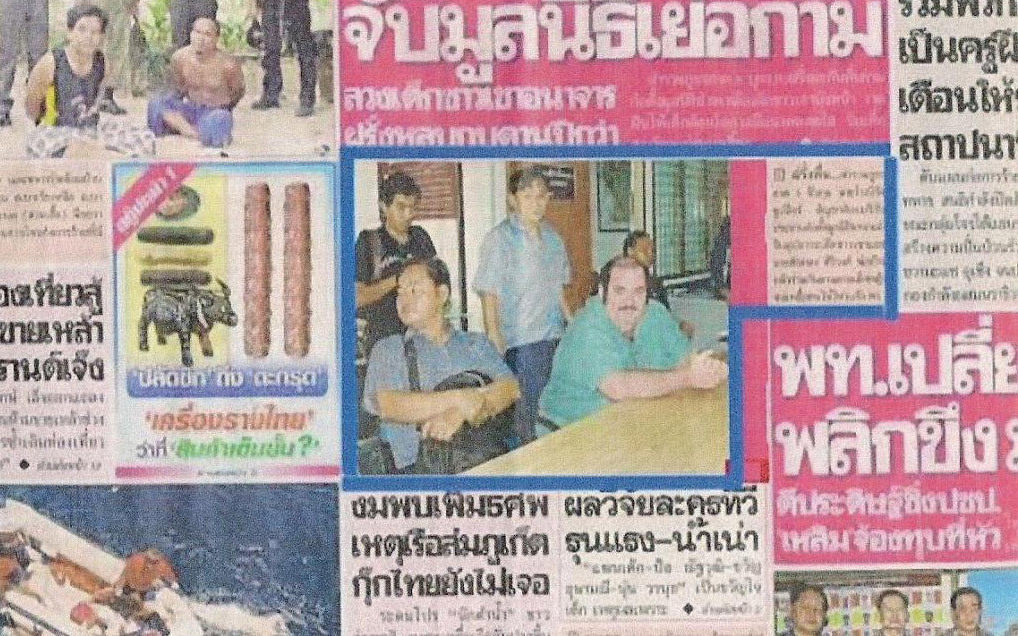
Thai-language paper carrying story of arrest of Moss/Morse and his employee.
The following is an English translation of the March 13 Thai-language newspaper report on police investigation of American missionary [translation provided by Akha rights NGO]:
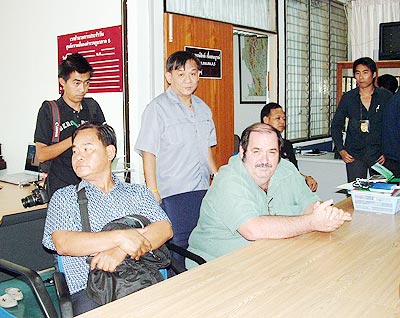
Robert Moss (seated right) and Chailong Siriwong are questioned at the headquarters of Police Bureau Region 5’s Juvenile and Women’s Protection Division. Two men charged with sexual abuse of young girls in their care Saksit Meesubkwang Two men, one American and one Thai, were recently arrested and charged with sexual abuse against a number of young hill tribe girls between the ages of 13 and 15. It seems that the two men’s abuse of the young girls in their charge may have been continuing unreported for a number of years. The men were questioned and charged at Police Bureau Region 5’s Juvenile and Women’s Protection Division; a search of the foundation’s premises resulted in the seizure of CDs and DVDs which will be used as evidence. Robert Moss, 55, the proprietor of Hor Fuang Fah, a foundation which supplied accommodation and access to education for hill tribe girls, with premises in Muang and Mae Taeng districts, together with his employee Chailong Siriwong, 49, are, at present, denying the charges. During questioning, Chailong insisted that he had not sexually abused the girls, and that he had loved them as would a father. He refused to comment about Moss’s involvement, stating that it was “none of his business”. Prior to the two men’s arrest, Somboon Jai-ngarm, the principal of Mae Tang’s Sop Perng Wittaya School, had become concerned about the behaviour of a number of young girls from the foundation’s Mae Taeng premises who were being educated at the school. The students seemed ill, nervous and depressed, and were often found crying. Suspecting child sexual abuse, Somboon contacted local police, and was finally able to persuade 7 of the girls to talk with police. After the subsequent arrest of their alleged abusers, the victims felt able to tell their full stories. The Hor Fuang Fah foundation was supposedly acting to sponsor selected students from impoverished hill tribe families living in Chiang Rai’s Mae Suay district, providing them with education and a place to stay in Chiang Mai. The accused Thai, Chailong, originally from Mae Suay, was employed by Moss to drive the girls to and from school and to perform housekeeping duties. At least 100 young girls were resident at the facility. However, during questioning by police, the possibility that the foundation was being run for the financial benefit of its proprietor was revealed. Each student’s family was charged 3,000 baht annually for accommodation, food and transportation to school, and another 10,000 baht for education services. It is being suggested that the bulk of the charges, plus national and international donations received by the foundation, were retained by Moss. One of the abuse victims told the school’s principal that girls staying at the dormitories often went hungry, as food was in short supply. Another said that she was afraid she would have to die before she could get away from Moss and Chailong, and that if she could escape, she would never go back. Others said that on many occasions, Moss and Chailong would force girls to go with them to their private quarters in order to ‘give a massage’. Outsiders were not permitted to enter the foundation’s premises, even when girls were sick and needed medical attention, or when the school’s principal needed to check on their health. The children were also forced to work in Moss’s orchard. Since the arrests, almost half the girls have left the foundation’s premises; a number have been sent to other children’s homes in Chiang Mai, others have been taken back to their villages by their parents. Some, who have been terrified by the constant threat of abuse, have refused to return to the facility. Pol Lt Col Thawatchai Yoomark, deputy superintendent of the Juvenile and Women’s Protection Division, said that police suspect that a further number of organisations may be acting in this manner, and that their founders’ and executives’ history and profiles were being investigated by the authorities. Most foreign missionaries in northern Thailand are evangelical Protestants. There are also Roman Catholics. Most of the missionaries are Americans with a sizable contingent of western Europeans and Australians. Chiang Mai is a center for the foreign missionary activities in northern Thailand. |
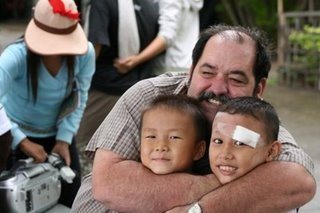
Photo of Moss/Morse with native boys
Attempts by NGOs to publicize
In early 2007, WMR conducted an in-depth investigation of the involvement of U.S. diplomats and members of the American expatriate communities in Thailand and Cambodia in pedophilia and child prostitution:
"[John Mark] Karr, it will be remembered, publicly claimed after his arrest in Thailand last year on unrelated child prostitution charges, to have been present at the murder of 6-year old Jon Benet Ramsey in 1996 in Boulder, Colorado. Karr, given rock star status by the corporate media, was interviewed by Larry King on CNN's tabloidish Larry King Live and, more recently, by Fox News' Greta Van Sustren.
A longtime U.S. resident of Thailand and an author of several books on Thailand's expatriate community told this editor that Karr’s unusual special treatment by the U.S. embassy in Bangkok last year is very unusual. In fact, it is practically unprecedented. The question is why?
After Karr was arrested by Thai police on what was reported to be "unspecified sex charges" unrelated to the Ramsey matter, the U.S. embassy, and particularly the large CIA station in Bangkok and the 16-person Department of Homeland Security contingent located in rented office space adjacent to the huge embassy compound, arranged for Karr’s hasty departure from Thailand to face charges in the Ramsey murder case. Karr was flown, un-handcuffed and sipping champagne, in business class from Bangkok to Los Angeles on Thai International Airways, courtesy of the American taxpayer. Again, why?
Karr, according to several informed sources in Asia, including former Japan Times weekly magazine editor Yoichi Shimatsu, who lives part time in Thailand, and Robert Finnegan, former editor of Indonesia’s English-language Jakarta Post, was more than a mere publicity-seeking alleged pedophile preying on young children – he fit the classic profile of a procurer of children for others – a business that leads directly to the very embassy that accorded him VIP treatment on his departure from Thailand. Both journalists have extensively investigated the scourge of pedophiles in Southeast Asia. And both have been singled out for attack by pedophile interests, operating through various front operations in the region, including anti-pedophile non-government organizations. [In an update to this article, a private investigator who is working on the cases of Jon Benet Ramsey and Iowa paperboy Johnny Gosch, abducted in 1982 at age 12, reports that the U.S. law enforcement contact in Japan reports that Karr may have been procuring for one other embassy in Bangkok, in addition to the U.S. embassy].
For a California schoolteacher, arrested in April 2001 for possession of child pornography, losing his teaching license, and vanishing into thin air after serving six months in a California jail, Karr led a charmed life in an upscale neighborhood of Bangkok. After Boulder, Colorado, authorities determined that Karr lied about killing Ramsey, Sonoma County, California prosecutors discovered that the computer containing the child pornography images for which Karr was originally arrested in April 2001 was missing. As a result, all criminal charges from that case were dropped against Karr. A seasoned law enforcement specialist commented that evidence does not simply "walk out" of evidence rooms without some powerful 'outside intervention.' . . .
Former Jakarta Post editor Finnegan is well aware of U.S. ambassador to Thailand Ralph "Skip" Boyce’s modus operandi. He believes that John Mark Karr was a typical intelligence cut out for the embassy in Bangkok, one whose major job for the embassy was to procure underage children for sex with visiting VIPs and senior diplomats. In fact, Bangkok is a major stopping point for U.S. members of Congress on "junkets." This editor has identified a number of House members who have visited Bangkok on numerous occasions. All of them are Republicans.
Because Karr was smart enough to spread out incriminating evidence he possessed of embassy involvement, they had no other choice but to extricate him from Thailand when he ran afoul of the local authorities. It was under the protection of the U.S. embassy that Karr was spirited out of Thailand on a business class Thai International Airways flight to the United States, where all charges, including those involving Jon Benet Ramsey and the Sonoma County kiddie porn charges, were dropped. It is clear that the Ramsey story was a ruse cooked up by the U.S. embassy to create such a firestorm of media attention that the Thai authorities, who had come under the rule of a military junta in a coup a few weeks earlier, had no other choice but to release Karr to the Americans."
A former senior U.S. State Department ambassador told WMR on background that for any U.S. diplomats to be involved in 'authorized' child prostitution would require embassy collusion at the "very top" within the embassy structure. During the Bush administration, WMR reported that Deputy Secretary of State and Director of National Intelligence John Negroponte helped provide cover for such activities because of a major conflict-of-interest in law enforcement investigation of child trafficking and abuse cases involving U.S. citizens in Cambodia, particularly at an orphanage on the outskirts of Phnom Penh near the international airport that was frequented by VIPs arriving in private jets who engaged in inappropriate activities with children.
Condoleezza Rice's excuse for not cracking down on U.S. embassy involvement with child prostitution was mainly Negroponte's presence within the intelligence and foreign policy structure of the Bush-Cheney administration. It remains unknown what reason Mrs. Clinton has for allowing such illegal activity to continue.
-------------------------------------------------------------------------------------------------------------------------------------------------------------------------
SPECIAL REPORT. The US security umbrella for child trafficking in Southeast Asia
It has been a year since this editor traveled to Southeast Asia to investigate U.S. diplomats and intelligence agents in the region who have participated, aided, and abetted in the sexual abuse and trafficking of children. Since that time, the situation has largely deteriorated. The only bright spot was the December 2007 early retirement and departure of U.S. ambassador to Thailand Ralph Boyce, who was repeatedly accused over the years of failing to take action against U.S. diplomats and their local interlocutors in countries where he was assigned as ambassador, including Thailand and Indonesia.
WMR has now learned that one orphanage in the region that was targeted by wealthy American patrons with close links to the CIA and Bush White House continues to suffer financially after the American patrons withdrew their support after their sexual abuse activities resulted in complaints from local staff.
Boys of the average age of 10 were used by one of the American patrons for sexual gratification and a few girls of the same age were used to "entertain" visiting dignitaries. WMR has reported in the past that members of Congress used congressional junkets to Southeast Asia as a screen for engaging in sex with children and underage teens.
WMR has also learned that children at the same orphanage were forced to appear in child porn movies that were then transmitted abroad via the Internet using extremely powerful encryption software. Upon abandoning the orphanage, the American patrons ensured the encryption software was pulled off the computers.
WMR has also learned that the CIA is pressuring local media outlets that report on the widespread abuse of children involving Americans in general and diplomats and American VIPs in particular. Some of the money used to silence the local media is being laundered by the agency through the National Endowment for Democracy (NED).
This editor has personally requested assistance from Congress to investigate and curtail the sexual abuse of children by U.S. diplomats and intelligence agents. However, given the fact that the abuse also involves members of Congress and their staff, the requests have been met with stony silence.
Anti-pedophile activists in Southeast Asia are considering a civil law suit against the American perpetrators, but lacking in funds, they are attempting to seek out pro bono legal assistance in the United States. So far, such assistance has not been forthcoming.
One major problem for the activists is that many "established" and "recognized" non-government organizations (NGOs) dedicated to the anti-pedophile cause are ciphers for larger organizations that want to divert attention and obfuscate about the actual perpetrators of pedophile activities. These include local NGOs supported by the Roman Catholic Church and the US Agency for International Development (USAID). USAID has long been a financial pass-through for the CIA.
----------------------------------------------------------------------------------------------------------------------------------------
January 28, 2008
Boyce never took action against abuse of children in northern Thailand
WMR has been informed by two knowledgeable sources that recently-departed US ambassador to Thailand Ralph "Skip" Boyce took no stand against the abuse of children in northern Thailand, including Akha tribal children in Chiang Rai and Chiang Mai provinces and Burmese refugee children on the Thai side of the border with Burma (Myanmar).
Boyce quietly accepted an early retirement last month and slipped away from the US embassy in Bangkok without much fanfare. Boyce was a well-known apologist for the Burmese military junta and did little to criticize the Burmese for the wretched status quo of Burmese refugees on the Thai side of the border. It is from Burmese refugee camps in Thailand that a number of children have been pressed into service as slave laborers and prostitutes.
WMR has learned that Thai children who are preyed upon for sex are killed and their bodies are disposed of after they are abused. The bodies are dumped in clusters of five to ten at a time. While Boyce was U.S. ambassador to Jakarta, there were reports of similar murders of children used as prostitutes with their skeletal remains later being discovered in caves in Bali and Java.
There have also been repeated reports of Christian missionaries being involved in the sexual abuse of Akha children in northern Thailand.
-------------------------------------------------------------------------------------------------------------------------------
January 25-27, 2008
UPDATED 1 X
Ambassador at center of diplo-pedo scandals takes early retirement
Ralph "Skip" Boyce, who has served as US ambassador to Indonesia and, more recently, Thailand, quietly announced his early retirement last month and has left the US Embassy in Bangkok.
Boyce was at the center of a WMR investigation of the cover-up of a major US State Department scandal involving US diplomats, primarily in Southeast Asia, with child prostitution and pedophilia. For example, it was Boyce who helped arrange John Mark Karr's hasty trip from a Bangkok prison on a business class flight to the United States. Karr falsely claimed he had killed Jon Benet Ramsey in Colorado after being arrested on non-related sex charges by Thai police.
Boyce's covering the tracks for known pedophiles in the State Department and CIA extended from his time in Jakarta, Indonesia to two postings in Bangkok, one as ambassador and a previous stint as deputy chief of mission.
Boyce was also a proponent of US tobacco sales in Thailand and a supporter of US engagement with the Burmese military junta.
-------------------------------------------------------------------------------------------------------------------------------
October 22, 2007
Canadian and other diplomats across Asia worried about Neil capture in Thailand
Former Canadian seminarian Christopher Neil sits in a Bangkok prison under suspicion by Thai authorities that he sexually molested a 9-year old boy in Thailand four years ago. Neil is also believed by INTERPOL to be the adult male subject appearing in decrypted Internet photos molesting Asian male children. The photos were decrypted by German experts in "Operation Vico," an international investigation of some 200 sexually-explicit photos involving boys taken in Vietnam and Cambodia four to five years ago.
Neil's job description and modus operandi are very similar to those of John Mark Karr, the enigmatic American former school teacher who has managed to avoid prison sentences in Thailand and California. Karr was arrested last year in Bangkok for a child sex-related crime but was soon whisked out of Thailand on a business class ticket from Bangkok to Los Angeles, courtesy of the CIA and U.S. Department of Homeland Security at the American embassy in Bangkok. WMR learned that it was the CIA station in Bangkok that instructed Karr to admit to killing Jon Benet Ramsey to cause an international outcry and media frenzy that would give Thai authorities no other choice but to release Karr to U.S. custody. The gambit worked and today, Karr walks a free man.
Like the accused Canadian pedophile Neil, Karr taught school in South Korea but acquired an affinity for Thailand. Karr had also lived in other havens for pedophiles: Costa Rica and Honduras.
On October 13, 2006, WMR reported the following:
After WMR was the first to report on the strange story of John Mark Karr, who was arrested on pedophilia charges by Thai authorities, falsely claimed to have killed Jon Benet Ramsey, and was whisked out of Thailand after the intervention of the CIA, Department of Homeland Security, and the U.S. Embassy in Thailand, State Department sources revealed to us that the U.S. embassies in Southeast Asia not only tolerate U.S. diplomats having sex with underage nationals of the host nations but act as "pimp services" for visiting and newly-transferred U.S. officials. One of the embassies involved is the U.S. Embassy in Yangon (Rangoon), Myanmar. WMR received information that Karr was pulled out of Thailand because he had information on the involvement of top U.S. government officials in the child prostitution trade in Thailand and any testimony by Karr in a Thai court could have proved 'embarrassing' for the Bush administration.
The situation at the US Embassy in Bangkok was so bad, a newly-arrived Deputy Chief of Mission wondered why barely legal-aged male staffers at one of the official State Department residences would line up at the foot of stairs before he went to bed. He later realized that they were waiting to see which one he would take to bed. One U.S. diplomat regularly traveled with two young boys he procured in Vientiane, Laos and Phnom Penh, Cambodia. When he took the boys on an assignment to Bandar Seri Begawan, he was declared persona non grata by the Brunei government because homosexuality is illegal in the Muslim monarchy. The U.S. embassy in Jakarta, Indonesia is another posting that tolerates its diplomats having sex with underage male prostitutes.
In February this year, this editor undertook an investigation in Thailand and Cambodia that discovered that Western embassies, non-governmental organizations, and religious organizations throughout Southeast Asia are involved in covering up of the participation of their personnel in the child sex trade. In some cases, diplomats and NGO officials are, themselves, involved in pedophilia.

With Neil's arrest, the VIP patrons of Southeast Asia's sex trade will be nervous about further revelations. Above, one of many sex tourist magnets for pedophiles in Thailand, this one in seedy Pattaya Beach.
On July 16, 2007, WMR provided further details on the Southeast Asia pedophilia network:
"I visited Karr’s neighborhood and his hotels in the Sathorn district of Bangkok and found his surroundings to be an oasis of European diplomatic and cultural missions, including the Danish and Austrian embassies, the German-Thai Cultural Center and Goethe Institute, and most intriguingly, the Joint U.S.-Thai Military Assistance Group (JUSTMAG), a highly-secured compound where U.S. Special Operations personnel operate, along with their Thai counterparts, against various Southeast Asian insurgent groups, including the Al Qaeda affiliate, Jemaah Islamiya.
The perception management campaign by the foreign media in Thailand to paint Karr as a filthy degenerate living in squalid conditions was not bought by the Thai media. It was not pimps and drug dealers with whom Karr rubbed shoulders but diplomats and members of the U.S. military.
Former Jakarta Post editor Robert Finnegan is well aware of U.S. ambassador to Thailand Ralph "Skip" Boyce’s modus operandi. He believes that John Mark Karr was a typical intelligence cut out for the embassy in Bangkok, one whose major job for the embassy was to procure underage children for sex with visiting VIPs and senior diplomats. In fact, Bangkok is a major stopping point for U.S. members of Congress on 'junkets.' This editor has identified a number of House members who have visited Bangkok on numerous occasions. All of them are Republicans."
WMR has learned that Nakhon Ratchasima, the northeast Thai province where Neil was arrested, is an important nexus in a route for the trafficking of children for sexual exploitation in Southeast Asia, especially from Laos and Cambodia to the Thai-Burmese border zone. The Thai-Burmese "in-between" border refugee zones not only provide sanctuary for Burmese minority groups and other refugees from the Burmese military junta but now provide a ready-made pool of virtual slave laborers and child prostitutes. Not only are the children used in the sex trade from Burma and rural northern Thailand but increasingly they are being trafficked into these political "neutral zones" from locations like Cambodia, Laos, and Vietnam.
We have also learned that the recent sanctions imposed by the Bush administration on Burma as a result of that country's junta crackdown on the latest neocon-prompted "thematic revolution" -- Burma's "Saffron Revolution" -- is having the effect of closing down garment and other factories in Burma, thus driving more young women, including children, to the sex trade zones of the Burmese-Thai border.
Kingpins in the Russian-Ukrainian-Israeli Mafia (RUIM) are also increasingly moving in on the Southeast Asia child sex trade, as WMR discovered in its investigation in February this year. The potential for blackmailing visiting U.S. and other Western politicians and businessman is an obvious side benefit to the RUIM as its involvement in the trafficking of children for sex increases in scope.
WMR has also learned from a knowledgeable source that the Canadian embassies in Jakarta and Bangkok and its High Commission in Kuala Lumpur are concerned about the Neil arrest. Canadian diplomats and NGO officials, like their Australian, American, British, German, Belgian, and New Zealand counterparts, will be on pins and needles about any revelations coming out of a trial for Neil in Thailand. The Thai military government is known not to look kindly on the acquiescence by Western embassies of the child sexual exploitation activities of their diplomats and other official representatives and visitors. There are already calls for Neil to be extradited to Canada. That is an obvious high priority strategy for the Canadian government and its Western allies.
-------------------------------------------------------------------------------------------------------------------------------
August 11, 2007
Pedophiles preyed on young survivors from Indian Ocean tsunami
There is an extremely sordid footnote to the story about the plague of pedophilia in Southeast Asia, on which WMR has reported extensively in the past. According to relief workers who went to southern Thailand’s Phuket region after the catastrophic December 26, 2004 tsunami that struck the coastal areas of the Indian Ocean, the Swedish media was warned by relief workers, including those from the Red Cross, about the possibility of child abductions.
Almost 100 children younger than 13 were among 565 missing in the aftermath of the disaster. The Swedish National Police compounded the problem by keeping a list of the dead and missing secret citing “privacy concerns.” In February 2005, a Swedish court ordered the list of the victims and the missing made public.
The coastal areas of Thailand traditionally make their income by smuggling and human trafficking, in addition to tourism and fishing. The alarm about abductions became clear when a Swedish boy named Kristian Walker was escorted out of a hospital by a German man who was not his father. Although the German man returned the child, a disturbing anomaly was noted by relief workers who were identifying bodies through dental records and DNA.
Although a number of Swedish adults and young girls were identified, the bodies of a number of Swedish boys were never recovered, heightening speculation that they had been snagged by abductors and sold into the white slave trade. Young blond boys are highly prized in places like India, Saudi Arabia, and the United Arab Emirates.
The Saudi and Emirati governments remain immune from international criminal probes into their roles in perpetuating child trafficking and prostitution.
Indonesian police reported that a number of orphaned and separated Indonesian children were moved from Aceh province to other parts of Indonesia and Malaysia for trafficking purposes. Likewise, after the 2002 terrorist car bombings in Bali, orphaned children fell prey to foreign pedophiles.
The Australian child advocacy group ChildWise, in a 2004 report, stated that foreign pedophiles operate openly on the streets of Bali, some adopting poor children left without parental support. And what kind of diplomats does Australia post to Indonesia? Individuals like William Stuart Brown, arrested for pedophilia on the Bali, was assigned to Indonesia as an official of Australia Aid (AusAID). Recalled to Australia after a 1984 incident with a boy in Indonesia, he remained with the Australian Department of Foreign Affairs and Trade with a diplomatic passport until 1995 when he resigned. He quickly returned to Indonesia where he lived openly with underage boys on the island of Lombok.
Brown was later sentenced to 13 years in prison in Indonesia. Brown hanged himself in his Bali jail cell on the second day of his prison sentence.
In 2003, the Australian embassy in Phnom Penh issued Clint Betterridge, a New South Wales schoolteacher, a replacement passport that allowed him to escape into Thailand a few days before his trial in Cambodia for having sex with nine Cambodian underage girls. He was convicted in absentia. Australian ambassador Louise Hand cited an “administrative error” in permitting Betterridge’s escape. Betterridge’s embassy special treatment was similar to that afforded to John Mark Karr in Bangkok. Both schoolteachers, both freed from jail and escaping extradition, and both fitting the profile of procurers.
Echoing the complaints heard from American diplomats about pedophiles at U.S. embassies, Alastair Gaisford, who served at the Australian embassy in Cambodia in the 1990s, claimed that the Australian foreign affairs department systematically covered up pedophile cases involving Aussie diplomats. He told the Sydney Morning Herald, “there is an institutionalized culture of never dealing with these people.”
The U.S. embassy in Bangkok is the second largest in the Far East (after Tokyo). Its CIA station is also rumored by many intelligence observers in Bangkok to be the second largest in Asia, after Tokyo. However, the U.S. embassy in Bangkok has another distinction – it is at the center of the State Department’s pedophile activities in Asia.
According to journalistic sources posted to the region, the pedophilia activity has centered around Ambassador Ralph (“Skip”) Boyce, the current U.S. ambassador to Thailand and the former ambassador to Indonesia. Boyce, who speaks fluent Thai, has spent much of his Foreign Service career in Southeast Asia. Before his stint in Indonesia, Boyce was Deputy Assistant Secretary of State for East Asia and the Pacific. He was Political Counselor Bangkok from 1988 to 1992, had a brief stint as Charge d’Affairs in Singapore from 1992 to 1994 and he returned to Bangkok as Deputy Chief of Mission from 1994 to 1998.
In 1995, while Boyce served as the number two man at the Bangkok embassy, a scandal engulfed the U.S. mission. The Consular Services section of the embassy conspired with Thai police and pedophiles in Belgium, Thailand, and the United States to allow a Thai boy from being sent from Thailand to Belgium, a noted haven for pedophiles. Thai government officials issued an order on behalf of the child’s American godfather to keep the youngster in Thailand. The boy’s Lao mother, a barmaid, was part of a ring of pedophiles in Pattaya Beach and Antwerp, Belgium. Amid protests, the woman transported the boy to Belgium.
Boyce ignored repeated warnings about the misconduct of his embassy’s Consular Affairs office. Boyce and his key staffers, including Consul General Thomas P. Furey and American Citizens Services chief Christopher Richard, later blocked a Thai police investigation of the matter.
Three successive American ambassadors to Thailand – William Itoh, Richard Hecklinger, and Darryl Johnson, refused to get involved in the case. Only Itoh officially responded to a letter asking for his intervention, however, he did not take any action.
Boyce has, time and time again, shown himself to be conducting his own foreign policy. Although the State Department has a full-time ambassador-at-large who deals with child trafficking matters, the last ambassador was replaced by a fundamentalist Christian, Mark Lagon, a stong advocate of faith-based initiatives, regardless of the fact that it has been elements of the church -- Catholic and Protestant -- that has provided, and continues to provide, cover for pedophiles around the world. At his swearing-in ceremony, Lagon boasted that he is a "practicing, confirmed Christian" and ended his remarks by asking God to bless his efforts.
Lagon is a veteran of the staff of North Carolina Senator Jesse Helms, the Project for the New American Century, and the American Enterprise Institute. He was brought into the State Department in 2004 as part of the purge of pro-Colin Powell and anti-necon elements in the department.
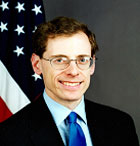
Mark Lagon, the man Bush appointed in February 2007 to head up anti-child trafficking activities of the State Department, which itself condones and supports such activities.
Boyce has been content to allow the problem to flourish at the embassies to which he has been assigned, not only in Bangkok but also in Jakarta. Although the Bush administration condemned the September 2006 Thai military coup, dubbed the “Silken Coup,” Boyce wears a yellow tie to affirm his support for the Royal Family, which authorized the coup. He has also refused to condemn the Burmese military junta, although that policy runs counter to official U.S. policy. Boyce has also pushed the interests of American tobacco and alcohol companies even though the Thai government is discouraging the use of both, especially among the young.


 Posts
Posts


![[Most Recent Quotes from www.kitco.com]](http://www.kitconet.com/charts/metals/gold/t24_au_en_eukg_2.gif)