Monday, 17 May 2010

strategy shift in the middle east

Strategy shift in the Middle East

Thierry Meyssan

The failure to reshape the Greater Middle East has left the field open to a new alliance, the Tehran-Damascus-Ankara triangle. Since nature is allergic to vacuums, Moscow is filling the space left vacant by Washington. The wind has changed and it’s blowing strong. In a matter of a few months, the entire regional balance of power has tipped.

16 May 2010

JPEG - 26.8 kb
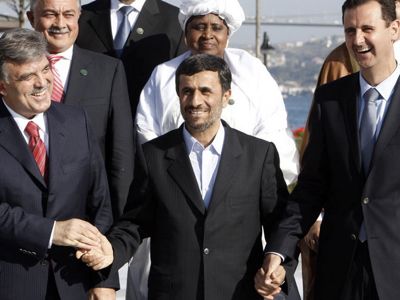
The new formula for the Middle East: the Turkey-Iran-Syria triangle (L to R, Presidents Gül, Ahmadinejad and Assad).
In recent months the equilibrium of the Middle East has undergone a complete shift. First of all, the capabilities and positions of a number of players have changed.

- The Israeli armed forces, who had gone from one victory to another for decades, are no longer able to control the ground. During their offensive against Lebanon (2006) and against Gaza (2008), they displayed an increase of destructive power, but showed they are not longer capable of achieving their goals, in this case the destruction of Hezbollah and Hamas. In addition, their arsenal, equipped as required by the United States, no longer guarantees their domination. Their tanks have become vulnerable to Russian RPG, when they used to constitute the major component of their blitzkrieg. Their navy is threatened by the land-sea missiles supplied to Hezbollah by China, which are now equipped with an anti-jamming system that they lacked in 2006. Finally, their air dominance will not resist for long to the proliferation of Russian S-300, currently being shipped to the region.

- The quasi-independence of Iraqi Kurdistan engineered by the United States, the economic development of this quasi-state under Israeli control and Washington’s blatant support of the separatist Kurds under the PKK umbrella, compelled the Turkish military to a complete turnaround. The Atlantic Alliance is no longer a warrant for Turkish territorial integrity and Israel becomes an enemy. While Ankara is careful to placate Washington, the tone with Tel Aviv has continued to escalate since the altercation between Recip Erdogan and Shimon Peres at the Forum in Davos, and the diplomatic incident linked to the Turkish television series The Valley of the Wolves.

- The Iraqi chaos and the creation of a quasi-state in Kurdistan have forced neighbouring states to work together to avert a spillover effect, especially since Washington has already attempted to destabilize them all to keep them out of the Iraqi game. Thus the United States and Israel covertly supported Kurdish separatists in Turkey (PKK), those in Iran (Pejak) and those in Syria. As a result, the Iran-Syria axis has been replaced by the Iran-Syria-Turkey triangle. This new alliance enjoys a historical legitimacy without parallel. Since the Islamic Revolution, Iran has been the leader of the Shiites. After Paul Bremmer’s destruction of the Iraqi Baath party, Syria stepped in as the undisputed leader of the secular camp. Finally, Turkey, heir to the Ottoman Caliphate, is the cradle of Sunni Islam. Taken together, these states cover nearly the entire field of Middle Eastern politics. This alliance has closed the curtain on the Divide et Impera (divide and rule) policy, successfully applied by the colonial powers to dominate this vast region. In particular, it puts an end to the Fitna, that is to say the Islamic "civil war" between Sunnis and Shiites. King Abdullah of Saudi Arabia has already invited Iranian President Ahmadinejad to join him in a pilgrimage to Mecca, of which he is the custodian. As the heir of the Ottomans, Turkey embodies the historical legacy of Sunni Islam. In addition, the new triangle widens Ankara’s horizons constantly blocked by the endless procrastinations of the European Union.

- The "de-Baathisation" process of Iraq, i.e. the hunting season against the former executive officers of the country, has caused a mass exodus. In six years, more than one million Iraqis have been welcomed to Syria. Such Arab hospitality includes totally free admission to schools and universities as well as access to the overall health system. Initially, this vast immigration wave caused a serious economic crisis, but once digested, it has provided Syria with highly qualified executives and has injected a new dynamism.

- The turmoil organized by the United States in Yemen forced the Saudi royal family to support King Abdhallah’s policy of appeasement towards Syria and Iran. Consequently, the Hariri Lebanese-Saudi clan was asked to reconcile with President Bashar al-Assad and to recognize the legitimacy of the armed Lebanese Resistance. Suddenly, the ambivalent results of the rigged 2009 parliamentary elections - where General Aoun and Hezbollah won by a majority of votes, but where a majority of seats was obtained by the coalition formed around the pro-American clan Hariri and the extreme Christian right - took on a different meaning, opening the way for a government of national unity. While the warlords like socialist Walid Jumblatt made a 180 ° turn in order to go with the tide.

However, this trend remains fragile since Washington may still have the possibility to destabilize the new troika. Be that as it may, several attempts by corrupt Syrian generals to overthrow Bashar al-Assad were foiled even before they could act. The multiple attacks orchestrated by the CIA in the non-Persian provinces of Iran failed to trigger separatist revolts. While the colour revolution, organized by the CIA and MI6 during the presidential election, was been drowned out by a human tidal wave. To the tens of thousands of protesters in the northern neighbourhoods of Tehran, the rest of the country responded with a massive demonstration of 5 million people. Finally, it appears that Washington is incapable of resorting again to Gladio to establish a military dictatorship in Turkey. On the one hand because the new generation of Turkish generals no longer buttressed to Kemalism and secondly because the AKP Muslim-Democratic is intent on dismantling Ergenekon (current version Turkish Gladio).

Washington and Tel Aviv could also fabricate fraudulent files to justify military action. Thus, since 2007, they have been alleging that Israel discovered and bombed a military nuclear research center in Syria and that Iran is developing a vast programe of a similar nature. More recently, the same powers have accused Syria of having introduced Scuds into Lebanon. However, these accusations do not stand up to analysis any more than those formulated by Secretary of State Colin Powell before the United Nations Security Council United Nations regarding Iraqi’s alleged possession of weapons of mass destruction. The numerous IAEA inspection teams that visited Iran only found evidence of civilian activities, and the UN peacekeeping forces in Lebanon have denied the presence of Scuds in the country.

Russian makes its entrance

The loss of U.S. influence is so palpable that General David Petraeus, Commander of U.S. Central Command, has set off alarm bells in Washington. In his view, the game played by the Israelis not only in Palestine, but especially in Iraq, has thwarted U.S. plans in the region. Moreover, the stagnation of the GIs situation in Iraq and Afghanistan has made them hostages to Turkey, Syria and Iran, the only ones able to pacify the rebellious populations. In a complete reversal of roles, the strategic ally of the Pentagon has become a burden, while its regional enemies are now its shields.

Noting the failure of U.S. plans to reshape U.S. Greater Middle East, Moscow has repositioned itself on the regional scene on the occasion of President Dmitry Medvedev’s visits to Damascus and Ankara.

With regard to Israel, Russia reaffirmed that the political settlement of the conflict should be based on the relevant UN resolutions (including the inalienable right of return for Palestinians) and the principles of the Madrid conference (return of the occupied territories, including East Jerusalem and the Golan Heights, in exchange for a peace treaty). Moreover, Dmitry Medvedev confirmed his country’s preference for the two-state solution. Given the presence of one million ex-Soviets in Israel, Moscow wants to forestall a foreseeable exodus in case the Zionist regime should fall. In this context, he advocated for reconciliation between Fatah and Hamas, and met Khaled Mechaal, the political leader of the Palestinian resistance, notwithstanding Washington’s stigmatisation of Hamas as a "terrorist" organisation. This represents a decisive step for Russia: President Medevedev had refused three times to receive Mechaal when he passed through Moscow; this time he had an interview with him and, what is more, in Damascus. On this occasion, the Russian president stressed the increasing urgency of the humanitarian situation in Gaza and deplored Washington’s lack of interest in solving this tragedy. Finally, alluding to Israeli threats to bomb the convoys of weapons from Syria to Lebanon, he warned Tel Aviv against an escalation of tension.

Russia supports the political and economic rapprochement in progress between Iran, Syria and Turkey. The three leading States in the Middle East have entered a phase of intense cooperation. In a matter of months, they have opened their borders and liberalised their trade at an accelerated pace. Their economies which were paralised by years of war have suddenly been energised. Russia has no intention of staying out of this new area of prosperity. Immediately, Ankara and Moscow have lifted visa requirements for their citizens. In this way, a Turk can enter Russia without any formalities while he cannot do the same in the United States nor the EU, despite the fact that Turkey is a NATO member and a EU candidate.

Moscow has set up permanent consultative bodies at high diplomatic and economic levels with Damascus and Ankara, in contrast with the policy of the United States. Earlier this year, U.S. Secretary of State Hillary Clinton had ordered Syria to distance itself from the Resistance. In response, President Bashar al-Assad immediately appeared alongside his Iranian counterpart Mahmoud Ahmadinejad and Hezbollah Secretary General Hassan Nasrallah and ironically signed a document titled "Treaty of reduced distance". The meeting was convened short notice and Khaled Mechaal could not attend, but Hamas was nevertheless involved in the process. Following up on his threats, President Barack Obama has renewed economic sanctions against Syria for another two years.

Rosatom and Atomstroyexport, which are completing the construction of a civilian nuclear plant in Iran (Bushehr) and are contemplating new ones, will build another one in Turkey for 20 billion dollars. It should be launched in seven years. A similar project is under study in Syria. The lack of electricity in a region that withstood Israeli bombardments is the main obstacle to economic development. From a Middle Eastern point of view, Russia’s eagerness to build these power stations stems less from a commercial appetite than from a desire to provide the populations concerned with the means to accelerate the economic development that Westerners have denied them for so long. In addition Stroitransgaz and Gazprom will ensure the transit of Syrian gas to Lebanon, Beirut being prevented by its Israeli neighbour from exploiting its large reserves offshore.

Militarily, Russia has taken delivery of its new naval base in Syria. This will allow it to restore the balance in the Mediterranean from which Russia has been more or less absent since the dissolution of the USSR. It also confirmed the forthcoming delivery of S-300 missiles to Tehran to protect Iran from U.S. and Israeli threats of bombardment.

While condemning Iran’s provocations, Russian diplomats have reiterated that they do not believe in Western accusations about Iran’s and Syria’s alleged nuclear weapons programme. While the protocol among the states bordering the Caspian Sea only provides for a supply of arms to Iran in case of attack, President Dmitry Medvedev spoke of a possible direct involvement of Russia and warned the United States against a war in Iran that could degenerate into a Third World War. On this basis, he endorsed the denuclearization plan of the region, that is to say the dismantling of the Israeli nuclear arsenal. The case has recently been brought before the IAEA.

Russia attaches special importance to helping Turkey resolve its ancient disputes with Greece and Armenia, including the Cyprus and Nagorno-Karabakh conflicts. Thus, Ankara could move away permanently from Tel Aviv and Washington and recover its full independence. Important, albeit insufficient, steps have been made by President Abdullah Gül vis-à-vis Yerevan. Ignoring 95 years of hatred, Turkey and Armenia established diplomatic relations. Further progress should follow vis-à-vis Athens with the blessing of the Orthodox Patriarch Cyril I of Moscow. From this point of view, Recip Erdogan’s visit to Greece marks a historical event that boosts the process of reconciliation in the Aegean Sea, which began in the 30s and was interrupted by the Second World War.

Disrupting U.S. strategy in the Black Sea and the Caspian, Ankara accepted a huge Russian investment to build a pipeline between Samsun to Ceyhan. It is expected to carry Russian oil from the Black Sea to the Mediterranean without having to use the straits, unfit for the transit of pollutants. Identically, Ankara is considering its possible involvement in the Russian South Stream gas pipeline project. If it were to be confirmed, it would render ineffectual the competing Nabucco project sponsored by the United States and the European Union.

Ultimately, Russia’s support ensures the sustainability of the Tehran-Damascus-Ankara triangle in the face of U.S. and European hostility. The strategic balance in the Middle East has tipped. The shockwave could spread to the Caucasus.

--------------------------------------------------------------------------------------------------------------

http://www.voltairenet.org/article165394.html

Basculement stratégique au Proche-Orient

Thierry Meyssan

L’échec du remodelage du Grand Moyen-Orient a laissé le champ libre à une nouvelle alliance, celle du triangle Téhéran-Damas-Ankara. La nature ayant horreur du vide, Moscou comble l’espace laissé vacant par Washington. Le vent a tourné et il souffle fort. En quelques mois, c’est tout l’équilibre régional qui a été bouleversé.


JPEG -  26.8 ko
La nouvelle donne au Proche-Orient : le triangle Turquie-Iran-Syrie (de gauche à droite, les présidents Gül, Ahmadinejad et Assad).

L’équilibre du Proche-Orient a été entièrement modifié au cours des derniers mois. Tout d’abord, les capacités et les positions de plusieurs acteurs ont changé.

- Les forces armées israéliennes, qui avaient enchaîné victoire sur victoire durant des décennies, ne sont plus capables de maîtriser le terrain. Au cours de leur offensive contre le Liban (2006), puis contre Gaza (2008), elle ont montré qu’elles ont accru leur puissance de destruction, mais qu’elles ne parviennent plus à atteindre les objectifs qu’elles se fixent, en l’occurrence détruire le Hezbollah et le Hamas.
En outre, leur arsenal, alimenté autant que de besoin par les Etats-Unis, ne garantit plus leur domination. Leurs chars sont devenus vulnérables aux RPG russes, alors qu’ils formaient l’outil central de leur blitzkrieg. Leur marine est menacée par les missiles sol-mer livrés par la Chine au Hezbollah et désormais dotés des système anti-brouillage qui leur manquaient en 2006. Enfin, leur domination aérienne ne résistera pas longtemps à la prolifération des S-300 russes, en cours de livraison dans la région.

- La quasi-indépendance du Kurdistan irakien organisée par les Etats-Unis, le développement économique de ce quasi-Etat sous tutelle israélienne, et le soutien trop visible des USA aux séparatistes kurdes du PKK ont contraint les militaires turcs à un revirement complet. L’Alliance atlantique n’apparaît plus comme la garante de l’intégrité territoriale turque et Israël devient un ennemi.
Si Ankara veille à ménager Washington, le ton n’a cessé de monter avec Tel-Aviv depuis l’algarade opposant Recip Erdogan à Shimon Peres lors du Forum de Davos, à l’incident diplomatique relatif à la série télévisée La Vallée des loups.

- Le chaos irakien et la création du quasi-Etat du Kurdistan ont contraint les Etats riverains à se concerter pour se protéger de la contamination. D’autant que Washington a tenté de les déstabiliser tous pour les tenir à l’écart du jeu irakien. Ainsi les Etats-Unis et Israël ont soutenu en sous-main les séparatistes kurdes de Turquie (PKK), ceux d’Iran (Pejak) et ceux de Syrie.
Par conséquent, l’axe Iran-Syrie a fait place à un triangle Iran-Syrie-Turquie. Celui-ci dispose d’une légitimité historique sans équivalent.
Depuis la Révolution islamique, l’Iran est le chef de file des chiites. Après la destruction du Baas irakien par Paul Bremmer, la Syrie est devenue le leader incontesté du camp laïque. Enfin, la Turquie, héritière du califat, est le berceau du sunnisme. A eux trois, ces Etats couvrent la presque totalité du champ politique proche-oriental.
Cette alliance clos le chapitre du Divide et Impera (diviser pour régner), que les puissances coloniales avaient su appliquer pour dominer cette très vaste région. Elle met particulièrement un point final à la Fitna, c’est-à-dire à la guerre civile musulmane entre sunnites et chiites. Déjà le roi Abdallah d’Arabie saoudite avait invité le président iranien Ahmadinejad à faire avec lui le pèlerinage à La Mecque, dont il est le gardien. Mais la Turquie est l’héritière des Ottomans, et à ce titre incarne le sunnisme historique.
De plus, pour Ankara, ce nouveau triangle élargit enfin un horizon bouché par les interminables atermoiements de l’Union européenne.

- La dé-baasisation de l’Irak, c’est-à-dire la chasse ouverte contre les anciens cadres administratifs du pays, a provoqué un exode massif. En six ans, plus d’un million d’Irakiens ont été accueillis en Syrie. Cette hospitalité arabe inclut l’accès gratuit sans contrepartie aux établissements scolaires et universitaires ainsi qu’à l’ensemble du système de santé. Dans un premier temps, cette ample vague migratoire a provoqué une grave crise économique dans le pays, mais une fois digérée, elle lui apporte des cadres très qualifiés et une nouveau dynamisme.

- Les troubles organisés par les Etats-Unis au Yémen ont contraint la famille royale saoudienne à soutenir la politique du roi Abdhallah d’apaisement avec la Syrie et l’Iran. Par voie de conséquence, le clan libano-saoudien Hariri a été prié de se réconcilier avec le président Bachar el-Assad et de reconnaître la légitimité de l’armement de la Résistance libanaise.
Du coup, le résultat ambigüe des élections législatives truquées —gagnées en voix par la coalition conduite par le général Aoun et le Hezbollah, mais gagnées en sièges par la coalition pro-US formée autour du clan Hariri et de l’extrême-droite chrétienne— a changé de signification et ouvert la voie à un gouvernement d’union nationale. Tandis que des chefs de guerre comme le socialiste Walid Jumblatt opéraient un virage à 180° pour s’aligner sur le sens du vent.

Cependant, cette évolution est fragile, Washington ayant peut-être la possibilité de déstabiliser la nouvelle troïka.
Quoi qu’il en soit, plusieurs tentatives de renversement de Bachar el-Assad par des généraux corrompus ont été éventées avant même qu’ils ne puissent passer à l’acte.
Les multiples attentats orchestrés par la CIA dans les provinces non-persanes d’Iran n’ont pas donné le signal de révoltes séparatistes. Tandis que la révolution colorée, organisée par la CIA et le MI6 à l’occasion de l’élection présidentielle, a été noyée par une marée humaine. Aux quelques dizaines de milliers de contestataires des quartiers nord de Téhéran a répondu une manifestation monstre de 5 millions de personnes.
Enfin, Washington semble dans l’incapacité d’user une nouvelle fois du Gladio pour instaurer une dictature militaire en Turquie. D’une part parce que la nouvelle génération de généraux turcs n’est plus arc-boutée au kémalisme et d’autre part parce que le gouvernement démocrate-musulman de l’AKP s’est appliqué à démanteler l’Ergenekon (version actuelle du Gladio turc).

Washington et Tel-Aviv peuvent aussi monter des dossiers mensongers pour justifier d’actions militaires.
Ainsi ont-ils laissé entendre depuis 2007 qu’Israël aurait découvert et bombardé un centre de recherche militaire nucléaire en Syrie et que l’Iran conduirait un vaste programme de même nature. Plus récemment, les mêmes puissances ont accusé la Syrie d’avoir fait entrer des Scud au Liban.
Toutefois ces imputations ne résistent pas plus à l’analyses que celles délivrées par le secrétaire d’Etat Colin Powell au Conseil de sécurité des Nations Unies à propos des prétendues armes de destruction massive irakiennes. Les diverses inspections de l’AIEA n’ont mit en évidence que des activités civiles, et la force de maintien de la paix des nations Unies au Liban a démenti la présence de Scud dans le pays.

L’entrée en scène de la Russie

La perte d’influence des Etats-Unis est si palpable que le général David Petraeus, commandant en chef du Central Command a sonné l’alarme à Washington. A ses yeux, le jeu joué par les Israéliens non seulement en Palestine, mais surtout en Irak, a plombé les projets états-uniens dans la région.
Plus encore, l’enlisement des GI’s en Irak et en Afghanistan en fait des otages de la Turquie, de la Syrie et de l’Iran, seuls en mesure d’apaiser les populations révoltées.
Dans une complète inversion des rôles, l’allié stratégique du Pentagone est devenu un boulet, tandis que ses ennemis régionaux sont ses boucliers.

Prenant acte de l’échec du remodelage US du Grand Moyen-Orient, Moscou s’est repositionné sur la scène régionale lors du voyage du président Dmitry Medvedev à Damas et Ankara.

Concernant les conflits avec Israël, la Russie a réaffirmé que le règlement politique devait être fondé sur les résolutions pertinentes de l’ONU (incluant l’inaliénable droit au retour des Palestiniens) et les principes de la conférence de Madrid (restitution des territoires occupés, dont Jérusalem-Est et le Golan syrien, en échange d’un Traité de paix).
En outre, Dmitry Medvedev a confirmé la préférence russe pour la solution à deux Etats. Compte tenu de la présence d’un million d’ex-Soviétiques en Israël, Moscou veut prévenir un exode prévisible en cas de chute du régime sioniste. Dans cette perspective, il a souhaité une réconciliation entre le Fatah et le Hamas, et a rencontré Khaled Mechaal, le leader politique de la Résistance palestinienne, alors même que celui-ci est qualifié de « terroriste » par les Etats-Unis. Il s’agit bien d’un pas décisif de la Russie : le président Medevedev avait refusé par trois fois de recevoir M. Mechaal de passage à Moscou, il a cette fois eu une entrevue avec lui, et qui plus est à Damas. A cette occasion, le président russe a souligné l’urgence croissante de la situation humanitaire à Gaza et déploré le désintérêt de Washington à résoudre ce drame.
Enfin, faisant allusion aux menaces israéliennes de bombarder les convois d’armes passant de Syrie au Liban, il a mis en garde Tel-Aviv contre une escalade de la tension.

La Russie soutient le rapprochement politique et économique en cours entre l’Iran, la Syrie et la Turquie. Les trois Etats leaders au Proche-Orient sont entrés dans une phase d’intense coopération. En quelques mois, ils ont ouvert leurs frontières et libéralisé leurs échanges à marche forcée. Leurs économies bloquées par les années de guerre ont été soudainement ventilées. La Russie entend ne pas rester à l’écart de cette nouvelle zone de prospérité. Immédiatement, Ankara et Moscou ont abrogé la nécessité de visas pour leurs ressortissants. Ainsi un Turc peut entrer sans formalité en Russie alors qu’il n’y est toujours pas autorisé ni aux USA, ni dans l’Union européenne, bien que la Turquie soit membre de l’OTAN et candidate à l’UE.

Moscou a créé des instances permanentes de concertation à haut niveau, aux plans diplomatique et économique, avec Damas et avec Ankara, qui contrastent avec la politique des Etats-Unis.
En début d’année, la secrétaire d’Etat US, Hillary Clinton, avait sommé la Syrie de prendre ses distances avec la Résistance. Pour toute réponse le président Bashar el-Assad s’était immédiatement affiché aux côtés de son homologue iranien Mahmoud Ahmadinejad et du secrétaire général du Hezbollah Hassan Nasrallah et avait signé un document ironiquement qualifé de « Traité de distance réduite ». La rencontre avait été improvisée de sorte que Khaled Mechaal n’avait pas eu le temps de s’y rendre, mais le Hamas était associé à la démarche.
Mettant ses menaces à exécution, le président Barack Obama a répliqué en reconduisant pour deux ans des sanctions économiques contre la Syrie.

Rosatom et Atomstroyexport, qui terminent la construction d’une centrale nucléaire civile en Iran (Bushehr) et sont en discussion pour de nouvelles, en construiront une autre en Turquie pour 20 milliards de dollars. Elle devrait être inaugurée dans sept ans. Un projet similaire est à l’étude en Syrie. Le manque d’électricité, dans une région qui a souffert des bombardements israéliens, est le principal handicap au développement économique. Du point de vue proche-oriental l’empressement russe à construire ces centrales n’est pas tant imputable à un appétit commercial qu’à une volonté de donner aux peuples concernés le moyen d’accélérer le développement économique que les Occidentaux leur ont si longtemps interdit.
En outre Stroitransgaz et Gazprom vont assurer le transit du gaz syrien vers le Liban, Beyrouth étant empêché par son voisin israélien d’exploiter ses importantes réserves off shore.

Au plan militaire, la Russie a pris livraison de sa nouvelle base navale en Syrie. Celle-ci lui permettra de rétablir l’équilibre en Méditerranée dont elle est plus ou moins absent depuis la dissolution de l’URSS. Elle a également confirmé la prochaine livraison de missiles S-300 à Téhéran afin de protéger l’Iran des menaces de bombardement états-uniennes et israéliennes.

Tout en stigmatisant les provocations iraniennes, les diplomates russes ont répété qu’ils ne croient pas aux accusations occidentales à propos de prétendus programmes nucléaires militaires iranien ou syrien. Alors que le protocole des Etats riverains de la Caspienne ne prévoit qu’une fourniture d’armes à l’Iran si celui-ci était attaqué, le président Medvedev a évoqué une possible intervention directe de la Russie et mis en garde les Etats-Unis contre une guerre en Iran qui dégénérerait en Troisième Guerre mondiale. Sur ce fondement, il a apporté son soutient au projet de dénucléarisation de la région, c’est-à-dire de démantèlement de l’arsenal nucléaire israélien. L’affaire vient d’être portée devant l’AIEA.

Moscou attache une importance particulière à aider la Turquie à régler ses contentieux séculaires avec la Grèce et l’Arménie, incluant les conflits de Chypre et du Haut-Karabagh. De la sorte, Ankara pourrait s’éloigner définitivement de Tel-Aviv et de Washington et reprendre sa complète indépendance. Des pas importants, mais insuffisants, ont été accomplis par le président Abdullah Gül vis-à-vis d’Erevan. Passant outre 95 ans de haine, la Turquie et l’Arménie ont établi des relations diplomatiques. D’autres avancées devraient suivre vis-à-vis d’Athènes avec la bénédiction du patriarche orthodoxe Cyril Ier de Moscou. De ce point de vue, la visite de Recip Erdogan en Grèce est un événement historique qui relance le processus de réconciliation en Mer Egée, amorcé dans les années 30 et interrompu par la Seconde Guerre mondiale.

Bouleversant la stratégie US en Mer Noire et dans la Caspienne, Ankara a accepté un gigantesque investissement russe pour la construction d’un pipe-line reliant Samsun à Ceyhan. Il devrait permettre d’acheminer le pétrole russe de la Mer Noire vers la Méditerranée sans avoir à emprunter les détroits, impropres au transit de matières polluantes. Identiquement, Ankara étudie sa possible participation au projet de gazoduc russe South Stream. Si celle-ci devait être confirmée, elle rendrait inutile le projet concurrent des Etats-Unis et de l’Union européenne, Nabucco.

En définitive, le soutien russe garantit la pérennité du triangle Téhéran-Damas-Ankara face à l’hostilité des Etats-Unis et de l’Union européenne. L’équilibre stratégique du Proche-Orient vient de basculer. L’onde de choc pourrait se propager au Caucase.

Monday, 10 May 2010

us to gain more control of pakistan after nyc "attack"

.
http://www.nation.com.pk/pakistan-news-newspaper-daily-english-online/print/Politics/09-May-2010/Pak-being-set-up-but-civilmly-leadership-remains-silent

Pak being “set up” but civil-mly leadership remains silent

Shireen M Mazari
1 day 16 hrs ago

Hillary Clinton has once again come into her own true self and issued a direct threat to Pakistan of “severe consequences” if the ‘terror attack’ of Times Square New York City had been successful and found to have definitively originated in Pakistan. It brings to mind an earlier moment when Hillary, during the course of her unsuccessful bid for the Democratic presidential nomination, had responded to a question on whether she would use tactical nuclear weapons against Pakistan in the context of a terror attack linked to Pakistan and she unhesitatingly declared “Yes”! She was also right up there with Bush on the question of the Iraq war until she realised how unpopular it was becoming within her own country. So she is very much in the same mould as Condi Rice!
However, her latest threat has established without an iota of doubt the larger US game plan for Pakistan, and the issue is not what the US plans to do so much as what our leadership is doing or not doing to protect itself from this increasingly threatening US agenda.

But first some serious questions that our leadership and our normally verbose Ambassador to Washington should have raised in the immediate aftermath of the Faisal Shahzad episode,
which is beginning to look more and more like a deliberately created incident to suck Pakistan into not only doing the US bidding vis a vis North Waziristan but also to provide a scenario which would allow more US forces into the country and move the US further into forcibly taking control of our nuclear assets.

Why should one presume the whole incident was created?

First: How come the explosion did not go off?

Two: How come such an easy trail of evidence was laid to track Faisal Shahzad?

Three: How come, he confessed to everything so easily and immediately?

Four: How come the US immediately, as if already prepared, began demanding permission for more troops into Pakistan?

Five: How come the CIA immediately announced more drone attacks on Pakistan?
In other words, things moved in an almost synchronized manner in succession that they had to have been pre-planned.

Six: Why are the US government and media paying no heed to Shahzad’s alleged connection to the Yemeni cleric and to the Taliban’s clear denial of any link to Shahzad?

What is disturbing though are the immediate utterances and silence of the different Pakistani players - apart from the brief but necessary statement from the ISPR that there was no tangible evidence to link Shahzad to Waziristan and the militants there:

First: Why did our Ambassador to Washington maintain a strange silence in the immediate aftermath instead of seeking access to Faisal Shahzad, given that despite being a US citizen his Pakistani links were being played up?

Two: How come Foreign Minister Qureshi immediately declared that Shahzad’s action was in response to the drone attacks, even before Shahzad himself allegedly talked of the disturbing effect of drones? Is there a common script here? Did Qureshi not know that by making such a statement he was accepting Shahzad’s guilt? More important, how did he know the cause unless he had met Shahzad, knew him earlier or had been told by him that this was the reason behind his alleged action?

Three: In a similar vein, Interior Minister also made a similar statement as if Shahzad had been found guilty already.

Four: Why should the father of Shahzad have been arrested? Apparently it was given out that his arrest was to facilitate the FBI team but is it the job of the government to aid and abet the US or to protect its own citizens? It would appear the answer is the former for this government, in which case there is little difference in how this democratic government is treating its citizens and how Musharraf treated Pakistanis.

What is truly disturbing though is the civil and military leadership’s silence on questioning the US intent. Why are we allowing the US to threaten us while we continue to entertain their civil, military and intelligence teams/delegations? Why are we not insisting on our investigation team being in Washington if the US can send an FBI team to Pakistan? Why have we not called for a Joint Investigation on the Shahzad issue?

In the aftermath of the Clinton threat, at the very least shouldn’t the Pakistan government suspend cooperation with the US, at least temporarily? Should our ambassador not convey our displeasure at this overt threat? Stoppage of NATO supplies and the downing of a drone will send a clearer message than any apologetic mumblings from the leadership.

Finally, is our military prepared to compromise our defence and security, target more Pakistani civilians, simply to do the US bidding and commence a premature and hasty North Waziristan operation? Incidentally, if the government is unwilling to use the capability its air force has of shooting down drones, as was demonstrated to the PM recently, why are we acquiring such expensive systems? If we cannot or will not fight anyone but our own tribals, we need to review our military expenditures.

In conclusion, it will be worth painting once again the holistic picture that should now be crystal clear even to the most myopic Pakistani, in the light of the Clinton threat. Send in more US troops to destabilise Pakistan; push the military into North Waziristan, stretching its lines of communications and capabilities and aggravating the civil-military divide as well as the dormant ethnic and sectarian fault lines within the institution of the military, thereby undermining its long term cohesiveness; another operation would add to terrorism within Pakistan as will the increased drone attacks in FATA; convince the world that Pakistan is in disarray and there should be international control over its nukes through the UNSC - which effectively would mean US control.
Nor is the US agenda premised only on diplomatic-military tactics. There is a strong economic component also. After all, the IMF factor is not merely coincidental; nor are the new economic managers with strong US/IMF/World Bank connections who have been brought in recently. Add to all this the growing US intrusions already within Pakistan at multiple levels and the picture should become evident that Pakistan is being set up for destruction. What is less clear to some, though not to all, is why our own leadership should be complicit in this destruction?

brussels: euro monster bailout nears $1 trillion

.
http://uk.news.yahoo.com/18/20100510/tbs-eu-in-monster-eurozone-aid-deal-euro-5268574.html

EU in monster eurozone aid deal, euro surges

1 hr 4 mins ago

BRUSSELS (AFP) – Europe on Monday agreed a package of crisis aid for troubled eurozone countries that Spanish finance minister Elena Salgado said could hit 750 billion euros with IMF involvement.

As the official announcement came through, the euro surged to 1.2907 dollars in Asian trade, up from 1.2755 dollars in New York late on Friday.

The fund would be made up of 440 billion euros from eurozone countries and another 60 billion euros of loan funds coming from the European Commission, with another 250-billion-euro facility added into the mix by the IMF.

Salgado and EU economic and monetary affairs commissioner Olli Rehn had initially said that IMF input would be of the order of 220 billion, but later said that the Washington lender would add half as much again as Europe.

The IMF's executive board approved a record 30-billion-euro loan Sunday for Greece, whose debt woes have shaken global financial markets.

The monster bailout "proves that we shall defend the euro whatever it takes," the European Union's commissioner for economic and monetary affairs, Olli Rehn, told a press conference after 11 hours of marathon Brussels talks.

The European Central Bank will also implement exceptional measures in support of a monster euro bailout package, Rehn said.

Japanese share prices also opened slightly higher, with the benchmark Nikkei-225 index gaining 34.46 points, or 0.33 percent, to 10,399.05 in the first minutes of trading.


http://www.telegraph.co.uk/news/worldnews/europe/eu/7703034/Taxpayers-face-13-billion-bailout-after-Alistair-Darling-caves-in.html

Taxpayers face £13 billion bailout after Alistair Darling caves in

Alistair Darling has caved in to a demand that British taxpayers underwrite at least £13 billion of debt held by other European governments as EU finance ministers agreed an even bigger bail-out for the euro.

Bruno Waterfield in Brussels and James Kirkup
2:05AM BST 10 May 2010

Taxpayers face £13 billion bailout after Alistair Darling caves  in
Chancellor Alistair Darling Photo: REUTERS

The Chancellor, representing Britain until a new government is formed, was forced to participate in a £95billion "stabilisation mechanism" aimed helping European Union countries that face a debt crisis.

The decision followed a crisis meeting in Brussels to discuss the financial turmoil that has raised doubts about the future of the euro.

It exposes the British taxpayer to £9.6 - £13 billion in liabilities should Spain or Portugal go the way of Greece.

Mr Darling had no choice but to surrender because the decision was taken under a Lisbon Treaty "exceptional occurrences" clause that stripped Britain of its veto.

"I think it’s important that we do everything we can to stabilise the markets to show we’re coming through what is a difficult period," he said.

Britain last night succeeded in staying out of an even larger fund solely for the 13 countries using the euro.

The EU agreed a £624 billion rescue package of bilateral “special purpose vehicle” loans for the 16 euro zone states struggling to finance their debts.

As well as the loans, an extra £52 billion (€60bn) of new cash for a “stabilisation mechanism” will be raised by allowing the European Commission to use the EU budget as collateral on international debt markets.

Britain escaped being sucked into the wider bailout loans but was forced to underwrite the “stabilisation mechanism” which, added to an existing “facility” of £43 billion, makes British taxpayers liable for £13 billion of a new £95 billion (€110bn) fund.

Already indebted euro zone states will be on standby with £382 billion (€440bn) of loans, which will be topped up by an IMF contribution of £191 (€220bn).

As the official announcement came through, the euro surged in Asian trade having risen even in volatile early morning Asia-Pacific trade, hitting 1.2884 dollars in Tokyo, up from 1.2755 dollars in New York late on Friday.

Olli Rehn, the EU's monetary affairs commissioner, said the EU deal "proved that we shall defend the euro whatever it takes".

The measures were rushed through over the weekend to be in place when the markets open today. Yesterday President Barack Obama urged EU leaders to restore confidence in their economies.

European stock markets and the euro have fallen and government bond yields have jumped as investors fear that the large deficits run up by some EU countries will cripple economic growth.

Anders Borg, the Swedish finance minister, warned that the markets could fall even further. He said: "We now see wolf pack behaviours, and if we will not stop these packs they will tear the weaker countries apart."

The £95billion "balance of payments facility" will underwrite loans taken out by vulnerable states and will be supported by all 27 EU members. The European Commission has also tabled a proposal for a fund where states with strong credit ratings would underwrite loans taken out by struggling eurozone members.

Mr Darling said Britain would not provide support for the single currency, but Sweden, another influential non-euro country, called that stance into question, saying it would "not rule out" being part of the wider fund.

Separately, the European Central Bank is later expected to announce that it will buy up Spanish and Portuguese government bonds at premium rates even if they are junked by markets.


http://www.bloomberg.com/apps/news?pid=20601085&sid=ap50DW8IqhBo

EU Crafts $962 Billion Show of Force to Halt Crisis

James G. Neuger and Meera Louis

May 10 (Bloomberg) -- European policy makers unveiled an unprecedented loan package worth nearly $1 trillion and a program of securities purchases as they spearheaded a drive to stop a sovereign-debt crisis that threatened to shatter confidence in the euro. Jolted into action by last week’s slide in the currency to a 14-month low and soaring bond yields in Portugal and Spain, governments of the 16 euro nations agreed to make loans of as much as 750 billion euros ($962 billion) available to countries under attack from speculators.

The ECB will also embark on “very significant operations,” European Union Economic and Monetary Commissioner Olli Rehn told reporters in Brussels after the 14-hour meeting. “The ECB has taken a decision to intervene in the secondary markets of government securities.”

Under pressure from the U.S. and Asia to stabilize markets, the European governments gambled that the show of financial force would prevent a sovereign-debt crisis and muffle speculation that the 11-year-old euro might break apart.

Europe’s failure to contain Greece’s fiscal crisis triggered a 4.1 percent drop in the euro last week, the biggest weekly decline since the aftermath of Lehman Brothers Holdings Inc.’s collapse. It prompted President Barack Obama to call German Chancellor Angela Merkel and French President Nicolas Sarkozy yesterday to urge “resolute steps” in Europe to prevent the crisis from cascading around the world.

Under the loan package, euro-area governments pledged to make 440 billion euros available, with 60 billion euros more from the EU’s budget and as much as 250 billion euros from the International Monetary Fund, said Spanish Economy Minister Elena Salgado.

“We are placing considerable sums in the interests of stability in Europe,” Salgado told reporters after chairing the meeting.

To contact the reporters on this story: James G. Neuger in Brussels at jneuger@bloomberg.net; Meera Louis in Brussels at Mlouis1@bloomberg.net

Last Updated: May 9, 2010 21:06 EDT

Friday, 7 May 2010

uk: governement must disclose torture evidence

.
http://www.telegraph.co.uk/news/newstopics/politics/lawandorder/7676560/Government-must-disclose-Guantanamo-evidence.html

Government 'must disclose Guantánamo evidence'

The Government must disclose publicly all evidence used in a civil damages claim being brought by six former Guantánamo Bay detainees, the Court of Appeal ruled.

04 May 2010

Former Guantanamo Bay detainee Binyam Mohamed

Former Guantanamo Bay detainee Binyam Mohamed
Photo: REUTERS

Binyam Mohamed and other former prisoners are seeking to sue the Government for complicity in torture, and the Government and security services wanted to present information in secret in their defence at the High Court.

But Lord Neuberger, the Master of the Rolls who headed a panel of three appeal judges, declared that it was not open to the courts to order a closed material procedure in an ordinary civil claim.

He said: ''The primary reason for our conclusion is that, by acceding to the defendants' argument, the court, while purportedly developing the common law, would in fact be undermining one of its most fundamental principles.''

The former detainees – Binyam Mohamed, Bisher Al Rawi, Jamil El Banna, Richard Belmar, Omar Deghayes and Martin Mubanga – deny any involvement in terrorism and allege that MI5 and MI6 aided and abetted their unlawful imprisonment and extraordinary rendition to various locations around the world, including Guantánamo, where they say they suffered torture and inhuman and degrading treatment.

The intelligence services, Attorney General Baroness Scotland, the Foreign Office and the Home Office contest the claims.

The Government asked for the trial to be heard under the closed procedure whereby the claimants would not see large parts of the evidence being used as a defence.

Mr Justice Silber ruled in the High Court in November last year that there was no reason in law why the court could not allow a "closed material procedure" to be used in a claim for damages.

This would mean that the Government and security services would not have to disclose information to the claimants' lawyers if they felt that doing so would damage the interests of national security, the UK's international relations, the detection and prevention of crime, or was likely to harm the public interest in some other way.

Instead, the material would be disclosed to "special advocates" – barristers who had been given security vetting and clearance.

These lawyers would be able to take instructions from the claimants – but before they actually saw any of the material the Government did not wish to disclose.

The former detainees took their case to the Court of Appeal where it was ruled in February that paragraphs which gave details of Binyam Mohamed's torture in US custody should be published.

The Government had argued that publishing the paragraphs, which summarised information received by the British security services from American intelligence, could damage the intelligence-sharing relationship between Britain and the United States.

Today the court again ruled against the Government in a case in which human rights groups Justice and Liberty and a number of media organisations intervened, arguing that the Government's secrecy proposals breach the right to a fair and open trial, and are contrary to the right to freedom of expression and the public's right to know what the authorities are or have been doing on its behalf.

Lord Neuberger said it is possible there may be a civil case where the closed material procedure would be appropriate.

"However, this is one of those cases where it is right for the court to take a clear stand, at least in relation to ordinary civil proceedings."

He added: "The importance of civil trials being fair, the procedures of the court being simple, and the rules of court being clear are all of cardinal importance. It would, in our view, be wrong for judges to introduce into ordinary civil trials a procedure which cuts across absolutely fundamental principles."

He said a person's right to know the case against him and to know the reasons why he has lost or won is fundamental to a fair trial.

Corinna Ferguson, legal officer at Liberty, said: "Yet again, the Court of Appeal has sent the strongest signal to the security establishment that it cannot play fast and loose with the rule of law. Fair and open justice belongs to people, not governments. Whoever governs us from Friday would be wise to bear this in mind."

Dinah Rose QC, representing five of the six men, argued at a Court of Appeal hearing in March that the closed material procedure with specially vetted barristers was never designed for such civil actions.

She told the judges that using the procedure in damages cases is a "fundamental change" which could be made only by Parliament.

She added: "One of the great dangers of the special advocate system is that in some circumstances it serves as a fig leaf for fundamental unfairness, because the hearing looks and sounds like a normal trial but it is not a trial at all – it is something completely different."

The appeal judges gave the Government 28 days to apply for permission to take the case to the Supreme Court.

Tuesday, 4 May 2010

il risorgimento nascosto

.
http://blogghete.blog.dada.net/archivi/2010-05

IL RISORGIMENTO NASCOSTO

Gianluca Freda (02/05/2010)


Dal libro “Terroni” di Pino Aprile (Edizioni Piemme, 2010)

Io non sapevo che i piemontesi fecero al Sud quello che i nazisti fecero a Marzabotto. Ma tante volte, per anni.

E cancellarono per sempre molti paesi, in operazioni “anti-terrorismo”, come i marines in Iraq.

Non sapevo che, nelle rappresaglie, si concessero libertà di stupro sulle donne meridionali, come nei Balcani, durante il conflitto etnico; o come i marocchini delle truppe francesi, in Ciociaria, nell’invasione, da Sud, per redimere l’Italia dal fascismo (ogni volta che viene liberato, il Mezzogiorno ci rimette qualcosa).

Ignoravo che, in nome dell’Unità nazionale, i fratelli d’Italia ebbero pure diritto di saccheggio delle città meridionali, come i Lanzichenecchi a Roma.

E che praticarono la tortura, come i marines ad Abu Ghraib, i francesi in Algeria, Pinochet in Cile. Non sapevo che in Parlamento, a Torino, un deputato ex garibaldino paragonò la ferocia e le stragi piemontesi al Sud a quelle di «Tamerlano, Gengis Khan e Attila».

Un altro preferì tacere «rivelazioni di cui l’Europa potrebbe inorridire».

E Garibaldi parlò di «cose da cloaca». Né che si incarcerarono i meridionali senza accusa, senza processo e senza condanna, come è accaduto con gl’islamici a Guantánamo. Lì qualche centinaio, terroristi per definizione, perché musulmani; da noi centinaia di migliaia, briganti per definizione, perché meridionali. E, se bambini, briganti precoci; se donne, brigantesse o mogli, figlie, di briganti; o consanguinei di briganti (sino al terzo grado di parentela); o persino solo paesani o sospetti tali. Tutto a norma di legge, si capisce, come in Sudafrica, con l’apartheid.

Io credevo che i briganti fossero proprio briganti, non anche ex soldati borbonici e patrioti alla guerriglia per difendere il proprio paese invaso.

Non sapevo che il paesaggio del Sud divenne come quello del Kosovo, con fucilazioni in massa, fosse comuni, paesi che bruciavano sulle colline e colonne di decine di migliaia di profughi in marcia.

Non volevo credere che i primi campi di concentramento e sterminio in Europa li istituirono gli italiani del Nord, per tormentare e farvi morire gli italiani del Sud, a migliaia, forse decine di migliaia (non si sa, perché li squagliavano nella calce), come nell’Unione Sovietica di Stalin.

Ignoravo che il ministero degli Esteri dell’Italia unita cercò per anni «una landa desolata», fra Patagonia, Borneo e altri sperduti lidi, per deportarvi i meridionali e annientarli lontano da occhi indiscreti.

Né sapevo che i fratelli d’Italia arrivati dal Nord svuotarono le ricche banche meridionali, regge, musei, case private (rubando persino le posate), per pagare i debiti del Piemonte e costituire immensi patrimoni privati.

E mai avrei immaginato che i Mille fossero quasi tutti avanzi di galera.

Non sapevo che, a Italia così unificata, imposero una tassa aggiuntiva ai meridionali, per pagare le spese della guerra di conquista del Sud, fatta senza nemmeno dichiararla.

Ignoravo che l’occupazione del Regno delle Due Sicilie fosse stata decisa, progettata, protetta da Inghilterra e Francia, e parzialmente finanziata dalla massoneria (detto da Garibaldi, sino al gran maestro Armando Corona, ...).

Né sapevo che il Regno delle Due Sicilie fosse, fino al momento dell’aggressione, uno dei paesi più industrializzati del mondo (terzo, dopo Inghilterra e Francia, prima di essere invaso).

E non c’era la “burocrazia borbonica”, intesa quale caotica e inefficiente: lo specialista inviato da Cavour nelle Due Sicilie, per rimettervi ordine, riferì di un «mirabile organismo finanziario» e propose di copiarla, in una relazione che è «una lode sincera e continua». Mentre «il modello che presiede alla nostra amministrazione», dal 1861, «è quello franco-napoleonico, la cui versione sabauda è stata modulata dall’unità in avanti in adesione a una miriade di pressioni localistiche e corporative» (Marco Meriggi, Breve storia dell’Italia settentrionale).

Ignoravo che lo stato unitario tassò ferocemente i milioni di disperati meridionali che emigravano in America, per assistere economicamente gli armatori delle navi che li trasportavano e i settentrionali che andavano a “far la stagione”, per qualche mese in Svizzera.

Non potevo immaginare che l’Italia unita facesse pagare più tasse a chi stentava e moriva di malaria nelle caverne dei Sassi di Matera, rispetto ai proprietari delle ville sul lago di Como.

Avevo già esperienza delle ferrovie peggiori al Sud che al Nord, ma non che, alle soglie del 2000, col resto d’Italia percorso da treni ad alta velocità, il Mezzogiorno avesse quasi mille chilometri di ferrovia in meno che prima della Seconda guerra mondiale (7.958 contro 8.871), quasi sempre ancora a binario unico e con gran parte della rete non elettrificata.

Come potevo immaginare che stessimo così male, nell’inferno dei Borbone, che per obbligarci a entrare nel paradiso portatoci dai piemontesi ci vollero orribili rappresaglie, stragi, una dozzina di anni di combattimenti, leggi speciali, stati d’assedio, lager? E che, quando riuscirono a farci smettere di preferire la morte al loro paradiso, scegliemmo piuttosto di emigrare a milioni (e non era mai successo)? Ignoravo che avrei dovuto studiare il francese, per apprendere di essere italiano: «Le Royaume d’Italie est aujourd’hui un fait» annunciò Cavour al Senato. «Le Roi notre auguste Souverain prend pour lui-même et pour ses successeurs le titre de Roi d’Italie.»

Credevo al Giosue Carducci delle Letture del Risorgimento italiano: «Né mai unità di nazione fu fatta per aspirazione di più grandi e pure intelligenze, né con sacrifici di più nobili e sante anime, né con maggior libero consentimento di tutte le parti sane del popolo». Affermazione riportata in apertura del libro (Il Risorgimento italiano) distribuito gratuitamente dai Centri di Lettura e Informazione a cura del ministero della Pubblica Istruzione Direzione Generale per l’Educazione Popolare, dal 1964. Il curatore, Alberto M. Ghisalberti, avverte che, «a un secolo di distanza (…), la revisione critica operata dagli storici possa suggerire interpretazioni diversamente meditate (…) della più complessa realtà del “libero consentimento” al quale si riferisce il poeta». Chi sa, capisce; chi non sa, continua a non capire.

Scoprirò poi che Carducci, privatamente, scriveva: «A Lei pare una bella cosa questa Italia?»; tanto che, per lui, evitare di parlarne «può anche essere opera di carità». (Storia d’Italia, Einaudi).

Io avevo sempre creduto ai libri di storia, alla leggenda di Garibaldi.

Non sapevo nemmeno di essere meridionale, nel senso che non avevo mai attribuito alcun valore, positivo o negativo, al fatto di essere nato più a Sud o più a Nord di un altro. Mi ritenevo solo fortunato a essere nato italiano. E fra gl’italiani più fortunati, perché vivevo sul mare.

A mano a mano che scoprivo queste cose, ne parlavo. Io stupito; gli ascoltatori increduli. Poi, io furioso; gli ascoltatori seccati: esagerazioni, invenzioni e, se vere, cose vecchie. E mi accorsi che diventavo meridionale, perché, stupidamente, maturavo orgoglio per la geografia di cui, altrettanto stupidamente, Bossi e complici volevano che mi vergognassi.

Loro che usano “italiano” come un insulto e abitano la parte della penisola che fu denominata “Italia”, quando Roma riorganizzò l’impero (quella meridionale venne chiamata “Apulia”, dal nome della mia regione. Ma la prima “Italia” della storia fu un pezzo di Calabria sul Tirreno).

Si è scritto tanto sul Sud, ma non sembra sia servito a molto, perché «ogni battaglia contro pregiudizi universalmente condivisi è una battaglia persa» dice Nicholas Humphrey (Una storia della mente). «Perché non riprendi una delle tante pubblicazioni meridionaliste di venti, trent’anni fa, e la ristampi tale e quale? Chi si accorgerebbe che del tempo è passato, inutilmente?» suggeriva ottant’anni fa a Piero Gobetti, Tommaso Fiore che poi, per fortuna, scrisse Un popolo di formiche. E oggi, un economista indomito, Gianfranco Viesti (Abolire il Mezzogiorno), allarga le braccia: «Parlare di Mezzogiorno significa parlare del già detto, e del già fallito».

Perché tale stato di cose è utile alla parte più forte del paese, anche se si presenta con due nomi diversi: “Questione meridionale”, ovvero dell’aspirazione del Sud a uscire dalla subalternità impostagli; e “Questione settentrionale”, di recente conio, ovvero della volontà del Nord di mantenere la subalternità del Sud e il redditizio vantaggio di potere conquistato con le armi e una legislazione squilibrata.

Dopo centocinquant’anni, questo sistema rischia di spezzare il paese. Si sa; e si finge di non saperlo, perché troppi sono gl’interessi che se ne nutrono.

Così, accade che la verità venga scritta, ma non sia letta; e se letta, non creduta; e se creduta, non presa in considerazione; e se presa in considerazione, non tanto da cambiare i comportamenti, da indurre ad agire “di conseguenza”.


(...)
03/05/2010 03:06:46
Grazie Gianluca, ma chissà quanti (soprattutto meridionali privati della "memoria storica") apriranno finalmente gli occhi? E' l'ora di sfatare le leggende metropolitane che circolano da troppo tempo in Italia, soprattutto nel nord, riguardo ai "terroni" mantenuti dalla padania (che i leghisti ancora non sanno cosa sia) e che approfittano dell'"assistenzialismo" per non lavorare! La tanto deprecata Cassa del Mezzogiorno non ha portato un sol centesimo nelle tasche dei meridionali, piuttosto è servita all'arricchimento di tanti industriali del nord per impiantare fabbriche fantasma nel sud, godendo di finanziamenti e privilegi fiscali vergognosi. Gli italiani dell'ex Regno delle Due Sicilie col "risorgimento" sono stati depredati di tutto, anche delle fabbriche - smontate pietra su pietra e rimontate nel nord - come hai dimenticato di dire, ed ai "terroni" non è rimasta altra soluzione che emigrare in massa (prima dell'unità d'italia emigravano per bisogno soltanto i "padani" e i piemontesi). Per finire, il petrolio Siciliano (di proprietà del popolo Siculo) viene gestito da società nazionali e multinazionali, ed proventi non finiscono di certo nelle tasche dei Siciliani, che per beffa pagano la benzina più dei Valdostani (non produttori di idrocarburi)!

quetta: tension rise after assassinations of punjabis

.
http://www.google.com/hostednews/afp/article/ALeqM5jXG0VdJJHAZmNMJWtQxPi9tFTJYA

Assassination spike threatens new Pakistan flashpoint

QUETTA, Pakistan — Targeted killings happen so often in Pakistan's city of Quetta, they have become almost routine. Assassins drive up, fire a hail of bullets and melt into shadows as their victims bleed to death.

Heading to and from work, or nipping to the shops, fear grips professional men and women in the southwestern province of Baluchistan, where a sharp increase in assassinations is being blamed on separatist rebels.

An upsurge in killings threatens to ignite the southwestern tinder box, with possible consequences for neighbouring Iran and Afghanistan, and heavyweight allies China and the United States.

Last week Nazima Talib became the most high-profile female victim, shot dead at point blank range as she got into a rickshaw to go home after another long day teaching mass communication at Balochistan University.

A mother of one, she was the third member of staff killed in the past two years. Now others wonder whether they will return home at the end of a day's work.

"Gunmen are roaming around killing teachers.... They have left us at the mercy of terrorists. I won't go to the university under these circumstances," said Farkhanda Aurangzaib, a professor in the English department.

Police say sectarian and ethnic targeted killings in Baluchistan have claimed 87 lives and injured 303 people in 168 incidents so far this year.

The killings embarrass the police, who concede that none of the assassins has been arrested, have forced some teachers to flee and fanned insecurity.

Hundreds of people have died since Baluch rebels rose up in 2004 demanding independence and control of profits from natural resources in their region.

Baluchistan, which makes up 40 percent of the country's landmass, is rich in oil and gas -- both desperately needed in energy-starved Pakistan.

For decades, its people have felt excluded or marginalised by the central government and the province has long been a fertile breeding ground for Taliban and Al-Qaeda-linked militants as well as separatist rebels.

The Baloch Liberation Army (BLA), a banned group fighting for an independent Baluchistan, claimed responsibility for Talib's death, threatened more killings and accused Pakistani security forces of mistreating Baluch women.

The group says its assassinations of Punjabis avenge the deaths of Baluch rebels and civilians at the hands of the military, whose ranks and top brass are dominated by Pakistan's richest and most populous province, Punjab.

Although Pakistan's weak civilian government has sponsored a reconciliation process with Baluch nationalists, it has limited control over the powerful military, blamed for the disappearance of hundreds of Baluch activists.

The surge in violence threatens to torpedo the prospects of political reconciliation, warns Ali Dayan Hasan of Human Rights Watch.

Targeted killings and disappearances underscore "political breakdown" in Baluchistan with assassinations an "instrument of political warfare," he said.

"It is placing large sections of the non-Baluch population in a state of anxiety and fear and will lead to greater instability and violence in the province," he told AFP.

"It is a rebellion against the Pakistani state but it has regional and international strategic and security implications, and there are many countries that stand to be affected or benefit from development in Baluchistan."

The Chinese have economic investments in the province. Baluchistan shares an extensive border with Iran, which is in turn keen that Pakistan does not become a staging ground for unrest among Iranian Baluch.

Militants crossing to and from Afghanistan also give Kabul and the United States a stake as they wage a nine-year war against the Afghan Taliban.

The militia's one-eyed leader, Mullah Omar, is reported to have carved out a haven in Quetta and its leadership council has been dubbed the Quetta Shura.

The Pakistani military fears that intensifying US-led operations against the Taliban in southern Afghanistan this summer will see militants flee across the border into Baluchistan, posing further problems to law and order.

For those at risk, there is little reprieve. "By living your everyday life you can simply be shot dead and it doesn't matter if you've been in Baluchistan 10, 20 years, half a century or longer," said Hasan.


related posts:

baluchistan: nato strategy exposed

intel updates: iran, baluchistan, echelon, dubai

pakistan: army warns government and washington

baluchistan: ralph peter's map unfolding

pipelineistan

10.000 indian troups already in afghanistan


Saturday, 1 May 2010

uk: too many laws, an unfair disgrace experts say

.
http://business.timesonline.co.uk/tol/business/law/article7112137.ece

Senior judge says 'torrent of legislation' made legal system incomprehensible


April 29, 2010

A new government should call a halt to the “torrent” of legislation that has made the legal system incomprehensible to judges and the public alike, a senior judge has said.

Judge Charles Harris, QC, president of the 600-strong Council of Circuit Judges, told The Times that the criminal law had become so complex that judges had to have it explained to them by academic experts.

As for the civil law, that was so complicated that some laws were “completely beyond the grasp of people to whom they apply”.

“Law which is not readily comprehensive is unfair law, because those to whom it applies have to spend time, money and anxiety in finding out by litigation what their obligations are.”

The judge, who heads the judicial rank handling all serious cases in the Crown and county courts, said that the last three prime ministers had produced an average of 2,629 laws a year.

In the past eight years there had been more than 3,000 statutory instruments a year and between 40 and 70 Acts of Parliament, he added.

“Some substantive civil law is so complex that it is wholly inaccessible to the laymen to whom it applies and not much easier to understand for lawyers.”

One example were the consumer credit laws, he said. “Academics graze contented in its thickets, while the people to whom the law applies have no choice but to sign contracts which they do not understand.”

As for the criminal laws, the editor of Archbold, the criminal law compendium, had described its state as a “disgrace”.

Judge Harris, 65, said that it was time for a bill to consolidate and rationalise the criminal laws; for a pruning out of all statues and for a halt to all legislation.

“It is vital to remember that laws should not be run up in haste and flung, as a palliative reaction, at every problem which may arise.”

His comments come as another judge issued a warning that the public are “best off having nothing to do” with litigation.

Pointing to all the lawyers’ bills and complexity involved in modern court cases, Lord Justice Mummery, a Court of Appeal judge, said: “I am sympathetic to all litigants who get caught up in our legal system.”

And the judge, the nation’s foremost expert on employment law, added: “The law is best kept as far away as possible; you’re best off having nothing to do with it”.

The judge made his comments when rejecting an appeal by a Devon lord of the manor against a bill for almost £15,000 his company was hit with after an Employment Tribunal hearing.

(...)